
Sea bathing in Regency Weymouth

Detail from Weymouth from the Look out taken May 1812 by JW Upham (1813)
The fashion for sea bathing
Sea bathing started becoming popular during the second half of the 18th century when two eminent doctors, Dr Russell and Dr Crane, began to recommend it to their wealthy clients as an aid to good health. Dr Russell favoured Brighton which grew rapidly under the patronage of the Prince of Wales, the future George IV.
Dr Crane, on the other hand, advocated his home town of Weymouth, where the regular visits of George III secured its place amongst the most popular seaside resorts. By the time of the Regency, the fashionable predilection for the seaside was firmly established.
Weymouth bay

Weymouth bay taken near the turnpike Sept 1812 by JW Upham (1813)
Weymouth was particularly suited to sea bathing because of its sheltered bay and wide sandy beach. Dr Crane described the resort in glowing terms:
The water of this fine Bay is quite pure, of a beautiful colour, and perfectly clear and transparent. The sands under foot are soft yet firm, and entirely free from obstruction. The declivity is so gradual as to be almost imperceptible – a great security to the weak and fearful. The Bay is so well sheltered by nature, that for tranquillity it surpasses what I have ever seen. 1
Feltham’s 1815 Guide to All the Watering and Sea-bathing Places says of Weymouth:
Being protected from all winds, the sea is here remarkably tranquil; and hence, at all times of the day, immersion in the briny flood is safe and delightful. 2
Bathing machines
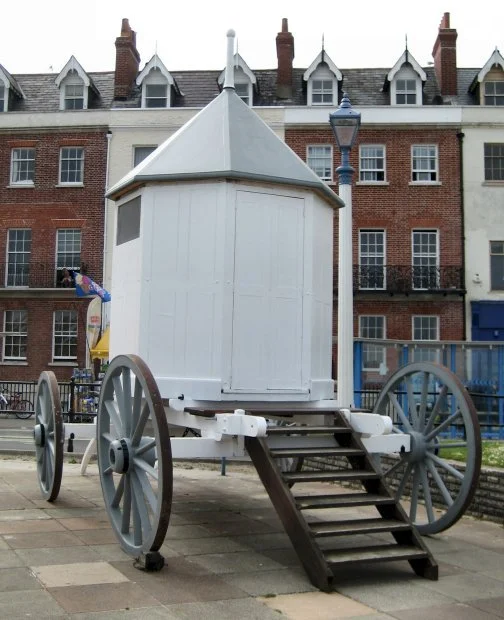
A replica of George III's bathing machine on Weymouth seafront (2012)
Bathing machines provided an easy and discreet way to change and then enter the water. Every day, they lined up on the beach in front of the Esplanade, ready to be hired. A bathing machine was drawn by a horse guided by a man and led into the required depth of water, at which point the horse would be unhitched and taken away. Female bathers wore long shifts called flannels; men wore drawers or bathed naked. Needless to say, the bathing machines of the different sexes were kept at a distance from each other!
In 1800, it was estimated that there were around 30 bathing machines for hire in Weymouth. By 1815, this estimate had increased to 40. Dr Crane advocated sea bathing in the morning before breakfast and so the machines were busy from about 6am to 12 noon every day in season. Visitors were encouraged to exercise after bathing in order to get warm again.
How much did it cost to hire a bathing machine?
In 1800, the cost of hiring a bathing machine was 6d plus an extra 6d for the guide, whilst a machine with an umbrella cost a shilling. To put these prices into perspective, it is useful to consider what it would cost today.
Using the Retail Price Index, 6d in 1800 would be equivalent to approximately £1.57 in 2010 – a very low cost. However, when this is weighted for average earnings in 1800, it is equivalent to around £24.90, which gives us a better idea of how affordable it would have been.

Georgian coins
For more information on these calculations, please see my article: How much did a ticket to a Regency ball really cost?
Rachel Knowles writes faith-based Regency romance and historical non-fiction. She has been sharing her research on this blog since 2011. Rachel lives in the beautiful Georgian seaside town of Weymouth, Dorset, on the south coast of England, with her husband, Andrew, who co-writes this blog.
If you have enjoyed this blog and want to encourage us and help us to keep making our research freely available, please buy us a virtual cup of coffee by clicking the button below.
Notes
Crane, Dr John, Cursory Observations on Sea-bathing (1795)
Feltham, John, A Guide to all the Watering and Sea-Bathing Places (1815)
Sources used include:
Chedzoy, Alan, Seaside Sovereign - King George III at Weymouth(2003, The Dovecote Press, Wimborne)
Crane, Dr John, Cursory Observations on Sea-bathing (1795)
Feltham, John, A Guide to all the Watering and Sea-Bathing Places (1815)
Groves, E, The Weymouth and Melcombe Regis New Guide(E Groves, 1835, Weymouth)
Hibbert, Christopher, George III (1998, Viking, Great Britain)
Simpkin & Marshall, Weymouth as a Watering Place (Simpkin & Marshall, 1857, London)
MeasuringWorth website - for calculators of relative worth
Photographs © RegencyHistory.net