
A la Ronde – a Regency History guide

A la Ronde, Devon (2015)
Where is it?
A la Ronde is a 16-sided house near Exmouth, Devon, built by Jane and Mary Parminter in the 1790s, and now owned by the National Trust.

A la Ronde and the view down to the sea, near Exmouth, Devon (2015)
The Parminters of A la Ronde

Miniature of Mary Parminter in the Dining Room, A la Ronde (2015)
The story of A la Ronde starts in 1784 when a group of single ladies went on the Grand Tour. The party consisted of Jane Parminter (1750-1811), her sister Elizabeth (1756-91), her cousin’s orphaned daughter Mary Parminter (1767-1849), and another single lady, Miss Colville. 1
The tour was financed by Jane’s wealth and lasted for about four years, though possibly longer for some of the party. Elizabeth became ill and returned to England in 1788. Jane and Mary may not have returned until 1791 when Elizabeth died.

One of the Parminters' packing cases in the Music Room, A la Ronde (2024)
The building of A la Ronde
By the time they returned to England, Mary had inherited a considerable fortune. She and Jane decided to build a house to live in together rather than be forced into marriages that they did not desire.
The result was A la Ronde, said to have been inspired by the octagonal basilica of San Vitale at Ravenna in Italy that they had seen during their Grand Tour.
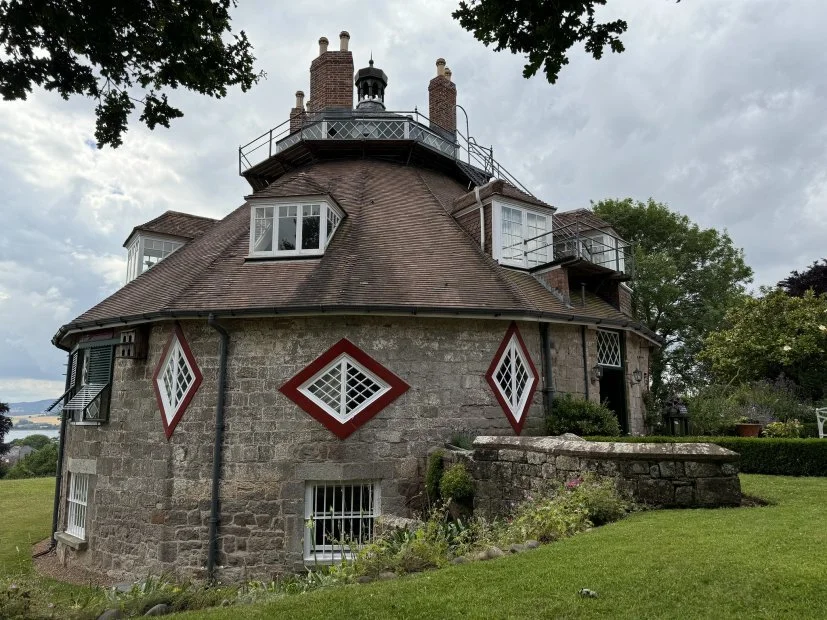
A la Ronde, Devon (2024)
The design of A la Ronde
The diamond-shaped windows with shutters were originally the only windows and every single one of them is on an angle to bring in the most light.

One of the original diamond windows of A la Ronde (2024)

One of the diamond windows of A la Ronde from the inside (2015)
Inside A la Ronde, there is a central octagon that reaches the full height of the house. All the other rooms come off this, as well as linking into each other by means of tiny lobbies, some of which still exist today.

The Octagon, A la Ronde, as reflected in the the glass globe hanging down in the centre of it. You can see all the doorways off it, as well as Andrew! (2024)
The rooms facing east were the Parminter ladies’ two bedrooms and they moved round the house during the day, following the natural light. These are now the Study and the Music Room.

Music room, A la Ronde (2024) - originally a bedroom

One of the lobbies between the downstairs rooms of A la Ronde. This one houses a library. (2024)
The Drawing Room was created by a later owner, the Reverend Reichel, out of two of the Parminters’ original rooms and its intervening lobby.

Sitting room, A la Ronde (2024) showing the Parminter cousins’ rare feather border

Sitting room, A la Ronde (2024)
The Dining Room has a late 18th century Wedgwood creamware dining service on display and a sideboard with pull-out holders for red and white wine for which the room was specially designed.

Dining room, A la Ronde (2024)
The Shell Gallery
Jane and Mary Parminter were very industrious and spent many hours crafting works of art. They decorated tables, made feather pictures and, at the top of the house, they created an incredible Shell Gallery - a mosaic room, with the walls adorned with shells and other treasures. They probably hired skilled craftsmen to help complete this incredible project.
From the upper level of the house you can glance up the staircase to the Shell Gallery. It has recently been conserved, but is too fragile for visitors to be allowed up.

The view up the staircase to the Shell Gallery, A la Ronde (2024)
A local artist has recently created a Room of Discovery inspired by the Shell Gallery, which is located in the basement of the house. This enables visitors to experience a replica Shell Gallery first hand. You’re even allowed to touch the shells, as long as you’re very gentle.

Rachel in the Room of Discovery, A la Ronde (2024)

Shells and feathers in the Room of Discovery, A la Ronde (2024)
The legacy of A la Ronde
On her death, Mary Parminter left A la Ronde to six unmarried female relations in a specified sequence. If they married, they forfeited their right to inherit. In 1880, Stella Reichel, the third lady to inherit, was due to get married.
Only one of the other named ladies still met the conditions of the bequest and she sold the reversion to Stella enabling her to sell A la Ronde to her brother, the Reverend Oswald Reichel, before her marriage. He became A la Ronde’s only male owner.
During this time, the house saw the most change. Externally, extra windows were added, the thatch on the roof was replaced by tiles, and a raised walkway was added round the outside of the roof, whilst inside, the Reverend installed central heating, knocked down walls and added stairs.
Several times the house was saved from redevelopment and in 1991 it was purchased by the National Trust.
Some highlights from our visits
The objects on display vary over time, but some of the highlights we’ve seen on our visits are:
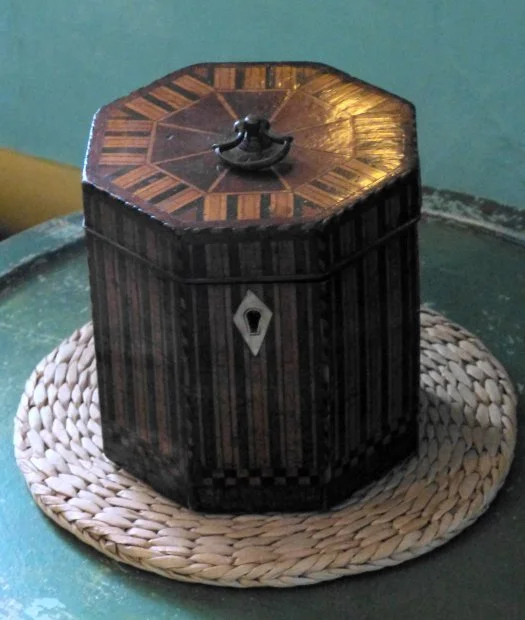
George III tea caddy on display in the Study, A la Ronde (2015)

A table inlaid by one of the Parminter cousins on display in the Drawing Room, A la Ronde (2015)
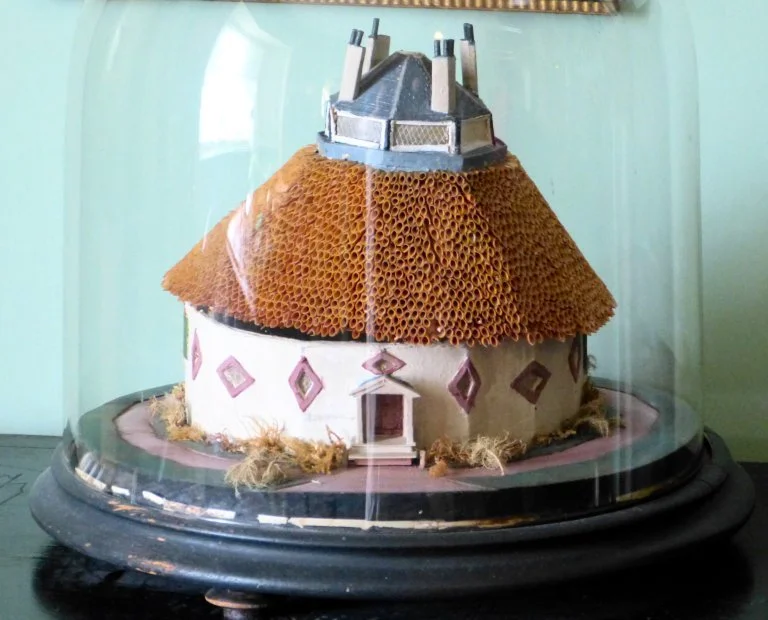
A model of A la Ronde which shows what the house was like before the Reverend Reichel's alterations.
On display in the Library, A la Ronde (2015)

Inlaid worktable by one of the Parminter cousins in the Drawing Room, A la Ronde (2015)

A silhouette ink drawing of the Parminter family in 1783 by François Torond - above the mantelpiece in the Drawing Room, A la Ronde (2015)

The table laid with Wedgwood creamware in the Dining Room of A la Ronde (2015)
Last visited: July 2024
Rachel Knowles writes faith-based Regency romance and historical non-fiction. She has been sharing her research on this blog since 2011. Rachel lives in the beautiful Georgian seaside town of Weymouth, Dorset, on the south coast of England, with her husband, Andrew, who co-writes this blog.
If you have enjoyed this blog and want to encourage us and help us to keep making our research freely available, please buy us a virtual cup of coffee by clicking the button below.
Note
The National Trust guidebook states Elizabeth’s death as 1795 but The Story of A La Ronde and Its People says that Jane was in London for the administration of her sister’s will in 1791 and the probate record supports this date.
Sources used include:
Meller, Hugh, A La Ronde, National Trust guidebook (1993, this edition 2004)
National Trust, The Story of A La Ronde and Its People (2011, revised 2013)
All photos © RegencyHistory.net