
Dr Johnson's House Museum - a Regency History Guide
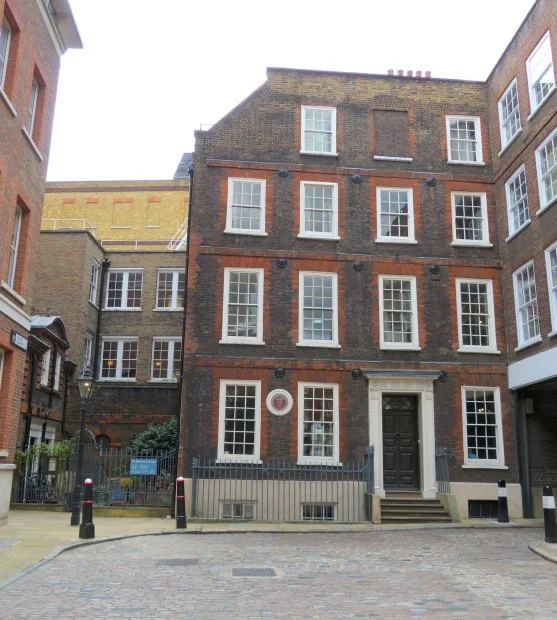
Dr Johnson's House Museum, 17 Gough Square, London (2015)
Where is it?
Dr Johnson's House Museum is just off Fleet Street, at 17 Gough Square, London.
History of the house
I'm always interested to know how 'ordinary' buildings, such as this, have made it to the 21st century, and how much it has been altered over the years.
Built in 1700 by wool merchant Richard Gough, the four-storey house is a rare survival on the edge of the City of London. Following Johnson's departure in 1759, it housed other tenants, was apparently a small hotel for a while and a photograph from 1911 indicates it was the premises of Waller & Baines, General Printers.
That same year it was bought by Cecil Harmsworth, a Liberal MP, and became a museum to Samuel Johnson. A tiny house, believed to be the smallest residence in the City, was built beside it as home for the curator. During the Blitz in 1940, when the area was regularly bombed, the house became a social club for auxiliary firemen. The house itself was struck by incendiary bombs and while the roof and garret were damaged, the repairs have not detracted from the character of the building.
We were pleased to discover that the museum is a National Trust partner, meaning NT members get entry at half price.
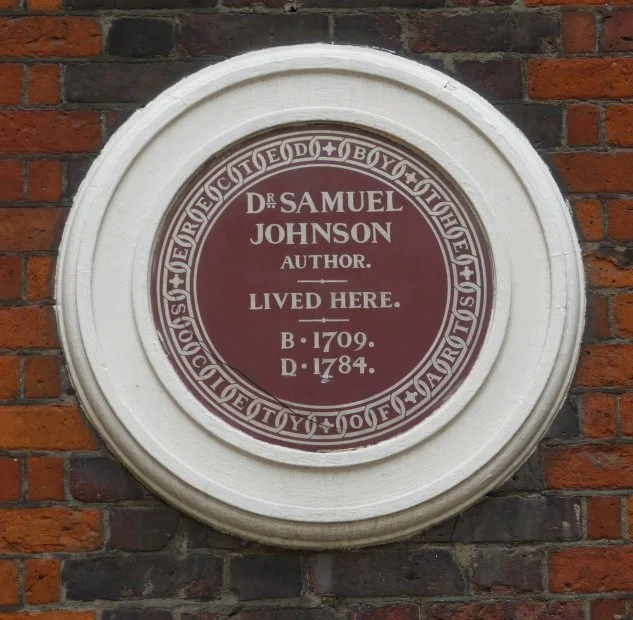
Samuel Johnson at 17 Gough Square (1748–1759)
Samuel Johnson (1709–1784) is famous for compiling not the first, but what many considered to be the definitive, English dictionary. He was a prolific writer, turning out essays, literary criticism, poetry and more.

Dr Johnson from The Life of Samuel Johnson by James Boswell (1791)
During his many years in London, from 1737 until his death, Johnson is believed to have lived in at least 17 different locations. He rented the house in Gough Square in 1748, in order to complete the work on his dictionary—a project that took nine years until its publication in 1755.
He lived there with his increasingly sick wife, Elizabeth, commonly known as Tetty, whom he had married 24 years earlier. Tetty was 21 years his senior and a widow with three children when they wed. For several years, until moving into Gough Square, they had lived separately, and even when together in the house, they slept in separate rooms - at her insistence. They had no children of their own.

Elizabeth Johnson—print on display on 1st floor, Dr Johnson's House Museum (2015)
Tetty's final years were blighted by ill health for which she became increasingly dependent upon opium and in addition she was often drunk. She died in March 1752.
Johnson felt her loss deeply and never fully recovered, though he outlived her by over 30 years.
Days after her death, a friend gave his young black slave, Francis Barber, to Johnson as a helper. Two years later, Barber's owner died and granted him freedom in his will. He was sent away to school, but returned to serve Johnson later in life.

Portrait thought to be of Francis Barber in the parlour, Dr Johnson's House Museum (2015)
Working in the Garret
The work on the dictionary was carried out in the Garret where Johnson "fitted up a room with desks and other accommodations" for his assistants. 1
Johnson was famously untidy, much to the annoyance of his wife while she was alive.
James Boswell, Johnson's friend and biographer, presents a small insight into Johnson's Garret when relating the visit of Dr Burney, the author Fanny Burney’s father, in 1758, after the dictionary was complete.
After dinner, Mr Johnson proposed to Mr Burney to go up with him into his garret, which being accepted, he there found about five or six Greek folios, a deal writing-desk, and a chair and a half. Johnson giving to his guest the entire seat, tottered himself on one with only three legs and one arm. 1
Johnson moved out of Gough Square in 1759.

An original volume of Samuel Johnson's dictionary published in 1755 (2015)
A brief tour of the house
We'd heard that the Samuel Johnson museum on Gough Square was a little thin on actual exhibits and this turned out to be the case. That said, we did not regret the visit.
For me, the house itself was the highlight of the trip, with its delightful steep staircase rising through four storeys, and the curious room partition arrangement on the first floor. Including the basement, which contains visitor toilets and a couple of information boards, the house has five levels.

A view down the spiral staircase, Dr Johnson's House Museum (2015)
Johnson’s tea cupboard and Parlour
The ground floor contains the museum reception and bookshop, the Front Hall including eighteenth century security measures on the front door and the Parlour.

Front door, Dr Johnson's House Museum (2015)
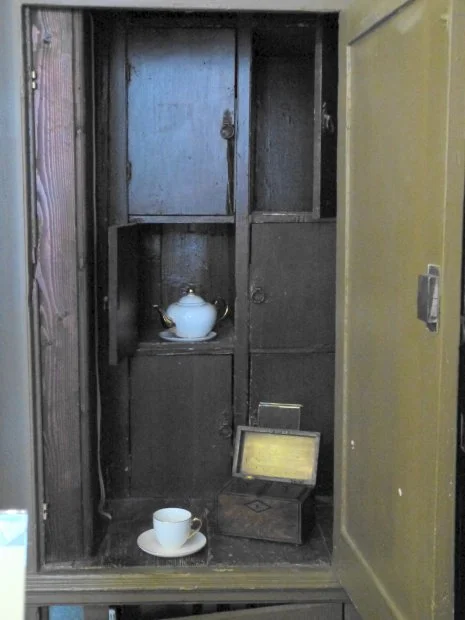
Dr Johnson's tea cupboard, in the reception of Dr Johnson's House Museum (2015)
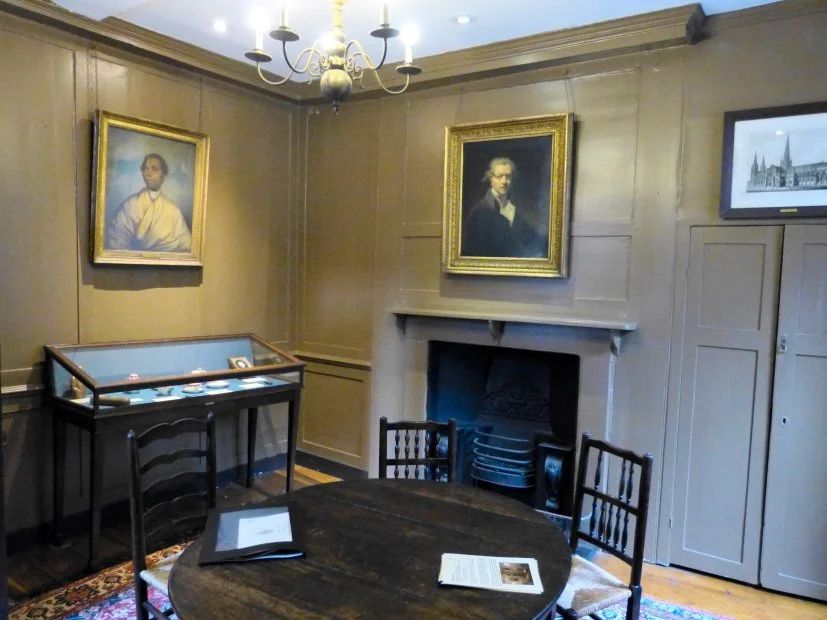
The Parlour, Dr Johnson's House Museum (2015)
A cabinet contains various artefacts including a teaset owned by Hester Thrale, a great friend of Johnson.

Hester Thrale's teaset, in the Parlour, Dr Johnson's House Museum (2015)

Dr Johnson's letter case - later decorated with his picture and writing, in the Parlour, Dr Johnson's House Museum (2015)
The first floor comprises a single room, although it can be separated using a huge pair of room partitions on massive hinges. While the rooms are given names and assigned possible uses, it seems unlikely that their true function during Johnson's occupation can be ascertained. There is a little furniture of the period but nothing that can be tied directly back to Johnson himself.

1st floor, Dr Johnson's House Museum (2015)
An original copy of Johnson’s Dictionary
The second floor includes the Will Room, displaying the document written for Johnson a short while before he died. He left most of his estate to his black servant, Francis Barber. It amounted to £70 per year. Johnson was never a wealthy man and while he was paid to write the dictionary, the notion of royalties was unknown so he received nothing after its publication.
Also on the second floor is a library containing an original copy of Johnson's dictionary, in a glass cabinet. Nearby is a facsimile copy of the two volumes that you can handle, allowing a very tactile engagement with the two hundred and fifty year old work.

Dictionary Room, 2nd floor, Dr Johnson's House Museum (2015)

Rachel looking at the facsimile copy of Dr Johnson's dictionary (2015)
A curiosity here is a brick from the Great Wall of China. The house contains a number of items donated in recognition of Johnson's contribution to literature, including this brick. While Johnson was not a great traveller, he expressed the desire to cross continents in order to learn.

A brick from the Great Wall of China on display on the 2nd floor of Dr Johnson's House Museum (2015)
The Garret
The highest level, or Garret, is where Johnson worked on the dictionary. During our visit it was given over to an exhibition of Shakespeare in Johnson's day. Johnson was a great friend of the actor and theatre manager David Garrick.

The Garret, Dr Johnson's House Museum (2015)

David Garrick's oak chest used for storing his costumes, on display in the Garret, Dr Johnson's House Museum (2015)
We were pleased to have toured 17 Gough Square, although I’m not sure that it’s worth making a long journey specifically to visit the house unless you are a Johnson enthusiast.
The museum is doing a good job of making a few artefacts and images go a long way, but because so few tangible reminders of Johnson have survived, the collection is always going to be a little thin.
Andrew Knowles researches and writes about the late Georgian and Regency period. He’s also a freelance writer and editor for business. He lives with his wife Rachel, co-author of this blog, in the Dorset seaside town of Weymouth.
If you have enjoyed this blog and want to encourage us and help us to keep making our research freely available, please buy us a virtual cup of coffee by clicking the button below.
Note
1. From The Life of Samuel Johnson by James Boswell (1791).
Sources used include:
Boswell, James, The Life of Samuel Johnson (1791)
Nokes, David, A Life of Samuel Johnson (2009)
Dr Johnson's House museum website
All photos © Andrew Knowles and RegencyHistory
Last visited 2015 and last updated 5/4/26
