
Arlington Court – a Regency History guide

Arlington Court (2014)
Where is it?
Arlington Court is a Neoclassical house near Barnstaple in North Devon. The stables are home to the National Trust Carriage Museum.
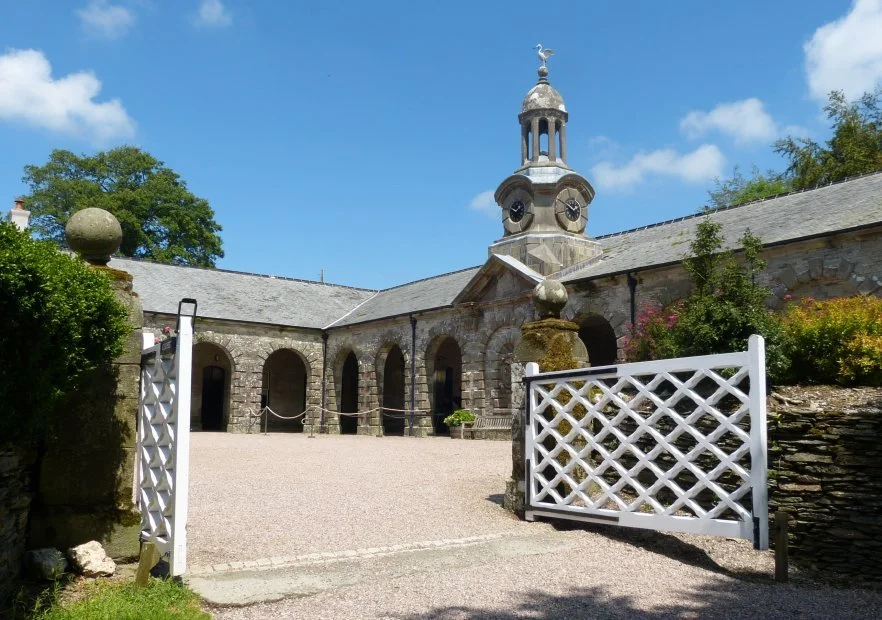
The stables, Arlington Court (2014)
History
The Arlington estate was owned by the Chichester family who had been wealthy Devonshire landowners since the 14th century. They supported the King during the Civil War and had a strong Catholic heritage. A Georgian house was built at Arlington in the early 1790s and a second Georgian house, in the Neoclassical style, was built in the 1820s. It is this house that still stands today.
The estate was given to the National Trust by Miss Rosalie Chichester in 1949.
The Georgian connection
Colonel John Palmer Chichester (1769-1823)
Colonel Chichester married Mary Anne Cary in 1790 and commissioned a fashionable Georgian mansion to be built at Arlington to replace the Tudor manor house he had inherited.

A View of Arlington Court and St James's Church Tower from the Park by Maria Pixell (1797) Photo 2023
After the death of his first wife in childbirth, Colonel Chichester married the Protestant, Agnes Hamilton, with whom he had six children. To the great distress of his family, he publicly renounced his Catholic faith in Exeter Cathedral in 1793.
By the early 1820s, it became apparent that the Colonel’s Georgian house had structural issues and he commissioned the architect Thomas Lee to build him a new house in the Neoclassical style. This house was completed in 1823. Sadly, Colonel Chichester died the same year and never lived in it.
Sir John Palmer Bruce Chichester (1794-1851)

Sir John Palmer Bruce Chichester, Arlington Court (2014)
Known to his friends as ‘Arlington Jack’, Sir John Chichester served in the Navy before inheriting Arlington on the death of his father in 1823. He decorated and furnished the house that his father had commissioned but never lived in—the Morning Room, Ante Room and Boudoir still have the original schemes of decoration.

The Ante Room, Arlington Court, with the Morning Room beyond. (2023)
Sir John was a Whig MP for Barnstaple from 1831 to 1841 and he was made a baronet in 1840. He married Caroline Thistlethwayte in 1838 and had two children.
What can you see at Arlington Court today?
The Neoclassical frontage

Arlington Court (2014)
The Staircase Hall

The Staircase Hall (2023)
An 18th century decoupage screen

An 18th century decoupage scrap screen (2023)
The Morning Room

The Morning Room, Arlington Court (2023)
Although known as the Morning Room, it was the original 1823 Dining Room. The painted fabric panels have been removed to reveal the pair of dumb waiters on either side of the pillars. The wallpaper was designed and supplied by John Gregory Crace and commissioned by Sir John Chichester c1839.

Dumb waiter, Morning Room, Arlington Court (2023)
The White Drawing Room

The White Drawing Room, Arlington Court (2023)

Ceiling, White Drawing Room, Arlington Court (2014)
The Boudoir

The Boudoir, Arlington Court (2023)
The Enderlein Charger

The Enderlein Charger (2014)
Items from Miss Chichester's collections
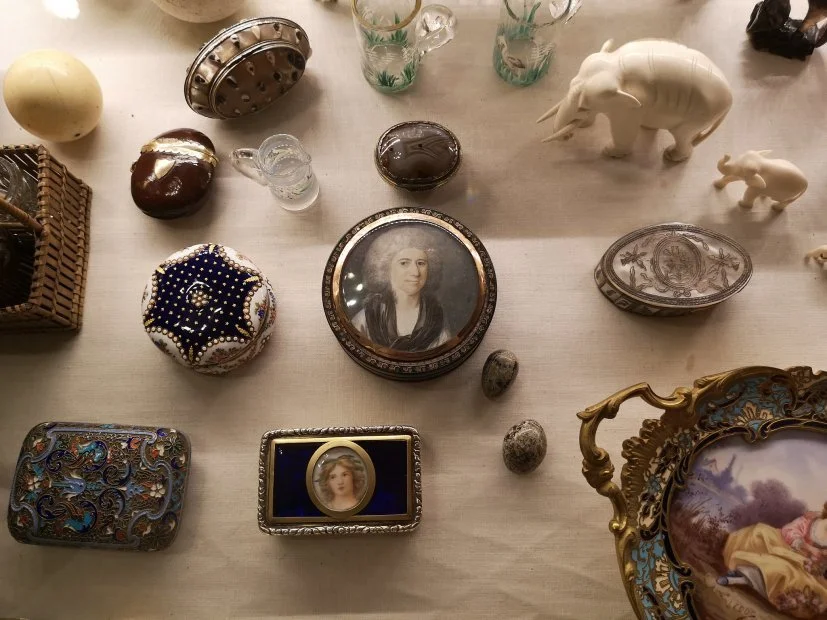
Snuffboxes and other items, Arlington Court (2023)
The National Trust's collection of carriages
(in the stables)

Travelling chariot in the National Trust Carriage Museum, Arlington Court (2014)
You can read more about the National Trust Carriage Museum here.
Last visited: July 2023
Rachel Knowles writes faith-based Regency romance and historical non-fiction. She has been sharing her research on this blog since 2011. Rachel lives in the beautiful Georgian seaside town of Weymouth, Dorset, on the south coast of England, with her husband, Andrew, who co-writes this blog.
If you have enjoyed this blog and want to encourage us and help us to keep making our research freely available, please buy us a virtual cup of coffee by clicking the button below.
Sources used include:
Badcock, Marigold, Gibbons, David and Parker-Williams, Demelza, Arlington Court and the National Trust Carriage Museum, National Trust Guide (2009)
All photographs © Regency History