
A litter of cupolas - Brighton Pavilion in 1823
The title comes from a quote by William Wilberforce about the Brighton Pavilion:
It looks very much as if St Paul’s had come down to the sea and left behind a litter of cupolas! 1
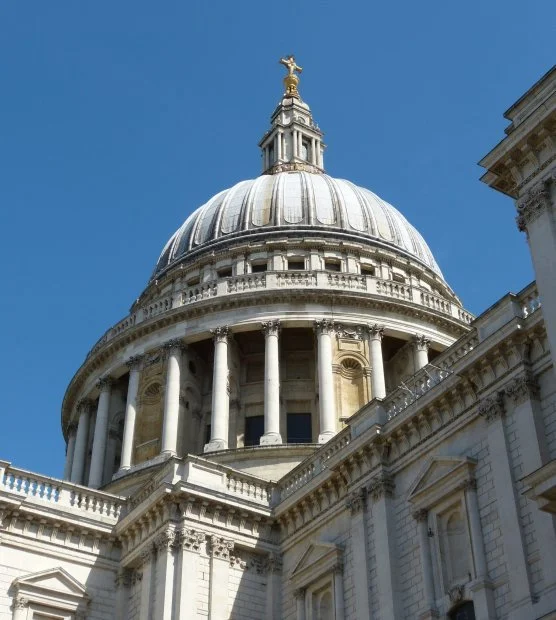
St Paul’s Cathedral, London (2015)

Brighton Pavilion - the Steyne front (2011)
A cupola is a dome. Hence a litter of cupolas is a number of little domes. A very witty description of Brighton Pavilion!
“A litter of cupolas” is Rachel’s first ever YouTube video, filmed in 2013. It is based on a speech she gave at her local Toastmasters’ group about the Brighton Pavilion. The speech transports the listener back in time to experience the Pavilion in its heyday.
Rachel Knowles writes faith-based Regency romance and historical non-fiction. She has been sharing her research on this blog since 2011. Rachel lives in the beautiful Georgian seaside town of Weymouth, Dorset, on the south coast of England, with her husband, Andrew, who co-writes this blog.
If you have enjoyed this blog and want to encourage us and help us to keep making our research freely available, please buy us a virtual cup of coffee by clicking the button below.
Note
Wilberforce, Robert Isaac and Samuel, The Life of William Wilberforce Volume IV (1839, John Murray) Wilberforce’s diary 1815.
Sources used include:
Feltham, John, A Guide to all the Watering and Sea-bathing Places (1815)
Hughson, David, London; being an accurate history and description of the British Metropolis and its neighbourhood Volume IV (1806, London)
Moule, Thomas, Great Britain Illustrated, a series of original views (1830)
Nash, John, Views of the Royal Pavilion with commentary by Gervase Jackson-Stops (1991)
Wilberforce, Robert, Isaac and Samuel, The Life of William Wilberforce (John Murray, 1839)
British Museum website.
Photographs © Andrew Knowles and Regency History