
What did Regency visitors think of the Brighton Pavilion?
Brighton Pavilion - a fairytale palace
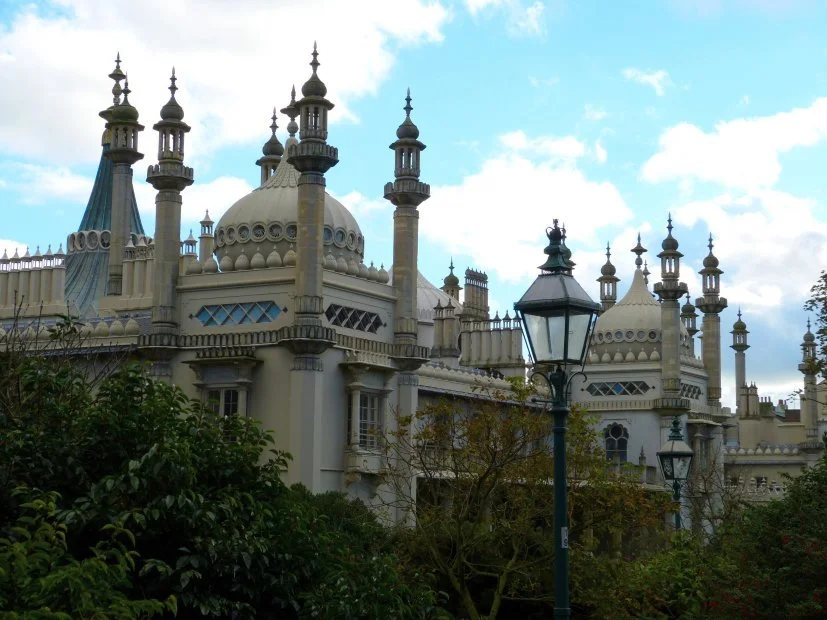
Brighton Pavilion from the gardens (2012)
Brighton Pavilion is a fairytale palace—a bizarre mixture of domes and minarets, fitted out internally in luxurious but eccentric style. You cannot help but marvel at the unconventional architecture and the sumptuous decoration, but it is not to everyone’s taste. When it was built, the Pavilion was far from universally admired.
A litter of cupolas

Brighton Pavilion from the Steyne (2011)
William Wilberforce wrote:
The Pavilion in Chinese style—beautiful and tasty, though it looks very much as if St Paul’s had come down to the sea and left behind a litter of cupolas. 1
Sydney Smith agreed:
It looks as if St Paul’s Cathedral has come down to Brighton and pupped. 2
These quotes are so similar that it seems likely that one was derived from the other.
Turnips and bulbs
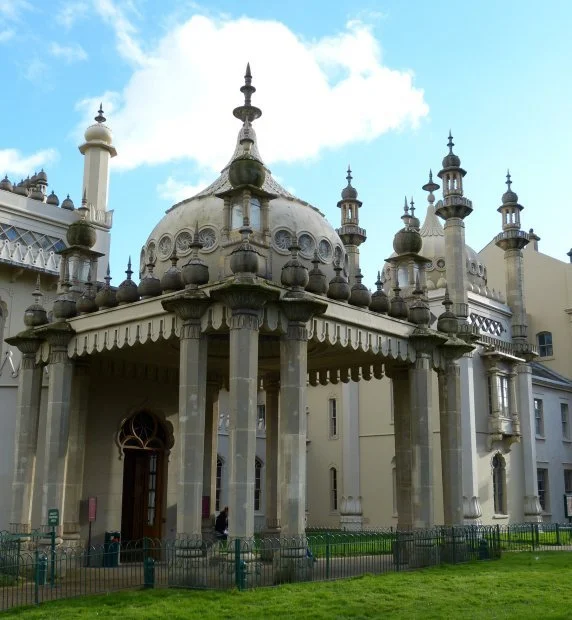
Entrance to Brighton Pavilion (2012)
William Cobbett claimed that the Pavilion, which he nicknamed the Kremlin, had “long been a subject of laughter all over the country.” He described the Pavilion in very unflattering terms, no doubt strongly influenced by his disgust at the Prince Regent’s extravagance in rebuilding it:
Take a square box, the sides of which are three feet and a half, and the height a foot and a half. Take a large Norfolk turnip, cut off the green of the leaves, leave the stalks nine inches long, tie these round with a string three inches from the top, and put the turnip on the middle of the box. Then take four turnips of half the size, threat them in the same way, and put them on the corners of the box. Then take a considerable number of bulbs of the crown imperial, the narcissus, the hyacinth, the tulip, the crocus, and others; let the leaves of each have sprouted to about an inch, more or less according to the size of the bulb; put all these, pretty promiscuously, but pretty thickly, on the top of the box. Then stand off and look at your architecture. There! That’s ‘a Kremlin’! 3
Pumpkins and pepper boxes
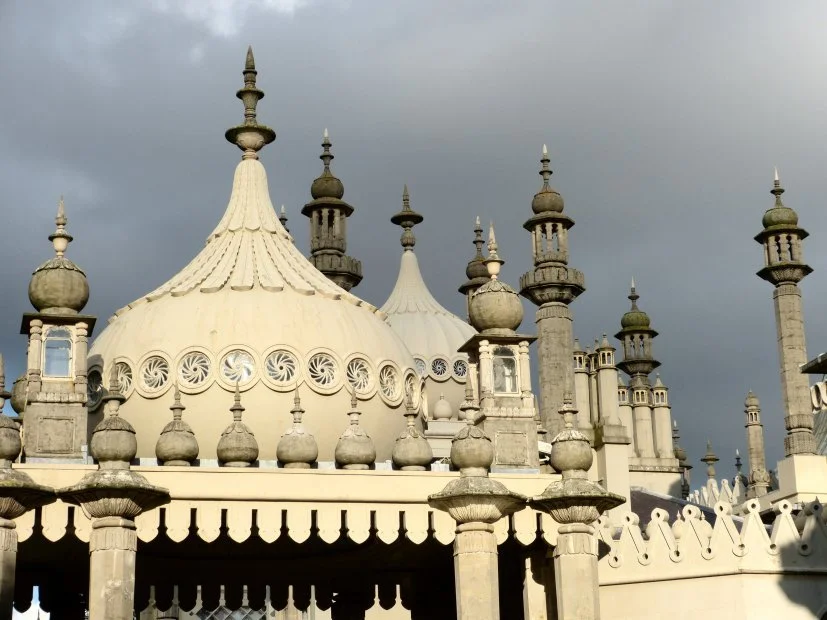
The skyline at Brighton Pavilion (2012)
William Hazlitt was similarly unimpressed:
The Pavilion at Brighton is like a collection of stone pumpkins and pepper boxes. It seems as if the genius of architecture had at once the dropsy and the megrims. Anything more fantastical, with a greater dearth of invention, was never seen. The King's stud (if they were horses of taste) would petition against so irrational a lodging. 4
The Folly at Brighton

The Joss and His Folly by George Cruikshank from The Queen's Matrimonial Ladder
by William Hone (1820)
Another less than flattering reference to the Pavilion and its owner was in The Joss and His Folly, a poem illustrated by George Cruikshank. The verses were written by William Hone and appeared in an 1820 pamphlet, The Queen’s Matrimonial Ladder, which accompanied a “national toy”.
The first four verses refer to “The Folly at Brighton”:
The queerest of all the queer sights
I’ve set sights on;
Is the what d’ye call’t thing, here,
The Folly at Brighton
The outside – huge teapots,
All drill’d round with holes,
Relieved by extinguishers,
Sticking on poles;
The inside – all tea-things,
And dragons, and bells,
The show-rooms – all show,
The sleeping rooms – cells.
But the grand Curiosity’s
Not to be seen –
The owner himself –
An old fat Mandarin. 5
A Regency icon
I like Brighton Pavilion. To me, it sums up George IV so beautifully. It is a vivid statement of his lifestyle—extravagant, inconsistent and hedonistic. He was continually redecorating and rebuilding, filling his palace with beautiful things and entertaining lavishly.
And yet when it was finished, he decided its situation was too public, and soon after, he abandoned it for the privacy of Windsor. Yes, it is over the top, but I am so glad that the palace has been preserved as a lasting symbol of the Regency.
Rachel Knowles writes faith-based Regency romance and historical non-fiction. She has been sharing her research on this blog since 2011. Rachel lives in the beautiful Georgian seaside town of Weymouth, Dorset, on the south coast of England, with her husband, Andrew, who co-writes this blog.
If you have enjoyed this blog and want to encourage us and help us to keep making our research freely available, please buy us a virtual cup of coffee by clicking the button below.
Notes
Wilberforce, Robert Isaac and Samuel, The Life of William Wilberforce Volume IV (1839, John Murray) Wilberforce’s diary 1815.
Low, Donald A, That Sunny Dome - a portrait of Regency Britain (Book Club Associates, 1977).
Cobbett, William, Rural rides in the counties of Surrey, Kent etc during the years 1821 to 1832, ed Pitt Cobbett (1893).
Hazlitt, William, Notes of a journey through France and Italy (1826).
Hone, William, The Queen's Matrimonial Ladder (1820).
Sources used include:
Cobbett, William, Rural rides in the counties of Surrey, Kent etc during the years 1821 to 1832, ed Pitt Cobbett (1893)
Low, Donald A, That Sunny Dome - a portrait of Regency Britain (Book Club Associates, 1977)
Feltham, John, A Guide to all the Watering and Sea-bathing Places (1815)
Hazlitt, William, Notes of a journey through France and Italy (1826)
Hone, William, The Queen's Matrimonial Ladder (1820)
Morley, John, The Royal Pavilion, Brighton
Nash, John, Views of the Royal Pavilion with commentary by Gervase Jackson-Stops (1991)
Wilberforce, Robert Isaac and Samuel, The Life of William Wilberforce (John Murray, 1839)
Photographs © Andrew Knowles and Regency History
Updated 23/3/26