
Jane Gordon, Duchess of Gordon (c1748-1812)

Jane, Duchess of Gordon from NW Wraxall's Posthumous memoirs (1836)
Family background
Jane Maxwell was born in Edinburgh in about 1748, the daughter of Sir William Maxwell, 3rd Baronet of Monreith, and his wife Magdalene. 1,2
As a girl, she lived in Hyndford’s Close, Edinburgh, with her mother and sisters. She was somewhat wild and reportedly rode down Edinburgh High Street on the back of a pig.
“The Flower of Galloway”
Jane was an extremely beautiful girl and the song, “Jenny of Monreith” was written in honour of her charms, which also earned her the sobriquet, “The Flower of Galloway”. 2
She had a lively wit and seemingly limitless energy, but her tendency to speak her mind did not always ingratiate her to others.
An illustrious marriage
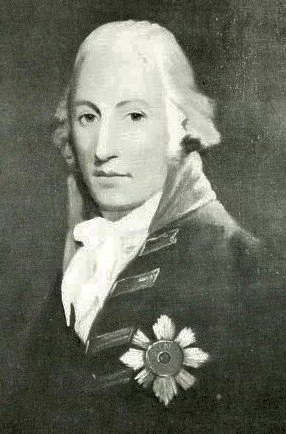
Alexander, 4th Duke of Gordon from The Gordon Book (1902)
On 23 October 1767, Jane married Alexander Gordon, 4th Duke of Gordon, in Edinburgh. 3 They had seven children: Charlotte (1768), George (1770), Madeleine (1772), Susan (1774), Louisa (1776), Georgiana (1781) and Alexander (1785).
Sadly, the marriage was not a happy one and the couple became permanently estranged. The Duke had a long-term mistress, Jane Christie, whom he married after Jane’s death. After their separation, Jane lived at Kinrara, a house on the River Spey in Inverness-shire.
Scottish society leader
Jane was a leading figure in Edinburgh society and entertained on a grand scale, first at Gordon Castle, and later at Kinrara.
She was a patron of the Northern Meeting, established in 1788 to promote social intercourse in the Highlands, and sponsored the Scottish poet, Robert Burns.

Robert Burns from The Complete Works of Robert Burns (1865)
Agricultural reformer
Jane took an active interest in the management of the Gordon estates in Badenoch and Strathspey. She was a proponent of agricultural reform and introduced the growing of flax and the industry of linen manufacture, establishing a lint mill in Kingussie.
Political hostess
Jane was very ambitious and sought to become for the Tory party what Georgiana, Duchess of Devonshire, was for the Whigs. She became a leading political hostess and held lavish assemblies at her Pall Mall home in London.
She was a devoted supporter of William Pitt and was intimate with both him and his best friend and closest advisor, Henry Dundas, who was reputedly also her lover. Sometimes she attended the House of Commons to hear a debate and even acted as a “whipper-in” of ministers.

William Pitt from Memoirs of George IV by Robert Huish (1830)
The Duchess of Devonshire’s rival
Nathaniel Wraxall described her as:
Far inferior to her rival [Georgiana, Duchess of Devonshire] in feminine graces, in accomplishments of the mind, and in elegance of manners, the last-mentioned duchess [Jane, Duchess of Gordon] possessed qualities not less useful, - pertinacity which no obstacles could shake, masculine importunity, emancipation from ordinary forms, - propelled by the hope of place, and by views of interest. 4
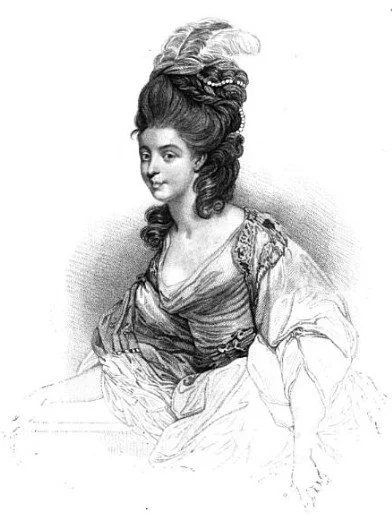
Georgiana, Duchess of Devonshire from NW Wraxall's Posthumous memoirs (1836)
But some saw her in a less favourable light. Lady Mary Coke wrote in 1787:
It will not be the first time that a man of great understanding [William Pitt] has been the dupe of a designing woman. 5
She continued:
The Duchess of Gordon resembles my Lady Bristol [Lady Elizabeth Foster’s mother], is like her in person, manner, contrivances, and like her, scruples nothing to gain her end, such a person must always be dangerous. 5
Fashion leader
In 1808, La Belle Assemblée declared:
It would be impossible to select any living female character who has made a more distinguished figure in the fashionable world than the Duchess of Gordon. 6

Jane, Duchess of Gordon from La Belle Assemblée (1808)
Jane was not as successful as the Duchess of Devonshire at setting fashion, but she did make tartan popular in 1791 after she wore a Gordon tartan dress to a Drawing Room. Horace Walpole called her “one of the Empresses of Fashion.” 7
She introduced Scottish dancing to the ton. Nathaniel Wraxall wrote:
She first introduced the custom of dancing at routs, an agreeable innovation on the interminable carding, and moreover, with patriotic zeal, she introduced Scotch dancing, till then unheard of in the fashionable world. 8
The Gordon Highlanders
In 1794, Jane helped to recruit soldiers for a new infantry regiment to join the war against France - the 100th Highlanders. Dressed in a military uniform and wearing a large black feathered hat, Jane toured the Duke’s lands, offering the King’s shilling – the payment for joining up – from between her lips. The regiment was renumbered the 92nd in 1798.
Family ambitions
Jane’s ambitions were not just political. She was extremely proud of the marriages she arranged for her five daughters whose husbands included three dukes and a marquis:
Charlotte married Colonel Charles Lennox, later 4th Duke of Richmond
Madeleine married Sir Robert Sinclair, 7th Baronet and then Charles Fysche Palmer
Susan married William Montagu, 5th Duke of Manchester
Louisa married Lord Brome, later Marquis Cornwallis
Georgiana married John Russell, 6th Duke of Bedford.

Charlotte Lennox, Duchess of Richmond from La Belle Assemblée (1807)
Death
Jane died on 14 April 1812 at the Pulteney Hotel in London and was buried at Kinrara on 11 May. 9
Rachel Knowles writes faith-based Regency romance and historical non-fiction. She has been sharing her research on this blog since 2011. Rachel lives in the beautiful Georgian seaside town of Weymouth, Dorset, on the south coast of England, with her husband, Andrew, who co-writes this blog.
If you have enjoyed this blog and want to encourage us and help us to keep making our research freely available, please buy us a virtual cup of coffee by clicking the button below.
Notes
I have found inconsistent details for Jane’s birth and different sources give various dates and places. She was born between 1748 and 1750, probably in Edinburgh, but possibly in Monreith.
Sometimes referred to as Monteith.
The date of Jane's wedding varies across different sources: 18 October (La Belle Assemblée; Debrett's Complete Peerage), 23 October (Oxford Dictionary of National Biography) and 28 October (An autobiographical chapter in the life of Jane, Duchess of Gordon).
Wraxall's Posthumous memoirs of his own time (1836).
Amanda Foreman's Georgiana, Duchess of Devonshire.
La Belle Assemblée (1808).
In a letter by Horace Walpole to Miss Berry in 1791 recorded in Three generations of fascinating women.
Wraxall op cit.
The date of Jane's death is sometimes recorded as 11 April (Debrett's Complete Peerage; Three generations of fascinating women).
Sources used include:
Bell, John, La Belle Assemblée (1807-8)
Bulloch, John Malcolm, editor, The Gordon Book (1902)
Courthope, William, editor, Debrett's Complete Peerage of the United Kingdom of Great Britain and Ireland (1838)
Foreman, Amanda, Georgiana, Duchess of Devonshire (HarperCollins, 1998, London)
Gordon, Jane, Duchess of, An autobiographical chapter in the life of Jane, Duchess of Gordon (1864)
Lodge, Christine, Gordon, Jane, Duchess of Gordon (1748/9-1812) Oxford Dictionary of National Biography (Oxford University Press, 2004; online edn Oct 2007, accessed 8 Apr 2013)
Russell, Lady, Three generations of fascinating women and other sketches from family history (1905)
Wraxall, Sir Nathaniel William, Posthumous memoirs of his own time (1836)