
Lady Caroline Lamb (1785-1828)
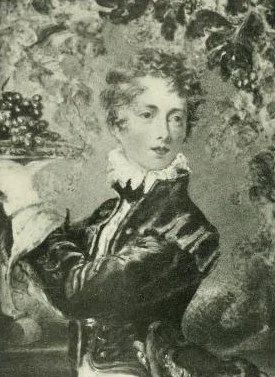
Lady Caroline Lamb from Wives of the Prime Ministers (1844-1906)
Profile
Lady Caroline Lamb (13 November 1785 - 26 January 1828) was a prominent member of Regency society and the author of the scandalous novel, Glenarvon. She was the wife of William Lamb, later Viscount Melbourne and British prime minister, and had a very public affair with the poet Lord Byron.
A temperamental child
Caroline Ponsonby was born on 13 November 1785, the only daughter of Frederick Ponsonby, 3rd Earl of Bessborough, and Henrietta Spencer, younger sister of Georgiana, Duchess of Devonshire.
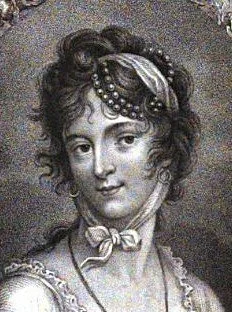
Henrietta, Countess of Bessborough from La Belle Assemblée (1810)
Caroline was brought up in the shadow of her parents’ unhappy marriage, influenced by the unrestrained decadence of the Devonshire House set. In person, she was slight and agile; in character, unconventional, intense and highly temperamental. She liked to gallop bareback and dress up in trousers, was frequently lost in day dreams and subject to mood swings. Her austere grandmother, Lady Spencer, into whose care she was frequently placed, found her unmanageable.
'The Fairy Queen'
In 1802, Caroline made her debut and became the most vibrant personality in London. She was a captivating conversationalist with ethereal good looks that led to her being nicknamed 'the Sprite' and 'the Fairy Queen, Ariel'. On the other hand, she was highly volatile and often flew into rages. However, such was the bewitching intensity about Caroline that people were always ready to forgive her exasperating behaviour.
A love match
Amongst the men that Caroline captivated was William Lamb, second son of Lord Melbourne, but he could not propose marriage because, as a younger son, he was not a good enough match. However, in January 1805, his fortunes changed with the death of his elder brother, Peniston, and as soon as the initial period of mourning was over, he proposed and was accepted.

William Lamb, 2nd Viscount Melbourne from The History of White's by Hon Algernon Bourke (1892)
William and Caroline were married on the evening of 3 June 1805 in Cavendish Square, London. But the day did not pass without incident. At the end of the service, the increasingly hysterical Caroline flew into a rage and had to be carried from the room. This outburst of emotion caused William to become very protective of his new wife, screening her from anything that might upset her.
Augustus
Childbearing was not easy for Caroline and she had only one surviving child, a son, Augustus, who was born on 29 August 1807. 1
It soon became apparent that he had learning difficulties, a fact that his father never really came to terms with. He remained with a mental age of about seven until his death in 1836.
A craving for attention
At first, the Lambs seemed to be an ideal couple, always flirting with each other, spending their time either at Brocket Hall in Hertfordshire or in London. But their idyllic happiness was short-lived. Caroline saw life as a drama in which she was the heroine and when life did not match up to her ideals, she reinvented it, living in a world of unreality. William was naturally lazy and peace-loving and did not believe in Caroline’s idealism. He failed to live up to her romantic notion of what a lover should be like. Their marriage became a sequence of arguments and reconciliations.
By 1810, the couple were living separate lives. William devoted himself to his parliamentary work, whilst Caroline developed friendships which would feed her ego. These included two with women of dubious reputations, Lady Wellesley and Lady Oxford, as well as intellectuals such as Monk Lewis. She also had a violent and very public flirtation with Lady Holland’s son, Sir Godfrey Webster.
Lord Byron

Lord Byron from The Life of Lord Byron by Thomas Moore (1844)
In March 1812, the first part of Childe Harold was published, and Lord Byron became famous overnight. After seeing him for the first time, Caroline wrote in her diary that he was “Bad, mad and dangerous to know.” Later she added: “That beautiful pale face will be my fate.”
Caroline pursued Byron, whom she saw as the sinfully romantic hero of Childe Harold and not the sulky man with the face of an angel and a lame leg. Their affair was conducted very publicly, each passionately jealous for the other’s attentions.
But Byron soon tired of Caroline’s obsessive behaviour and turned to less demanding companions: Caroline’s mother-in-law, Lady Melbourne, who became his confidante and Lady Oxford, his mistress. William did nothing, but waited for Caroline’s game to be played out.
The Byron obsession
When Byron wrote to end their relationship, Caroline’s sanity showed signs of collapse. She dressed her menservants in new livery with buttons saying “Ne crede Byron” (do not believe Byron) and ceremonially burnt his gifts to her on a bonfire.
On 5 July 1813, Byron and Caroline met for the first time since the end of their relationship, at a ball given by Lady Heathcote. Caroline broke a glass and started slashing her arms with the pieces, causing a tremendous scandal. She had taken a step too far and society shunned her.
But Caroline could not let Byron go. He had become a fixation with her. She wrote to him and kept turning up at his London rooms, often dressed as a page. On 2 January 1815, Byron married Anne Isabella Milbanke, William’s cousin. Caroline predicted that it would fail. It did.
Glenarvon
Caroline’s behaviour became increasingly unpredictable and in 1816, she was threatened with being sent away. In desperation, she wrote Glenarvon, a strange Gothic tale of fashionable society whose characters were based on real people. It was published anonymously on 9 May 1816 and met with instant success. But Caroline’s authorship was an open secret and the scandal was enormous.
Lady Jersey rescinded Caroline’s voucher for Almack’s and even her cousins eschewed her.
Though William’s initial reaction to the novel was that he would never see her again, perversely, when people began to cut her, he relented and stood by his deranged wife: “We will stand or fall together.”
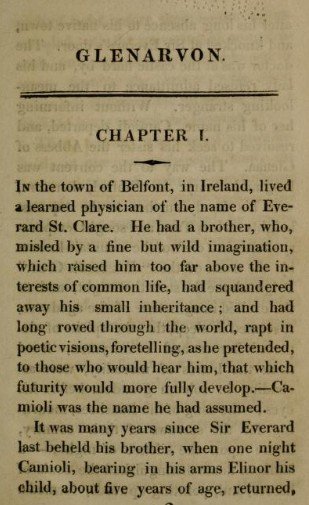
Opening page of Glenarvon by Lady Caroline Lamb (1816)
Insanity
Caroline was desperate for admiration but was now an outcast from polite society. She had a number of literary friends, such as Lady Morgan, and some very unfashionable admirers, the most presentable of whom was Bulwer Lytton. William did not seem to be jealous. He pitied any man who was caught in his wife’s toils and saw them as fellow sufferers.
When Caroline learned that Lord Byron was dead, she fell into a hysterical fever. Later, she accidentally met with his funeral procession, and collapsed on discovering whose wake it was. She frequently had violent moods where she broke things or galloped wildly round the park. Her appearance became unkempt, she ate erratically and she frequently resorted to laudanum and brandy.
William looked after Caroline, soothing her nerves and helping her with her novels - Graham Hamilton (1822), Ada Reis (1823) and Penruddock (1823). But caring for Caroline took its toll on William, and in 1825, it was decided they should separate. However, after just a few months apart, he relented, and Caroline was back living at Brocket. Though William lived in London, he often visited.
Illness and death
Soon Caroline’s health began to fail. She was weary of life, and at last, became calmer. Now, it seemed, her affection was all for her husband. William was away, having been appointed Chief Secretary for Ireland, but the letters between them were tender and affectionate.
By October 1827, Caroline was dangerously ill with dropsy. In mid-January, she asked: “Send for William. He is the only person who has never failed me.” A few days after William’s arrival at Melbourne House, on 26 January 1828, Caroline died. She was buried in Hatfield churchyard on 7 February.
Rachel Knowles writes faith-based Regency romance and historical non-fiction. She has been sharing her research on this blog since 2011. Rachel lives in the beautiful Georgian seaside town of Weymouth, Dorset, on the south coast of England, with her husband, Andrew, who co-writes this blog.
If you have enjoyed this blog and want to encourage us and help us to keep making our research freely available, please buy us a virtual cup of coffee by clicking the button below.
Note
Some sources say 11 August.
Sources used include:
Cecil, Lord David, Melbourne (1939, 1954)
Franklin, Caroline, Lamb, Lady Caroline (1785-1828), Oxford Dictionary of National Biography (Oxford University Press, 2004; online edn, Oct 2005, accessed 28 Nov 2012)
Lee, Elizabeth, Wives of the Prime Ministers 1844-1906 (1918)
Moore, Thomas, The Life of Lord Byron (1844)