
Lulworth Castle – a Georgian visitor attraction

Lulworth Castle from The Beauties of England and Wales by J Britton and EW Brayley (1803)
A noble pile
The 1785 Weymouth Guide described Lulworth Castle at length:
It is a noble pile of building, a little North of the church, upon the edge of the park, on a rising ground, commanding a fine prospect of the sea, from an opening between the hills and from the top of the castle is a most extensive view over the country, especially on the North and East. 1
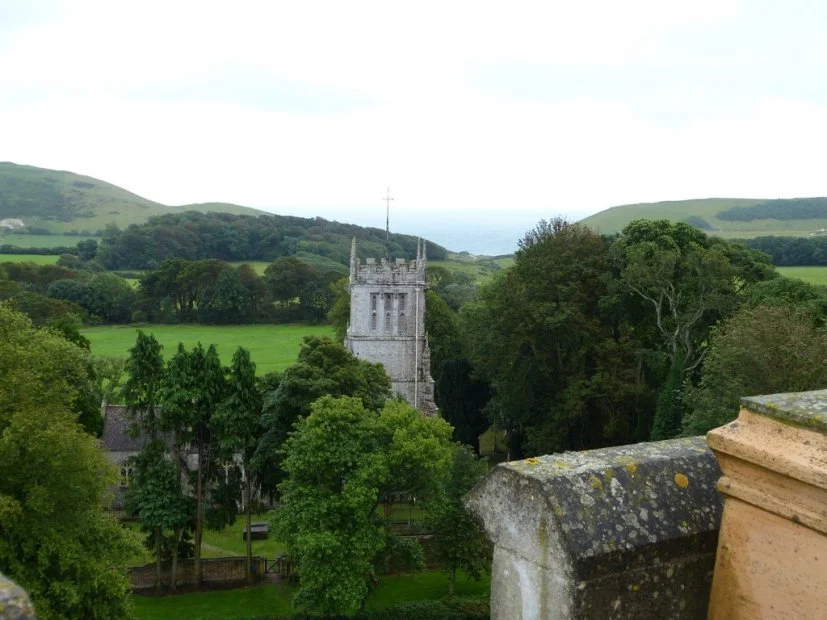
View from the roof of Lulworth Castle (2012)
The Weymouth Guide continued:
It is an exact cube of 80 feet in diameter, rising 16 feet above the walls, which, as well as the towers, are embattled. The offices are under ground, and arched with stone, the principal front is to the East. Over the doors at the entrance are the statues of two ancient Romans in their gowns; and on each side of the door which is supported by four pillars of the Doric order, is a large niche, and over them two shields, on which were the arms of Weld, now worn out. 1
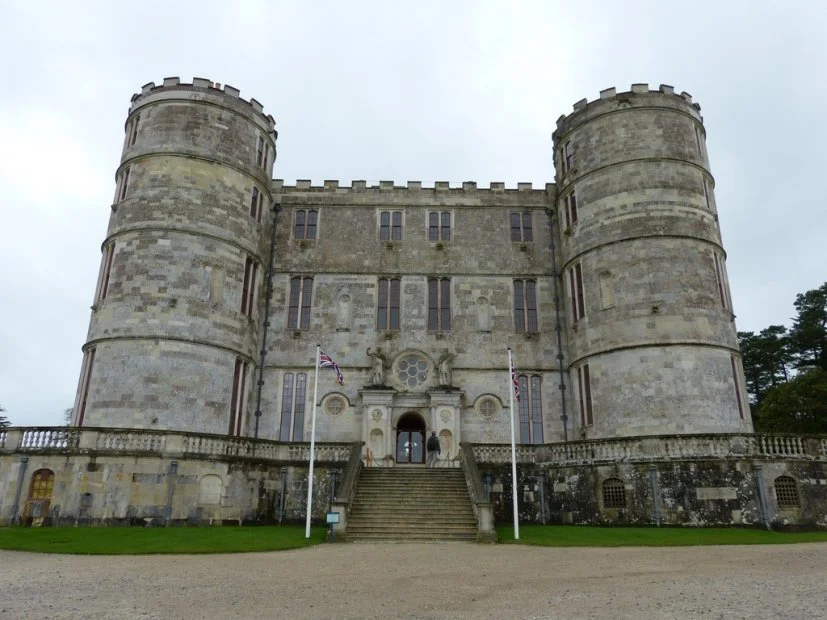
Lulworth Castle (2012)
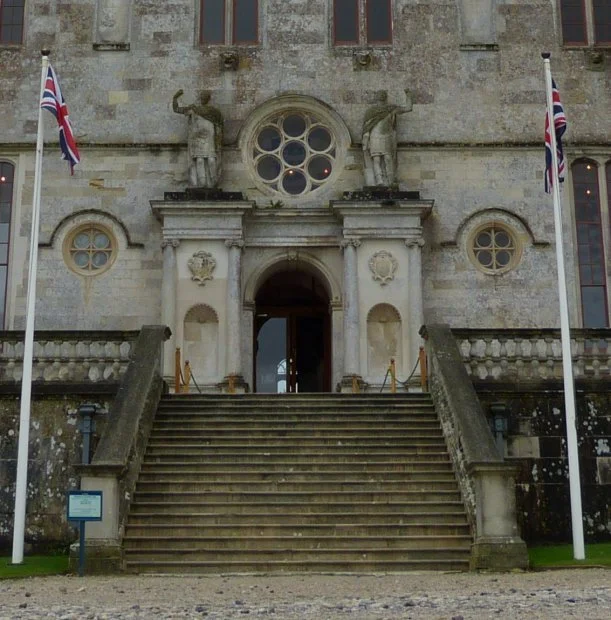
Entrance to Lulworth Castle with statues of two Romans, pillars and shields as described above. (2012)
After giving some of the building’s history, the Weymouth Guide continued:
It is reckoned, for its uniformity, one of the finest seats in the county, and was justly admired by Charles II. The large gardens adjoining, and the groves of trees that almost surround the edifice, add greatly to the beauty and grandeur of the place; and it is perhaps one of the best furnished private houses in the kingdom. 1
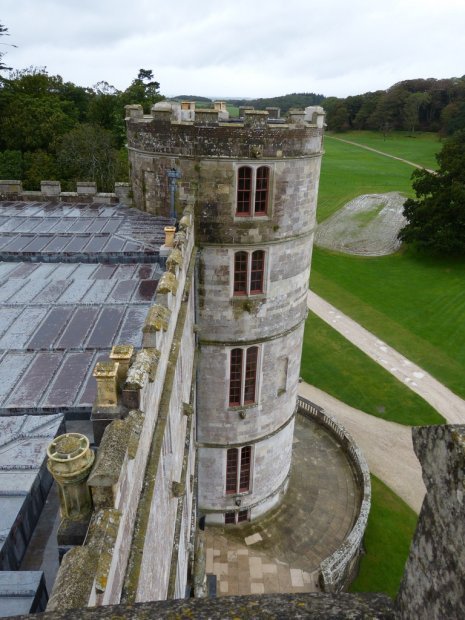
View of one of towers of Lulworth Castle from the roof (2012)
A Georgian art gallery
The 1785 guide gave a long list of pictures which were on show. These included:
Family portraits by Sir Peter Lely and Sir Godfrey Kneller
A portrait by Angelica Kauffman
Two family pictures by Holbein
A view of the Castle by De Bruyne
Some pencil likenesses by Giles Hussey Esq of Marnhull in Dorset.
The rooms open to the public
Of particular note was the drawing room:
This Room is fifty feet by twenty-five, and eighteen feet high. The ceiling, from a design of Mr John Tasker’s, is the performance also of Mr Hague. The chairs and settees are worked in silk, with elegant carved and gilt frames. The noble glasses were manufactured near Prescot in Lancashire. The carpet, which is woven to answer the compartments in the ceiling, was made by Moore, of Chiswell Street, London, and is not only the largest, but supposed to be the most elegant he ever made. 1
The Library was described as “neatly fitted up, and contains about 2,000 volumes of the best authors.” 1
The King’s Bed Chamber was “twenty-four feet by twenty-one, and eighteen feet high. The State Bed and hangings are of blue Damask, as are the chairs and window curtains.” 1
Lulworth Cove

The arched rock, Lulworth, from The Beauties of England and Wales by J Britton and EW Brayley (1803)
The Weymouth Guide went on to describe the nearby cove:
But to return to Lulworth—The Castle is two miles Eastwards of West Lulworth, where is a house of entertainment; and on the foot path between this place and Lulworth Cove is a most delightful view of St Alban’s Head, over the rocks on the South East of Warbarrow Bay, and also over West Lulworth, almost the whole length of Portland Island.
Lulworth Cove is a natural basin, surrounded with very high cliffs, in the shape of a horse-shoe, of which the opening forms the entrance. It is 1380 feet in diameter, twenty-one feet deep at low water; admits vessels of eighty tons burthen, and is a great natural curiosity; as are also the lands hereabouts, which form the most romantic and pleasing variety of prospects. 1
A warning to strangers
The description of Lulworth in the 1785 guide ended with a word of caution:
The cove is about ten miles distant from Weymouth, from which it is an easy and pleasant sail; yet it may be proper to hint to strangers, that the gale which carries them pleasantly thither may so far retard their return as to leave them the whole night upon the water. It has therefore been found most convenient to be met by carriages or horses at Lulworth. 1
King George III came by boat when he visited in 1789. The journey from Weymouth took over six hours!
An 1815 guide to Lulworth
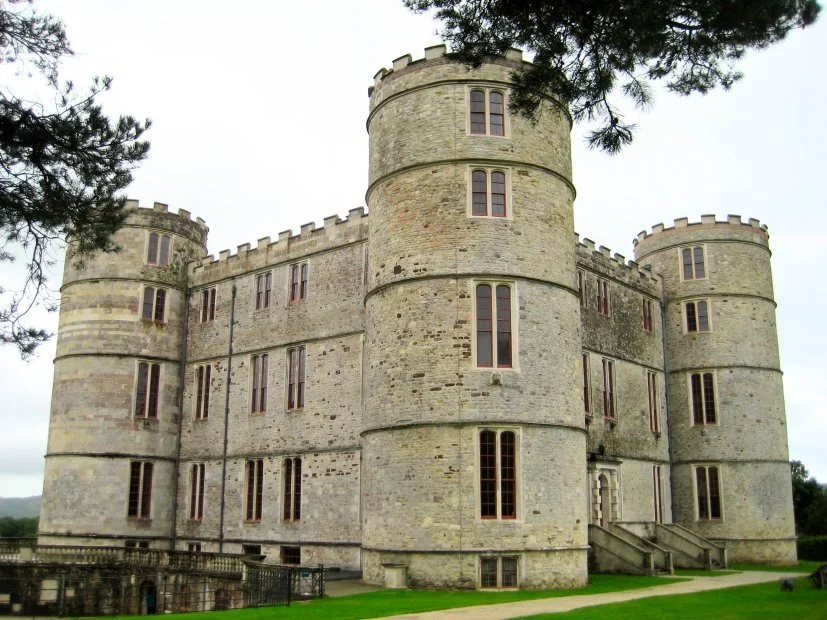
Lulworth Castle (2012)
The entry for Lulworth Castle in A Guide to all the Watering and Sea-Bathing Places (1815) is much shorter:
About sixteen miles from Weymouth stands Lulworth Castle, which, notwithstanding its distance from Weymouth, is a constant object of attraction to strangers. It is the seat of Thomas Weld, Esq, and is not only admired for its situation, but in itself forms a most superb pile, adorned with statuary, painting, fine gardens, and other elegant and beautiful accompaniments, The environs are extremely well wooded, and happily intersected by hill and dale. From the south front of the house is seen a beautiful expanse of water, and a moving scene of ships.
Lulworth probably retains the name of Castle, from its being built on the site of an ancient fortress. The present edifice was erected about 1600. The possessor being of the Roman Catholic persuasion, has fitted up a beautiful chapel, and made many other improvements in his mansion and domain.
The magnificent manner in which Mr Weld received their Majesties and the royal family, when they did him the honour of a visit some years ago, would reflect a lustre on the taste, opulence, and loyalty, of the first subject in the kingdom.
The pictures and other works of art are too numerous to particularise, but they may be seen every Wednesday, from ten to two. 2
Rachel Knowles writes faith-based Regency romance and historical non-fiction. She has been sharing her research on this blog since 2011. Rachel lives in the beautiful Georgian seaside town of Weymouth, Dorset, on the south coast of England, with her husband, Andrew, who co-writes this blog.
If you have enjoyed this blog and want to encourage us and help us to keep making our research freely available, please buy us a virtual cup of coffee by clicking the button below.
Notes
Delamotte, Peter, The Weymouth Guide (1785, Weymouth)
Feltham, John, Editor of the Picture of London, A Guide to all the Watering and Sea-Bathing Places (1815)
Sources used include:
Britton, John & Brayley, Edward Wedlake, The Beauties of England and Wales (Vernor & Hood et al, 1803, London) Chedzoy, Alan, Seaside Sovereign - King George III at Weymouth (The Dovecote Press, 2003, Wimborne)
Delamotte, Peter, The Weymouth Guide (1785, Weymouth)
Feltham, John, Editor of the Picture of London, A Guide to all the Watering and Sea-Bathing Places (1815)
Groves, E, The Weymouth and Melcombe Regis New Guide (E Groves, 1835, Weymouth)
Weld, Wilfrid, The Weld Family & Lulworth (Guidebook to Lulworth Castle purchased Aug 2012)
Photographs © Andrew Knowles and RegencyHistory
Last updated 6/4/26