
When was the London season?

The first quadrille at Almack's from The Reminiscences and Recollections of Captain Gronow (1889)
Many a Regency heroine has gone to London to have a ‘season’ in the hope of finding a husband. But when was the London season?
Parliamentary sessions
The London season developed to coincide with the sitting of parliament. During the months when parliament was in session, members of both Houses needed to be in attendance in London and came to the capital bringing their families with them. The London season grew up in response to this influx of upper class people who needed to be entertained.
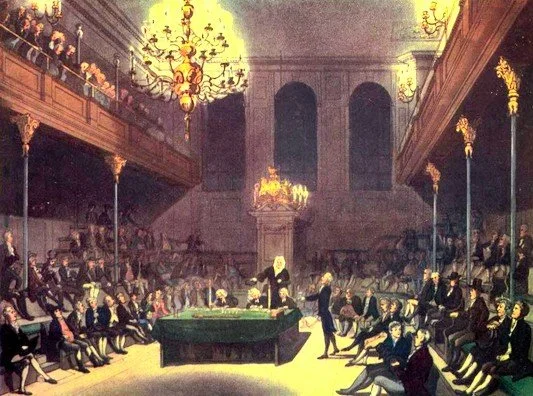
The House of Commons from The Microcosm of London (1808-10)
So when was parliament in session?
In her biography of Georgiana, Duchess of Devonshire, Amanda Foreman stated:
The aristocratic ‘season’ came into existence not only to further the marriage market but to entertain the upper classes while they carried out their political duties. The season followed the rhythm of Parliament: it began in late October with the opening of the new session, and ended in June with the summer recess.1
An article on the court in The Penny Magazine (1837) suggested similar timing:
The London ‘season’, or winter, was reckoned, during the last century [the 18th century], from about the month of November till that of May. It was regulated, as it is now, by the usual duration of the session of Parliament. Affluent people, who divided their time between London and the country, had less inducement then to absent themselves from the metropolis after the winter had set in, than they have now; and the state of the roads and means of communication rendered it convenient to the legislature to meet before travelling became, if not dangerous, at least very troublesome and annoying.2
The shift of the season

The Opera House from The Microcosm of London (1808-10)
But this is talking about the season in the late 18th century, long before the Regency started, so was the season held at the same time throughout the Georgian period?
The article in The Penny Magazine sheds some light on this:
During the present century [19th century], the commencement of the London ‘season’ has been gradually postponed. Since 1806, the opening of the session of Parliament has been veering from November to January; since 1822, it has almost settled into a rule (unless, of course, when interrupted by anything extraordinary) that it should not be opened till about the month of February, the session extending till July, or the beginning of August. Thus the London ‘season’, or winter, has been thrown into the months of spring and summer.2
So, when was the season?
To summarise, parliament traditionally sat from late October or November through to May or June. As travel was difficult, there was little incentive to leave the capital once the winter weather had set in and therefore it was convenient for the upper classes to stay in London during the whole of the winter period and the London season was fixed accordingly.
However, as travel improved with the spread of turnpike roads and more investment in the infrastructure, the ton was able to travel more easily to and from London during the winter months. It was no longer necessary to become established in London before the winter weather set in and so the opening of parliament, and hence the season, shifted to January or February. The most active part of the season was the period between Easter and when parliament adjourned for the summer, in July or August.
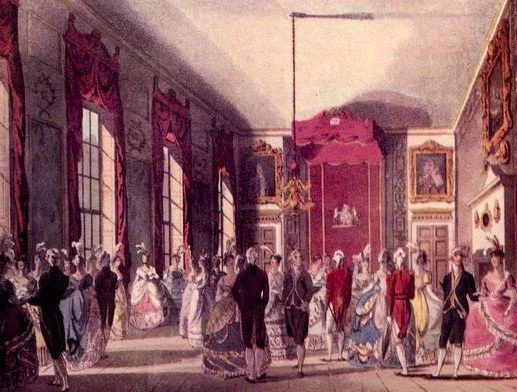
A drawing room at St James's Palace from The Microcosm of London (1808-10)
An interesting observation
If you examine the actual dates of the parliamentary sessions, you will discover that, during the 1780s, parliament often began in January and conversely, many of the parliamentary sessions after 1800 began before Christmas. The shift in the start date of the parliamentary sessions from October/November to January/February was certainly not consistent and the shift in the season had more to do with the increased ease of travel during the winter.
The summer recess
After the close of the parliamentary session, in June to August, the nobility would leave the city and return to their country estates. They might visit a spa such as Cheltenham or Bath or a seaside watering place such as Brighton or Weymouth, or go travelling abroad.
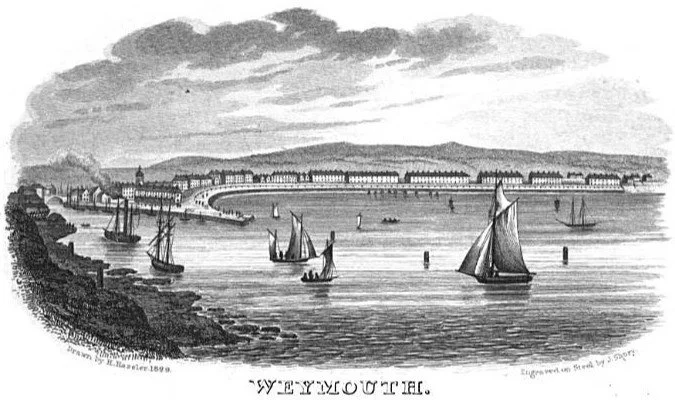
Weymouth bay from Weymouth and Melcombe Regis New Guide by E Groves (1835)
The little season?
The question arises as to whether there was, in fact, a ‘little season’ in the Regency period, held during the autumn months of September to November. Although this concept is used in many Regency romances, I have not been able to find any contemporary evidence that such a season existed during this period, although it was definitely a part of the Victorian social calendar.
No doubt those people who came back to town early, in September or October, typically those who did not own country estates, entertained each other during these months, but the existence of an official little season is questionable.
The royal family in residence
The Debrett’s website suggested that the timing of the season was determined by when the royal family were in residence in London, from October to December and from April to July.3
This broadly corresponds with the normal parliamentary sessions, though with a gap over the winter, and might help explain why the period after Easter became the height of the London season during the Regency.

St James's Palace from Leigh's New Picture of London (1827)
Rachel Knowles writes faith-based Regency romance and historical non-fiction. She has been sharing her research on this blog since 2011. Rachel lives in the beautiful Georgian seaside town of Weymouth, Dorset, on the south coast of England, with her husband, Andrew, who co-writes this blog.
If you have enjoyed this blog and want to encourage us and help us to keep making our research freely available, please buy us a virtual cup of coffee by clicking the button below.
Notes
1. Georgiana, Duchess of Devonshire by Amanda Foreman (1998).
2. A looking-glass for London – no. XI – the Court from The Penny Magazine (April 1837).
3. Debrett's website visited in 2013 - the page about the history of the season no longer exists.
Sources used include:
Ackermann, Rudolph, and Pyne, William Henry, The Microcosm of London or London in miniature Volume 1-3 (Rudolph Ackermann 1808-1810, reprinted 1904)
Chancellor, E. Beresford, Memorials of St. James’s Street and Chronicles of Almack’s (1922)
Foreman, Amanda, Georgiana, Duchess of Devonshire (HarperCollins, 1998, London)
Gronow, Captain RH, The Reminiscences and Recollections of Captain Gronow (1889)
Groves, E, The Weymouth and Melcombe Regis New Guide (E Groves, 1835, Weymouth)
Leigh, Samuel, Leigh's New Picture of London (London, 1827)
The Penny Magazine (1837)