
Hair powder and pomatum
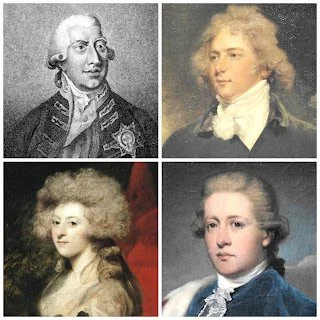
George III in a white wig
George IV, Maria Fitzherbert
and William Cavendish, Duke of Devonshire,
showing the effect of powder in the hair
The fashion for hair powder
The fashion for putting powder in your hair allegedly started with Henry IV of France (1553-1610) who started using brown powder in his hair to hide the grey hairs. Those around him hurried to adopt the custom. It did have an additional benefit. Powder helped to reduce the greasiness of the hair which was useful at a time when hair washing was certainly not a daily pursuit!
Wigs and white powder
Henry IV’s son Louis XIII (1601-1643) also had a hair problem—he started to go bald at a young age. To hide his baldness, he started to wear a long haired wig and, unsurprisingly, his courtiers soon followed suit. The fashion spread to England and was adopted by Charles II (1630-85) and his court.
The rarest and most expensive wigs were white. As a result, people put white powder on their wigs in order to make them look as white as possible. People also used white powder on their hair. It intensified the blondeness of very fair hair but made darker hair look grey, the shade depending on the natural hair colour.

George IV as Prince of Wales by John Hoppner (1792) © The Wallace Collection
In the first of The Merry Romances, A Perfect Match, Mr Merry reluctantly allows his manservant to powder his hair for a ball:
John handed Mr Merry his hat and cane and grinned. For once, he had managed to persuade his young master to stand still for long enough to powder his hair thoroughly, heightening the blondeness of its colour. John secretly thought that there were few gentlemen who could wear powder to such good effect.1
A universal fashion
Powder was not just a fashion adopted by the few; its use was widespread throughout most of the 18th century and not to use it was seen as a breach of social etiquette.
In her novel, The Sylph, published in 1778, Georgiana Cavendish, Duchess of Devonshire, wrote:
Monsieur bowed and shrugged, just like an overgrown monkey. In a moment I was overwhelmed with a cloud of powder. ‘What are you doing? I do not mean to be powdered,’ I said.
‘Not powdered!’ repeated Sir William; ‘why you would not be so barbarous as to appear without—it positively is not decent2
In her journal, Mary Frampton wrote of 1780:
At that time everybody wore powder and pomatum.3
In 1789, she went on to write:
I was dressed as a grown-up person for the first time, and wore powder, then the mark of distinction of womanhood.4
What was hair powder made from?
Hair powder was made from flour or starch and varied considerably in quality, with the best powders being made from highly refined starch.
Although white was the most popular colour, other shades were also used, including brown, grey, orange, pink, red, blue and violet.

Horn and ivory powder bottles on display at the Science Museum, London (2015)
Powdering room
Putting on hair powder was a messy and time consuming business. First the hair was covered with hair lotion known as pomade or pomatum which helped the powder to stick. Then the person being powdered was covered with a powdering gown or protective apron whilst the powder was applied using a set of bellows. A cone shaped device could be used to cover their face to prevent the powder going into their eyes.
In 1791, Mary Frampton’s journal stated:
The ladies wore the hair flowing down their backs and high in front, with much pomatum and powder put on with different kinds of puffs. The finishing powder had a brown hue and a strong perfumed smell, and was called ‘Maréchale’ powder. This powder was applied at a distance, that every hair might be frosted with it. One pound, and even two pounds, of powder were sometimes put into the hair or wasted in the room in one dressing.5
Ideally, this operation would take place in a special room – a powdering room or closet – in order to contain the mess. In Dr Johnson’s House Museum in Gough Square, London, there is a set of double doors off the parlour which lead to his powdering closet. This was where he stored his wigs and sat to have powder applied without spreading it all over the house.

The Parlour, Dr Johnson's House Museum, Gough Square, London. The double doors to the right of the fireplace lead to Dr Johnson's powdering closet (2015)
Sweet Cypress Hair Powder
In A Perfect Match, set in 1788-9, the heroine’s mother, Mrs Westlake, wears her hair “fashionably powdered”. She could have bought her hair powder from Sharp’s along with the Olympian Dew she used to prevent wrinkles.
You can read about the wonders of Olympian Dew in an earlier blogpost here.
According to an advertisement in The Times, Sharp’s could offer:
Sweet Cypress Hair Powder (made by Sharp). It is the lightest, sweetest and the best for the Hair of any 1s 2d per Pound, Stamp included; or 11sper Dozen – All Sorts of Hair Powders made (as may be seen every Day) from the purest French Starch, and sold Cheaper than at any other House.6
What does “stamp included” mean?
William Pitt the Younger introduced a sales tax on hair powder in 1786. Taxing fashion was a clever move as people who wanted to be fashionable were forced to pay the tax. It is this tax that the phrase “stamp included” refers to. Clearly the seller was paying the sales tax on behalf of the consumer. The tax was charged at a rate of 1d for items costing less than 8d; increased to 1½d for items costing between 8d and 1s; and rose to a maximum of 1s for items costing more than 5s.
This stamp duty was not just on hair powder but was payable on
...every packet, box, bottle, phial, or other inclosure, that shall contain any sweet scents, odours, or perfumes, or any dentifrice, or other preparation for the teeth, or any pomatum, hair powder, or other preparation for the hair.7
However, it was only the hair powder that was advertised as “stamp included”.
Pomades and pomatums
In the advertisement in The Times, Sharps also recommended:
Rose, Orange, Jessamine, Violet, and white Marechalle Pomatums, that will keep good in any Climate twelve months; 1s per Roll and Pot.
The Pomade de Grasse, Sharp has sold with great Reputation and Success for many Years; and now, as heretofore, does most solemnly assure the Public, that it will certainly and effectually thicken and strengthen the Hair; keep it from falling off or turning Grey. Sold with Directions for Use.
The very best Foreign Powders and Pomatum, wholesale and Retail.8
The decline of hair powder
In 1795, Pitt introduced a new tax on hair powder. Those wishing to use hair powder had to obtain an annual certificate for the privilege at a cost of one guinea. There was an outcry against the expense of this licence and the tax did not have quite the effect that Pitt had hoped for.
There was already a move toward more natural hairstyles and many people chose to abandon their hair powder altogether rather than spend a guinea on a licence. The tax never brought in the anticipated revenues; it simply hastened the demise of the fashion for hair powder.

'Leaving off powder, -or- a frugal family saving the guinea' by James Gillray (1795) © British Museum
Rachel Knowles writes faith-based Regency romance and historical non-fiction. She has been sharing her research on this blog since 2011. Rachel lives in the beautiful Georgian seaside town of Weymouth, Dorset, on the south coast of England, with her husband, Andrew, who co-writes this blog.
If you have enjoyed this blog and want to encourage us and help us to keep making our research freely available, please buy us a virtual cup of coffee by clicking the button below.
Notes
1. A Perfect Match, chapter 10, by Rachel Knowles (2015).
2. The Sylph by Georgiana Cavendish, Duchess of Devonshire (1778).
3. The Journal of Mary Frampton (1779-1846) by Mary Frampton, edited by Harriot Georgiana Mundy (1885).
4. Ibid.
5. Ibid.
6. "To The Ladies. Sharp,." Times [London, England] 12 Apr. 1788: 2. The Times Digital Archive. Web. 24 Jan. 2015. The monetary system was in pounds, shillings and pence represented by the letters l, s and d respectively.
7. Debrett (ed), The Parliamentary Register or History of the Proceedings and Debates of the House of Commons during the third session of the Sixteenth Parliament of Great Britain (1787).
8. Times op cit.
The collage consists of the following pictures:
George III from Bissett, Robert, The History of the Reign of George III (Edward Parker, 1822, Philadelphia)
George IV as Prince of Wales by John Hoppner (1792) Photo by Andrew Knowles Portrait © The Wallace Collection
Maria Fitzherbert by Sir Joshua Reynolds (c1788) © NPG London
William Cavendish, 5th Duke of Devonshire by Anton von Maron Photo by Andrew Knowles Portrait © Chatsworth
Sources used include:
Cavendish, Georgiana, Duchess of Devonshire, The Sylph (1778)
Debrett (ed), The Parliamentary Register or History of the Proceedings and Debates of the House of Commons during the third session of the Sixteenth Parliament of Great Britain (1787)
Frampton, Mary, The Journal of Mary Frampton (1779-1846) edited by Harriot Georgiana Mundy (1885)
Knowles, Rachel, A Perfect Match (2015)
Demodecouture.com on hairstyles-cosmetics-18th-century Times Digital Archive
All photographs © regencyhistory.net