
Prince Adolphus, Duke of Cambridge (1774-1850)

Adolphus, Duke of Cambridge from A Biographical Memoir of Frederick, Duke of York and Albany by John Watkins (1827)
Profile
Prince Adolphus (24 February 1774 - 8 July 1850) was the seventh son of George III and Queen Charlotte. He was more economical than his brothers and was popular at court, but did not get on well with his niece, Queen Victoria.
Early years
Prince Adolphus Frederick was born at Buckingham House on 24 February 1774. He spent his early years at Kew, sharing a house with his older brothers, Ernest and Augustus.
On 2 June 1786, he was made a Knight of the Garter and, shortly after, went with Ernest and Augustus to the University of Göttingen.1
Here his studies included the classics and theology, and he learned to fence.
A career in the army
In 1790, Adolphus travelled to Berlin to study military tactics before becoming a Colonel in the Hanoverian army. He fought in Flanders in 1793, where he was wounded and captured temporarily by the French. After recuperating in England, he returned to the Hanoverian army where he served again in Flanders. He retreated back to Hanover with the Hanoverians, but when they refused to stand up to Napoleon in 1803, Adolphus was forced to return to England.
Back in England, Adolphus was made Military Commander of the Home District and Colonel in Chief of the Coldstream Guards, but these were empty titles and he saw no active service. On 26 November 1813, he was promoted to Field Marshal in the British army.
Governor General of Hanover
In 1813, Adolphus returned to Hanover where he served as Governor General. He was made Viceroy in 1831 which gave him the power to introduce a more liberal constitution in Hanover.
On the death of William IV in 1837, his brother, the Duke of Cumberland, acceded to the Hanoverian crown and, once more, Adolphus was forced to return to England.
Duke of Cambridge
On 27 November 1801, Adolphus was made Duke of Cambridge, Earl of Tipperary and Baron of Culloden.2
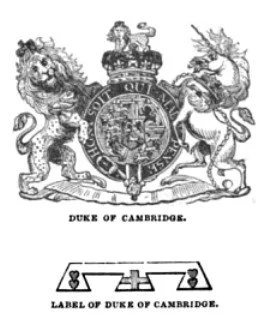
Arms and label of the Duke of Cambridge from Debrett's Complete Peerage (1838)
A popular prince
Adolphus was described by a lady visiting Hanover in 1799 as being
...extremely handsome, tall and finely formed with fair complexion and regular features, charming manners and a flow of amusing conversation.3
Caroline, Princess of Wales, on the other hand, described him in less flattering terms:
The Duke of Cambridge looks like a sergeant, and so vulgar with his ears full of powder.4
Adolphus was popular at court and with the public and was the only one of George III’s sons who successfully lived within his means and had a personal life that was free from scandal.
He was very fond of music and skilled at playing the violin. In later years, he was apt to join in impromptu at musical parties, either singing or on his violin. He became very deaf and was notorious for speaking out loudly during church services.
Adolphus was sympathetic towards the Jews and was criticised in the press for his religious tolerance after he went to the Great Synagogue in Duke’s Place in 1809 to see a Jewish service with his brothers the Duke of Cumberland and the Duke of Sussex.
A broken engagement
In 1797, Adolphus was unofficially engaged to his cousin Princess Frederica of Mecklenburg-Strelitz, the widow of Prince Louis of Prussia, but George III did not want them to marry until the war was over. In the meantime, Frederica became pregnant by Prince Frederick of Solms-Braunfels whom she subsequently married. After she had been widowed a second time, she married the Duke of Cumberland.

Frederica, Duchess of Cumberland from La Belle Assemblée (1830)
A successful marriage
On 7 May 1818, Adolphus married Princess Augusta Wilhelmina Louisa of Hesse-Cassel in Cassel. The ceremony was repeated at Buckingham House on 1 June. Adolphus and Augusta had three children: George William Frederick Charles (1819), Augusta Caroline (1822) and Mary Adelaide (1833).

Augusta, Duchess of Cambridge from La Belle Assemblée (1830)
Not the favourite uncle
Queen Victoria did not get on well with her uncle Adolphus or his wife. Adolphus’s son, George, spent much of his childhood at Windsor in the hopes that he would marry his cousin, but the match did not take place as neither Victoria nor George desired it. Moreover, Victoria seems to have been offended that it should ever have been suggested.
In addition, there was the matter of precedence. The Duke of Cambridge allowed Victoria’s husband, Prince Albert, to take precedence over him. But instead of receiving this graciously, the Queen assumed this as a matter of course, offending the Duke and Duchess.

Prince George of Cambridge from The Girlhood of Queen Victoria (1912)
The Duchess retaliated by sitting during a toast to Prince Albert at a party—the Queen insulted the Cambridges by excluding them from a ball at Buckingham Palace. When Prince Albert failed to appear at a banquet to celebrate being given the freedom of the city of London, the Duke of Cambridge gave a rather coarse speech which was reported in the press, much to the Queen’s horror and embarrassment. Fortunately, their relationship improved over time.

Prince Albert and Queen Victoria from portraits by Dalton after F Winterhalter from The Girlhood of Queen Victoria (1912)
Final years
Having left Hanover in 1837, Adolphus was obliged to start a new life in England, devoting much of his time to charitable works. Adolphus died at Cambridge House, Piccadilly, on 8 July 1850. He was buried at Kew on 17 July, but his remains were transferred to the royal vault in St George’s Chapel, Windsor, on 10 January 1930.5
Rachel Knowles writes faith-based Regency romance and historical non-fiction. She has been sharing her research on this blog since 2011. Rachel lives in the beautiful Georgian seaside town of Weymouth, Dorset, on the south coast of England, with her husband, Andrew, who co-writes this blog.
If you have enjoyed this blog and want to encourage us and help us to keep making our research freely available, please buy us a virtual cup of coffee by clicking the button below.
Notes
(1) From Ernest Augustus (1771-1851), Oxford Dictionary of National Biography by Alan Palmer (2004)
(2) From Debrett's Complete Peerage (1838); Adolphus Frederick, Oxford Dictionary of National Biography by Alan Palmer (2004) states 24 November 1801 and Wikipedia states 17 November 1801.
(3) From Royal Dukes by Roger Fulford (1933, revised 1973)
(4) From George IV by Christopher Hibbert (1972, 1973)
(5) From College of St George's Chapel, Windsor website.
Sources used include:
Courthope, William, editor, Debrett's Complete Peerage of the United Kingdom of Great Britain and Ireland (1838)
Fulford, Roger, Royal Dukes (1933, revised 1973)
Hibbert, Christopher, George III (1998, Viking, Great Britain)
Hibbert, Christopher, George IV (1972, Longmans, 1973, Allen Lane, London)
Hibbert, Christopher, Queen Victoria (HarperCollins, 2000, London)
Huish, Robert, Memoirs of her late royal highness Charlotte Augusta (1818)
Palmer, Alan, Adolphus Frederick, Prince, first Duke of Cambridge, (1774-1850), Oxford Dictionary of National Biography, (Oxford University Press, 2004, online edn, May 2009, accessed 23 Mar 2013)
Palmer, Alan, Ernest Augustus (1771-1851), Oxford Dictionary of National Biography, (Oxford University Press, 2004, online edn, May 2009, accessed 23 Mar 2013)
Victoria, Queen, The Girlhood of Queen Victoria, A Selection from Her Majesty's Diaries between the years 1832 and 1840, edited Viscount Esher 2 Volumes (1912)
Watkins, John, A Biographical Memoir of Frederick, Duke of York and Albany (1827, London)