
Prince Augustus, Duke of Sussex (1773-1843)

Augustus, Duke of Sussex from A Biographical Memoir of Frederick, Duke of York and Albany by John Watkins (1827)
Profile
Prince Augustus, Duke of Sussex (27 January 1773 - 21 April 1843), was the sixth son of George III and Queen Charlotte.
Early years
Prince Augustus Frederick was born on 27 January 1773 at Buckingham House. He spent his early years at Kew, sharing a house with his brothers Ernest and Adolphus. He was nominated a Knight of the Garter on 2 June 1786 and then travelled to the University of Göttingen to study.1
Ill health
Augustus was prevented from joining the army like his brothers because of ill health; he suffered badly from asthma. In later years, he habitually wore a black skull cap and was constantly worrying about his health. In 1832, he started to go blind, but underwent what was then a new and dangerous cataract operation which saved his sight.

Prince Augustus, Duke of Sussex, from Lady's Magazine (1792)
Appearance and character
Augustus was over six foot three inches tall and had a handsome face like his brother George IV. He was gifted musically with a particularly fine singing voice of which he was very proud.
I have the most wonderful voice that was ever heard – three octaves – and I do understand music.2
He had a genuine interest in the arts and science and amassed a huge library, a variety of singing birds and a large number of clocks. He also became involved with many charitable concerns. He became grand master of the Freemasons in 1811, was elected president of the Society of Arts in 1816 and was elected president of the Royal Society in 1830, though he resigned from the latter in 1838 because the presidential dinners were costing him too much money.
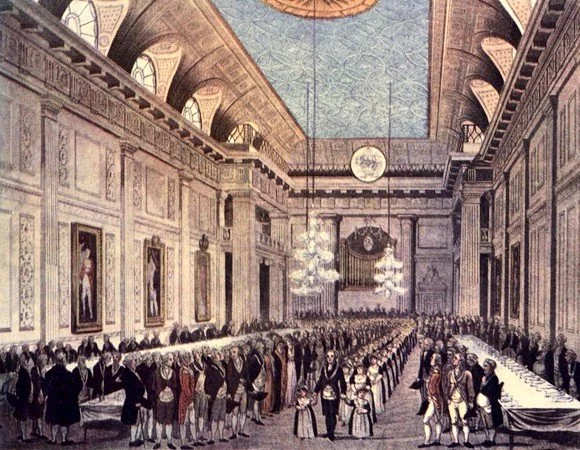
The Freemasons’ Hall, Great Queen Street from The Microcosm of London volume 2 (1808-10)
Romance in Rome
In 1792, Augustus spent the winter in Rome, as the warmer climate was better for his asthma. During this time, he met and fell in love with Lady Augusta Murray, a daughter of the Earl of Dunmore who was some years his senior. They were married on 4 April 1793 in a private ceremony without witnesses conducted by an English clergyman, the Reverend Gunn. The ceremony was repeated on 5 December at St George’s Hanover Square, using the names Augustus Frederick and Augusta Murray.
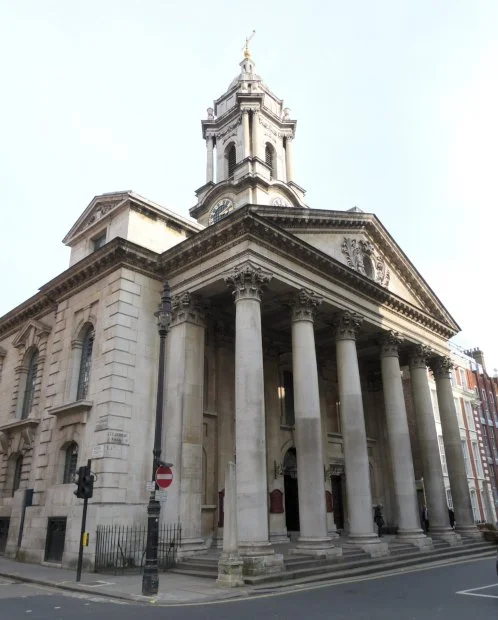
St George's Hanover Square (2015)
Illegal and unsuccessful
Under the Royal Marriages Act of 1772 Augustus needed the King's consent for his marriage to Augusta in order for it to be valid. As Lady Augusta was not of royal birth, that consent was not given, and the King had the marriage set aside in August 1794. The couple had two children, Augustus Frederick (1794) and Augusta Emma (1801), who took the surname d’Este.
They lived together in Berlin and then in London until 1801 when the couple separated. Later, Lady Augusta had to be restrained from using the title of Duchess of Sussex and she lost custody of the two children. From 1809 until her death in 1830, she was known as the Countess d’Ameland.
After William IV became king, Augustus d’Este caused a scandal by trying to prove that his parents’ marriage was legitimate and claiming the right to inherit his father’s title.
Duke of Sussex
On 27 November 1801, Augustus was made Duke of Sussex, Earl of Inverness and Baron Arklow and given a parliamentary allowance of £12,000, which he desperately needed.
Augustus was a devoted Whig and held very progressive political views in complete opposition to his father and later his brother George, supporting the abolition of the slave trade, Catholic emancipation and political reform.
In 1830, when William IV became king, he made Augustus ranger of the royal parks.
Princess Charlotte
When Princess Charlotte ran away to her mother at Connaught House in 1814 as a result of her father’s harsh treatment, it was to the Duke of Sussex that she looked for help. Advised that they had no legal right to resist the Princess being taken forcibly back to Carlton House, Augustus encouraged her to return to her father.
But the matter did not stop there. Augustus wrote to Lord Liverpool, the Prime Minister, demanding to see his niece and referring to her virtual imprisonment in her father’s house.
On 19 July 1814, Augustus took it one step further and addressed Lord Liverpool in public in the House of Lords, asking whether the Princess was allowed to see her friends, whether she was allowed “the free exercise of her pen”, whether she had personal liberty, whether she was to be allowed to go sea-bathing (which had been recommended for her health) and whether she was to be given an establishment of her own.
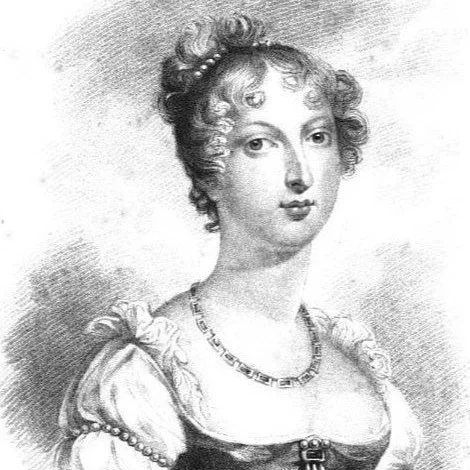
Princess Charlotte of Wales from La Belle Assemblée (1816)
The address caused considerable embarrassment in the House. Lord Liverpool forbore to make any answer and the Lord Chancellor, Lord Eldon, took it upon himself to rebuke Augustus.
But the publicity had the desired effect. Princess Charlotte was soon seen riding in Windsor Park and in September, she was sent to Weymouth for her health. However, it caused a further deterioration in the relationship between Augustus and his brother George.
A second illegal marriage
After the death of Lady Augusta in 1830, Augustus contracted a second illegal marriage. On 2 May 1831 he married Lady Buggin, the widowed daughter of the Earl of Arran, who became known as Lady Cecilia Underwood.
In 1840, she was made Duchess of Inverness by Queen Victoria, who was very fond of Augustus, her favourite uncle.
Death

Kensington Palace (2017)
The Duke of Sussex died on 21 April 1843 at Kensington Palace from erysipelas, a bacterial infection of the skin sometimes known as St Anthony’s Fire. He was buried in the public cemetery at Kensal Green on 4 May 1843 and Lady Cecilia was later buried beside him.

The grave of Augustus, Duke of Sussex, in Kensal Green Cemetery, London (2015)
Rachel Knowles writes faith-based Regency romance and historical non-fiction. She has been sharing her research on this blog since 2011. Rachel lives in the beautiful Georgian seaside town of Weymouth, Dorset, on the south coast of England, with her husband, Andrew, who co-writes this blog.
If you have enjoyed this blog and want to encourage us and help us to keep making our research freely available, please buy us a virtual cup of coffee by clicking the button below.
Notes
(1) From Ernest Augustus (1771-1851), Oxford Dictionary of National Biography by Alan Palmer (2004)
(2) From Royal Dukes by Roger Fulford (1933, revised 1973)
Sources used include:
Ackermann, Rudolph and Pyne, William Henry, The Microcosm of London or London in miniature Volume 2 (Rudolph Ackermann 1808-1810, reprinted 1904)
Fulford, Roger, Royal Dukes (1933, revised 1973)
Henderson, TF and revised by Van der Kiste, John, Augustus Frederick, Prince, Duke of Sussex (1773-1843) Oxford Dictionary of National Biography (Oxford University Press, 2004; online edn Jan 2008, accessed 23 Mar 2013)
Hibbert, Christopher, George IV (1972, Longmans, 1973, Allen Lane, London)
Huish, Robert, Memoirs of her late royal highness Charlotte Augusta (1818)
Palmer, Alan, Ernest Augustus (1771-1851), Oxford Dictionary of National Biography, (Oxford University Press, 2004, online edn, May 2009, accessed 23 Mar 2013)
Watkins, John, A Biographical Memoir of Frederick, Duke of York and Albany (1827, London)
All photographs © RegencyHistory.net