
Prince Edward, Duke of Kent (1767-1820)

HRH Edward, Duke of Kent from A Biographical Memoir of Frederick, Duke of York and Albany by John Watkins (1827)
Profile
Prince Edward, Duke of Kent and Strathearn, (2 November 1767 - 23 January 1820) was the the fourth son of George III and Queen Charlotte and a younger brother of George IV.
Early years
Prince Edward Augustus was born at Buckingham House on 2 November 1767, the fifth child of King George III and Queen Charlotte. He was named after George III’s brother Edward, Duke of York, who died shortly before the new Prince’s birth. He was tutored by John Fisher who later became Bishop of Salisbury.
Army career
In 1785, Edward was sent to Luneburg to begin his career in the army as a cadet in the Hanoverian foot guards. He completed his military training under Lieutenant Colonel Baron Von Wangenheim, a strict military tutor whom Edward described as “a mercenary tyrant”.
He served in Hanover, Geneva, Gibraltar, the West Indies and Canada. He was gazetted brevet Colonel in the British army and elected a Knight of the Garter in 1786, subsequently rising to Major General (1793), General (1794) and Field Marshal (1805).
Harsh disciplinarian or respected leader?
Edward gained the reputation of a stern disciplinarian, making him unpopular with his men. This was brought to a head in 1802, when he was made Governor of Gibraltar and asked to bring the garrison back into order. His harsh actions resulted in a mutiny, but having successfully quelled it, he was recalled to England.
The Duke of York condemned Edward’s behaviour as “from first to last as marked by cruelty and oppression”. His brother allowed him no opportunity to defend himself and they quarrelled violently.

Prince Frederick, Duke of York from La Belle Assemblée (1827)
However, it would appear that Edward’s leadership was respected by the officers at Gibraltar who gave a fete in his honour in May 1791 before he was transferred to Quebec. He was also commended for helping to repress St Lucia and Martinique whilst serving under Sir Charles Grey in the West Indies in 1794.
The least worthy of sons
George III seemed to have little interest in Edward and yet was very quick to criticise him. Edward received very few letters from home and was spied on by his valet, Rhymers.
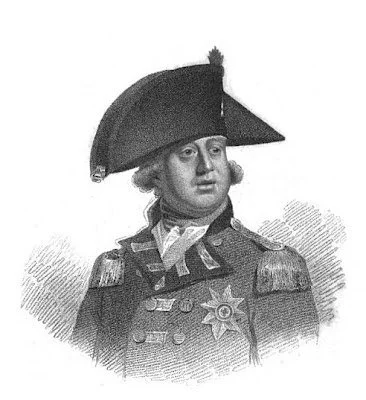
George III from Memoirs of Queen Charlotte by WC Oulton(1819)
Wangenheim gave Edward a very meagre sum out of the £6,000 a year he was paid for his maintenance, forcing him to borrow in order to equip himself in the manner befitting a Prince. When his father learned that he was in debt, he was sent to Geneva in disgrace, but he was still not given an adequate allowance and his debts continued to amass.
Desperate for contact with home, in 1790 Edward escaped from his mentor and travelled to England. His father was furious. The King afforded Edward only a very short interview before effectively banishing him to Gibraltar. He was not allowed home on leave until he suffered a fall from his horse in October 1798.
Edward was created Duke of Kent and Strathearn on 24 April 1799 and parliament finally voted him an income of £12,000 a year. However, his monetary problems continued to haunt him throughout the rest of his life.
Character
Despite his reputation for harsh military discipline, Edward was popular with his servants and reportedly Princess Charlotte’s favourite uncle, actively promoting the match between the Princess and Prince Leopold.
He helped negotiate Mrs Fitzherbert’s return to the Prince of Wales in 1799, but also remained on friendly terms with his brother’s wife, Princess Caroline.

Princess Charlotte from Huish's Memoirs of her late royal highness Charlotte Augusta (1818)
His habits were remarkably similar to those of his father – he rose early, ate and drank sparingly and liked to spend time outside. He was very polite and attentive to women and placed a high value on his time.
His conversation was intelligent and informed and he had a gift for public speaking. He was also a prolific correspondent.
He supported charitable works, such as the Literary Fund, and introduced regimental schools for the children of his men. He was interested in Robert Owen’s social experiments, supported anti-slavery and was in favour of Catholic emancipation, which may explain some of his father’s enmity towards him.
Madame de Saint-Laurent
Whilst serving in Gibraltar, Therese-Bernadine Mongenet became Edward’s mistress. She was known as Madame de Saint-Laurent and stayed with the Prince for almost 28 years, until the death of Princess Charlotte in 1817 prompted the royal Dukes to marry in order to secure the succession.
Marriage
On 29 May 1818, Edward married Princess Victoria Mary Louisa of Saxe-Coburg-Saalfeld in Coburg. She was the widow of Emich Carl, 2nd Prince of Leiningen and Prince Leopold’s sister. The ceremony was repeated in the Queen's drawing room in Kew Palace on 11 July 1818, at the same time as his brother William, Duke of Clarence, married Princess Adelaide of Saxe-Meiningen.
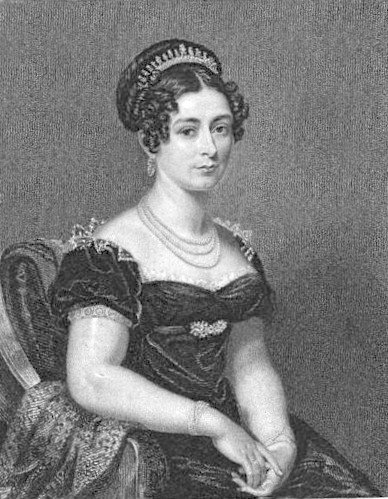
Victoria, Duchess of Kent from La Belle Assemblée (1825)
Parliament refused to grant an additional sum for the maintenance of his enlarged household, and so the couple lived mainly at Amorbach Castle, Leiningen, Victoria’s dower house, in order to economise.
The birth of Princess Victoria
The couple lived abroad until shortly before the birth of Queen Victoria. Despite the Regent’s refusal to fund the trip, they travelled to England in April 1819 so that their baby could be born in Kensington Palace.
Alexandrina Victoria was born on 24 May 1819 and christened a month later, on 24 June. “Look at her well,” her proud father said, “for she will be Queen of England.” 1
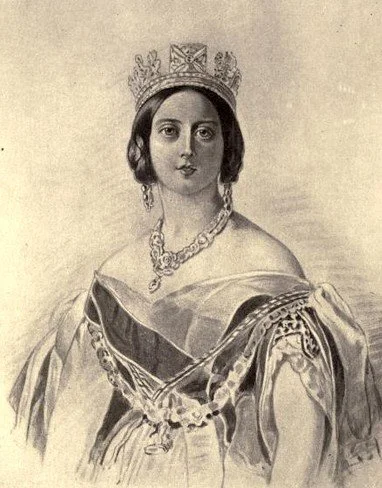
Queen Victoria by Dalton after F Winterhalter from The Girlhood of Queen Victoria (1912)
Death
After the Princess’s birth, it was necessary for the Duke and Duchess once again to retrench. Bishop Fisher advised a sojourn in Devon for the sake of economy and health and they leased Woobrook Cottage in Sidmouth.

Woolbrook Cottage, Sidmouth from The Life of Field-Marshal His Royal Highness, Edward, Duke of Kent by Erskine Neale (1850)
Edward caught a cold, and subsequently became ill with pneumonia. He died in Sidmouth on 23 January 1820 and was buried on 12 February in St George’s Chapel, Windsor, in a huge coffin almost 7½ feet long and 3 foot wide.
Rachel Knowles writes faith-based Regency romance and historical non-fiction. She has been sharing her research on this blog since 2011. Rachel lives in the beautiful Georgian seaside town of Weymouth, Dorset, on the south coast of England, with her husband, Andrew, who co-writes this blog.
If you have enjoyed this blog and want to encourage us and help us to keep making our research freely available, please buy us a virtual cup of coffee by clicking the button below.
Note
Reported in Longford, Elizabeth, Edward, Prince, Duke of Kent and Strathearn (1767-1820), Oxford Dictionary of National Biography (Oxford University Press, 2004, online edn, May 2009, accessed 10 Feb 2012).
Sources used include:
Hibbert, Christopher, George III (1998, Viking, Great Britain)
Hibbert, Christopher, George IV (1972, Longmans, 1973, Allen Lane, London)
Hibbert, Christopher, Queen Victoria (HarperCollins, 2000, London)
Huish, Robert, Memoirs of her late royal highness Charlotte Augusta (1818)
Longford, Elizabeth, Edward, Prince, Duke of Kent and Strathearn (1767-1820), Oxford Dictionary of National Biography (Oxford University Press, 2004, online edn, May 2009, accessed 10 Feb 2012)
Neale, Erskine, The Life of Field-Marshal His Royal Highness, Edward, Duke of Kent (Richard Bentley, 1850, London)
Oulton, Walley Chamberlain, Authentic and Impartial Memoirs of Her Late Majesty Charlotte, Queen of Great Britain and Ireland (1819, London)
Watkins, John, A Biographical Memoir of Frederick, Duke of York and Albany (1827, London)