
Mrs Fitzherbert (1756-1837)
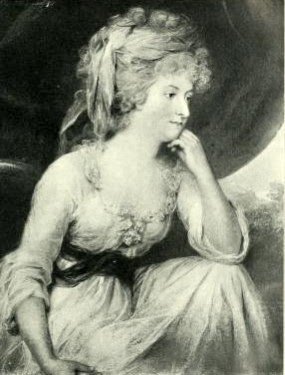
Mrs Fitzherbert from The Creevey Papers (1904)
Profile
Maria Fitzherbert (26 July 1756 - 27 March 1837) was the secret wife of George, Prince of Wales, the future George IV.
Early life
Maria Fitzherbert was born Maria Ann Smythe on 26 July 1756, the eldest daughter of William Smythe and Mary Ann Errington. She came from a respectable family: William was the son of Sir John Smythe, Baronet, of Acton Burnel in Shropshire and her mother was related to the Earl of Sefton. She was strictly reared as a Roman Catholic and her education was completed in France.
Twice widowed
In July 1775, Maria married Edward Weld, a wealthy Catholic landowner of Lulworth Castle, who was sixteen years her senior. The marriage did not last long; Weld died after falling from his horse just a few months later, having failed to sign a new will in Maria's favour.

Lulworth Castle (2012)
In 1778, she married again, this time to Thomas Fitzherbert of Swynnerton in Staffordshire. This marriage was also short-lived; Fitzherbert died from wounds inflicted during the anti-Catholic Gordon Riots in 1780, leaving Maria Fitzherbert a widow for the second time.
Lady of fashion
Huish described Maria Fitzherbert as a woman of “great accomplishments and beauty.” He continued that she was:
...unquestionably, a most beautiful woman, but perhaps too much inclined to fullness of figure; and yet it may be said that she was indebted to that prominence of habit for a great portion of her personal loveliness and attraction.1
La Belle Assemblée wrote:
Mrs Fitzherbert is universally acknowledged to be a woman of refinement and elegant manners, of accomplishments equally solid and fascinating, and acquirements of a very high degree in the intellectual scale.2
Wife or mistress?
In 1783, Maria became the object of royal attentions. George, Prince of Wales became infatuated with her, wanting her to become his mistress, but Maria’s devout Catholic beliefs would not allow it. George decided that marriage was the only way to secure Maria's affections.
On 15 December 1785 the Prince of Wales married Mrs Fitzherbert in a secret ceremony conducted by Robert Burt, an impoverished curate who set aside his scruples for the £500 fee.

George, Prince of Wales, by Hoppner (1792) at Wallace Collection
The marriage however was not legal. Not only did it contravene the Act of Settlement of 1701, preventing a Roman Catholic from ascending the British throne, but it breached the Royal Marriage Act of 1772. As a descendant of George II who was under 25 years of age, the prince required the king’s consent for the marriage to be legal.
His consent would never have been given, because George III was vehemently opposed to his children marrying either Catholics or commoners, and Maria Fitzherbert was both.
Queen of Brighton

Brighton Pavilion (2018)
George and Maria spent much of their time in Brighton where Mrs Fitzherbert was treated like a queen. They had separate houses which together formed the heart of fashionable society there.
Mrs Fitzherbert’s house, Steine House, was a modest residence which boasted a long veranda overlooking the Steine, whilst the Prince of Wales lived at Brighton Pavilion.

Mrs Fitzherbert's house on the Steine (2018). According to the plaque, she lived here from 1801 to 1837.
The inconstant prince
However, by 1794, George and Maria's relationship was showing signs of strain, and the prince’s affections were wandering towards an older woman, Frances, Countess of Jersey.
On 24 August, at Weymouth, George told his father that all connection with Mrs Fitzherbert had ceased and that he was ready to seek a Protestant bride, namely, his cousin, Caroline of Brunswick. By agreeing to this marriage, George hoped to appease parliament so that they would pay the huge debts he had amassed as well as shielding his relationship with Lady Jersey.
After their separation, the prince treated Mrs Fitzherbert with callous coldness, although his brothers continued to honour her with respect, especially the Duke of Kent who bought her a house, Castle Hill in Ealing, in 1798.
Temporary reconciliation
In August 1798, George suddenly sought reconciliation with his former mistress. Maria was understandably sceptical. The prince characteristically sought to wear down her resistance. He revealed a will he had written in 1796 which left everything to Maria, “my real and true Wife” and showered her with presents.
The couple were reunited in June 1800, though their relationship was not on as secure a footing as before.

Mrs Fitzherbert from Memoirs of George IV by Robert Huish (1830)
By 1807, the prince’s affections were wandering again, this time towards Lady Hertford. Unable to bear any further humiliation, on 18 December 1809, Maria sent George a farewell letter and after 1811, she did not return to the Pavilion until after George's death.
However, she was more fortunate than many of George’s other mistresses. She received financial provision by way of a pension.
Minney Seymour
Mrs Fitzherbert had a young ward who lived with her, Minney Seymour.
La Belle Assemblée stated:
Her conduct towards this young orphan seemed to be affectionate and tender without example.2
Life after George
After George’s death in 1830, William IV, was anxious to make amends with his brother’s long-term mistress. He invited Mrs Fitzherbert to the pavilion and offered her the title of Duchess. Although initially disinclined, Mrs Fitzherbert was persuaded and, from this time, her servants wore royal livery and she visited the Pavilion regularly.
Maria Fitzherbert died on 27 March 1837 and was buried in Brighton.
Updated 20/10/21
Rachel Knowles writes faith-based Regency romance and historical non-fiction. She has been sharing her research on this blog since 2011. Rachel lives in the beautiful Georgian seaside town of Weymouth, Dorset, on the south coast of England, with her husband, Andrew, who co-writes this blog.
If you have enjoyed this blog and want to encourage us and help us to keep making our research freely available, please buy us a virtual cup of coffee by clicking the button below.
Notes
(1) From Memoirs of George IV by Robert Huish (1830).
(2) From La Belle Assemblée (May 1810).
Sources used include:
Bell, John, La Belle Assemblée (1810)
Chedzoy, Alan, Seaside Sovereign - King George III at Weymouth (2003)
Creevey, Thomas, The Creevey Papers, A selection from the correspondence & diaries of the late Thomas Creevey, MP, edited by Sir Herbert Maxwell (John Murray, 1904, London)
Dinkel, John, The Royal Pavilion, Brighton
Fry, Plantagenet Somerset, The Kings & Queens of England & Scotland (1990)
Huish, Robert, Memoirs of George IV (1830)
Huish, Robert, Memoirs of her late royal highness Charlotte Augusta (1818)
Parissien, Steven, George IV, The Grand Entertainment (2001)
Watson, J. Steven, Oxford History of England: The Reign of George III 1760-1815 (1960)
All photographs © Regencyhistory.net