
George IV (1762-1830)

George IV from Huish's Memoirs of her late royal highness Charlotte Augusta (1818)
Profile
George, Prince of Wales, was the eldest son of George III and Queen Charlotte. He ruled for nine years as Regent, from 1811 to 1820, when his father became incapacitated due to mental instability and ill health, finally becoming King George IV on 29 January 1820 on his father's death.
He ruled for ten years until his own death in 1830. As his only legitimate issue, Princess Charlotte, had died in childbirth in 1817, he was succeeded by his brother, William IV.
The early years
George Augustus Frederick, Prince of Wales, was born on 12 August 1762 at St James’s Palace, the eldest son of George III and Queen Charlotte.
Unfortunately, George did not get on with his royal parents. George III preferred his second son, Frederick, to his heir and Queen Charlotte is said to have hated her eldest son. The King and Queen had simple tastes which did not sit well with the young Prince of Wales who chafed at the restrictions put on his behaviour. He took every opportunity to annoy his father whilst the King despised his heir’s extravagant and hedonistic lifestyle. He was further alienated from his father after an abortive attempt to take power during the Regency crisis of 1788.
Unlike his brothers, George was not allowed to enter military service, but was kept at home with his sisters, who adored him, with very little to do. This lack of occupation only drove him to more excesses and increased his resentment towards his parents.

The National Gallery, Trafalgar Square
Patron of the arts
George was genuinely devoted to the arts and became a great connoisseur of paintings and furniture, amassing a huge collection during his lifetime and inspiring the establishment of the National Gallery. He loved both playing and listening to music, was well versed in literature and was an ardent supporter of the theatre.
He also loved architecture and was intimately involved with the redesign of Buckingham Palace and Windsor Castle, and, most notably, the Brighton Pavilion, which remains a lasting monument to his architectural extravagance, where his creative genius was allowed free reign. His patronage of Brighton encouraged the development of the fashionable seaside resort.
The Prince Regent's set
As a young man, George was both handsome and popular. He was considered to be 'the first gentleman of England' because of his polished manners and witty conversation. He was extravagant and entertained lavishly, moving in a set of people who shared in his excesses of gambling and drinking that included the Barrymore brothers, Richard Brinsley Sheridan, Beau Brummell and Charles James Fox.

George, Prince of Wales by Hoppner at Wallace Collection
However, George was selfish and unfeeling and a far from faithful friend. Parissien states that: "Although he was frequently complimented on his manners, when it came to people or principle he found it all too easy to abandon them, along with consideration and politeness."
George the womaniser
George was a passionate but inconstant lover. He had many mistresses, including:
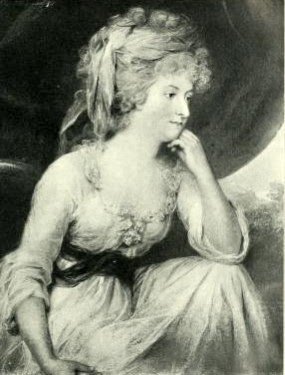
Mrs Fitzherbert from The Creevey Papers (1912)
A disastrous marriage
He reluctantly agreed to marry his cousin, Caroline of Brunswick, in 1795, in order to get parliament to pay his debts. They had one daughter, Princess Charlotte, but the marriage was a disaster and the couple soon separated. George's callous treatment of his wife coupled with his extravagance lost him much of his early popularity.

Princess Caroline of Brunswick from Huish's Memoirs of her late royal highness Charlotte Augusta (1818)
His final years
In later life, George became vastly overweight through years of overindulgence. His health deteriorated and he spent the latter part of his reign in virtual seclusion in the Royal Lodge, Windsor. He died at Windsor on 26 June 1830, aged 67 years of age.

Upper Ward, Windsor Castle from The History of the Royal Residences by WH Pyne (1819)
Rachel Knowles writes faith-based Regency romance and historical non-fiction. She has been sharing her research on this blog since 2011. Rachel lives in the beautiful Georgian seaside town of Weymouth, Dorset, on the south coast of England, with her husband, Andrew, who co-writes this blog.
If you have enjoyed this blog and want to encourage us and help us to keep making our research freely available, please buy us a virtual cup of coffee by clicking the button below.
Sources used include:
Chedzoy, Alan, Seaside Sovereign - King George III at Weymouth (The Dovecote Press, 2003, Wimborne)
Fry, Plantagenet Somerset, The Kings & Queens of England & Scotland, (1990)
Huish, Robert, Memoirs of her late royal highness Charlotte Augusta (1818)
Parissien, Steven, George IV, The Grand Entertainment (John Murray, 2001)
Watson, J. Steven, Oxford History of England: The Reign of George III 1760-1815, (1960)