
Georgian pockets
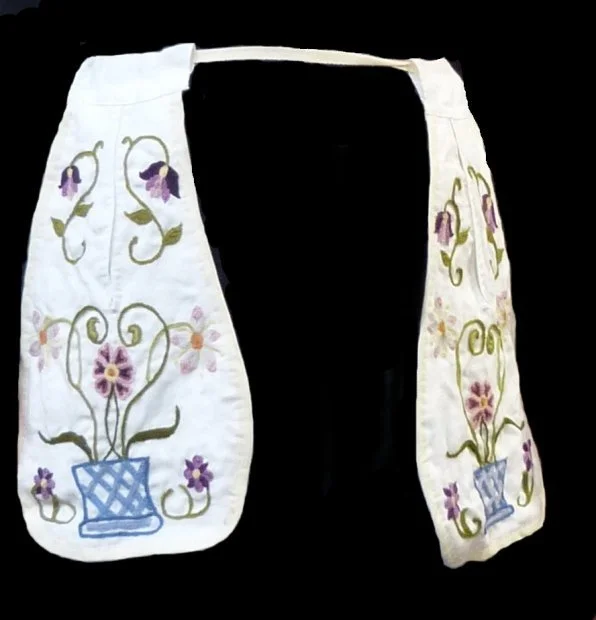
A pair of Georgian pockets - replicas made by Embellished at the International Living History Fair (2013)
A pair of pockets
In an age before handbags, ladies used pockets to carry around their personal possessions underneath their skirts. These were not the small pockets we have sewn into our garments today, but deep cloth bags which were completely separate from a lady’s dress.
Pockets usually came in pairs on a cord and were fastened around the waist over a lady’s shift and under-petticoat but below her petticoats. There were slits in the side seams of the petticoats so that these pockets could be accessed. They were often handmade and might be given as gifts, although they could also be bought ready-made from a haberdasher’s shop.
I tried on a pair of pockets made by Joanna Tyrrell of Embellished at the International Living History Fair in October 2013. I am afraid that they do not look right over trousers, but it does give you an idea of how big these pockets were.
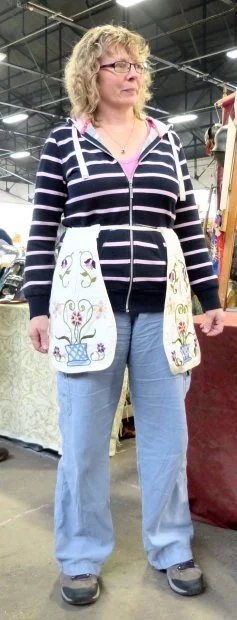
A pair of pockets modelled by Rachel at the International Living History Fair (2013)
What would you find in a pocket?
All manner of objects might be found in a pocket including money, letters, a journal, a handkerchief, a pair of scissors, a comb, writing implements, keys, a watch, glasses, a snuffbox, smelling salts, food and sewing accessories.

London souvenir box showing the Queen's Palace from the Museum of London's collection (2014)
As pockets often held items of value, they were liable to theft by ‘pickpockets’, who would cut the pocket strings and steal the pockets as they fell or slash the pockets and retrieve the contents. Sometimes people slept with their pockets underneath their pillows to protect them from being stolen.
Georgian pockets go out of fashion
When dresses became more fitted in the 1790s, pockets went out of fashion and ladies started carrying their possessions around in reticules, which were, in effect, outside pockets.

Reticule from La Belle Assemblée (1812)
Rachel Knowles writes faith-based Regency romance and historical non-fiction. She has been sharing her research on this blog since 2011. Rachel lives in the beautiful Georgian seaside town of Weymouth, Dorset, on the south coast of England, with her husband, Andrew, who co-writes this blog.
If you have enjoyed this blog and want to encourage us and help us to keep making our research freely available, please buy us a virtual cup of coffee by clicking the button below.
Sources used include:
Bell, John, La Belle Assemblée (John Bell, 1806-1837, London)
All photographs © RegencyHistory.net