
The wit and wisdom of John Constable
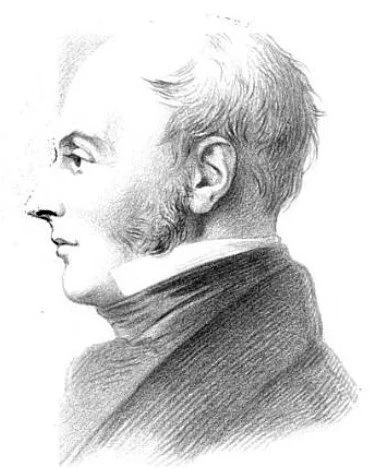
John Constable from Memoirs of the Life of John Constable by CR Leslie (1845)
John Constable (1776-1837) was an English painter famous for his landscapes, particularly of the Suffolk countryside. Here is a selection of quotes said by him and about him.
Read more about John Constable’s life here.
On Brighton
Brighton is the receptacle of the fashion and off-scouring of London. The magnificence of the sea, and its, to use your own beautiful expression, ‘everlasting voice’, is drowned in the din and tumult of stage coaches, gigs, flys, &c. and the beach is only Piccadilly or worse by the sea-side. Ladies dressed and undressed; gentlemen in morning-gowns and slippers, or without them or any thing else, about knee deep in the breakers; footmen, children, nursery-maids, dogs, boys, fishermen, and Preventive Service men with hangers and pistols; rotten fish, and those hideous amphibious animals, the old bathing-women, whose language, both in oaths and voice, resembles men, all mixed together in endless and indecent confusion.
In a letter to his friend, Archdeacon Fisher, from Brighton, 29 May 1824.

Brighton Steyne from History of Brighton and its environs by R Sickelmore (1827)
2. On Turner
I dined with the Royal Academy last Monday in the Council room…I sat next to Turner, and opposite Mr West and Lawrence. I was a good deal entertained with Turner. I always expected to find him what I did. He has a wonderful range of mind.
In a letter to his future wife, Maria, 30 June 1813.
3. On Byron
The world is rid of Lord Byron, but the deadly slime of his touch still remains.
In a letter to Fisher, May 1824.

Lord Byron from A Journal of the Conversations of Lord Byron with the Countess of Blessington (1893)
4. Constable’s wit
The amiable but eccentric Blake, looking through one of Constable’s sketch books, said of a beautiful drawing of an avenue of fir trees on Hampstead Heath, ‘Why, this is not drawing, but inspiration;’ and he replied, ‘I never knew it before; I meant it for drawing.’
5. An unexpected reply
He could not easily resist the temptation of making an unexpected reply, and when Archdeacon Fisher, one Sunday, after preaching, asked him how he liked his sermon, he said, ‘Very much indeed, Fisher; I always did like that sermon.’
6. Constable’s wisdom
The difference between power and truth is very material in painting, as it is in other matters of taste. It may be illustrated by an anecdote of Barry and Garrick. Few actors had more power than Barry; indeed, he was able for some time to divide the admiration of the town with Garrick. They played Lear in competition fifty nights; but the public were set right by an epigram, which placed the distinction between them in the proper light, the last line of which was: ‘To Barry we give loud applause, to Garrick only tears.’

David Garrick from Memoirs of the Life of David Garrick by T Davies (1808)
7. When a cottage is better than a palace
Whatever may be thought of my art, it is my own; and I would rather possess a freehold, though but a cottage, than live in a palace belonging to another.
8. On Raphael’s drawings
On hearing somebody say of the celebrated collection of Raphael’s drawings that belonged to Sir Thomas Lawrence, ‘They inspire,’ he replied, ‘They do more, they inform.’
9. Nothing is ugly
To a lady who, looking at an engraving of a house, called it an ugly thing, he said, ‘No madam, there is nothing ugly; I never saw an ugly thing in my life: for let the form of an object be what it may, - light, shade and perspective will always make it beautiful. It is perspective which improves the form of this.’
10. A great encourager
A friend of Constable expressing to him his dissatisfaction at his own progress in art, received (as he told me) the greatest encouragement to proceed he ever met with, in the following answer: ‘If you had found painting as easy as you once thought it, you would have given it up long ago.’
11. A long apprenticeship in art
There has never been a boy painter, nor can there be. The art requires a long apprenticeship, being mechanical, as well as intellectual.
12. Quoting Dr Johnson
There were many occasions on which Constable quoted the aphorism of Dr Johnson: ‘That which is greatest is not always best.’

Drawing manual - the Cabinet of Arts (1805) from the V&A Museum, London
13. On the practice of painting
The more facility of practice I get, the more pleasure I shall find in my art; without the power of execution I should be continually embarrassed, and it would be a burthen to me.
In a letter to fellow artist, John Dunthorne, c1799.
14. A preference for a six-foot canvas
I am most anxious to get into my London painting-room, for I do not consider myself at work unless I am before a six-foot canvas.
In a letter to Fisher, 23 Oct 1821.
15. Constable’s style of art
I am certain my reputation rises as a landscape painter, and that my style of art, as Farrington always said it would, is fast becoming a distinct feature.
In a letter to Fisher, 17 April 1822.
16. Constable in the newspaper
I beg to congratulate you on the appearance of your name in the newspapers. Do not despise them too much. They cannot give fame, but they attend on her. Smoke gives notice that the house is on fire.
In a letter from Fisher dated Feb 12 1824, Weymouth.
17. On Constable’s love of the Suffolk landscape
Still I should paint my own places best; painting is with me but another word for feeling, and I associate ‘my careless boyhood’ with all that lies on the banks of the Stour; those scenes made me a painter, and I am grateful; that is, I had often thought of pictures of them before I ever touched a pencil, and your picture is the strongest instance of it I can recollect; but I will say no more, for I am a great egotist in whatever relates to painting.
In a letter to Fisher, 23 Oct 1821.
18. An over-weening affection for the English landscape
In the frontispiece to English Landscape, Constable confessed:
Perhaps, the Author, with an over-weening affection for these scenes, may estimate them too highly, and may have dwelt on them too exclusively.
19. The pastoral feeling of landscape
I hold the genuine pastoral feeling of landscape to be very rare, and difficult of attainment. It is by far the most lovely department of painting as well as of poetry.
17 Nov 1824.
20. Nature in all her beauty
The landscape painter must walk in the fields with an humble mind. No arrogant man was ever permitted to see nature in all her beauty.
In his last lecture, 25 July 1836.
21. Constable’s belief that his paintings would never be popular
My pictures will never be popular for they had no handling. But I do not see handling in nature.

Watermill at Weald and Downland Museum (2004)
22. Constable’s appearance
Constable was
remarkable among the young men of the village for muscular strength, and being tall and well formed, with good features, a fresh complexion, and fine dark eyes, his white hat and coat were not unbecoming to him, and he was called in the neighbourhood the ‘handsome miller’.
CR Leslie of Constable.
23. A path contrary to inclination
I see plainly it will be my lot to walk through life in a path contrary to that in which my inclination would lead me.
In a letter to JT “Antiquity” Smith, 2 March 1797, when forced to take on a role in his father’s business rather than pursue his art.
24. “We shall yet be happy”
Be assured, we have only to consider our union as an event that must happen, and we shall yet be happy.
In a letter to his future wife, Maria, 1811.
25. Fondness for children
His fondness for children exceeded, indeed, that of any man I ever knew.
CR Leslie of Constable.
26. On being accepted as a full member by the Royal Academy
It has been delayed until I am solitary, and cannot impart it.
On being accepted as a full member of the Royal Academy in 1829, the year after his beloved wife Maria’s death.
Read about John Constable's life here.
More quotes and anecdotes:
Rachel Knowles writes faith-based Regency romance and historical non-fiction. She has been sharing her research on this blog since 2011. Rachel lives in the beautiful Georgian seaside town of Weymouth, Dorset, on the south coast of England, with her husband, Andrew, who co-writes this blog.
If you have enjoyed this blog and want to encourage us and help us to keep making our research freely available, please buy us a virtual cup of coffee by clicking the button below.
Note
All quotes are from Memoirs of the Life of John Constable, Esq, RA (1845) by CR Leslie.
Sources used include:
Leslie, Charles Robert, RA, Memoirs of the Life of John Constable, Esq, RA (1845)
Sickelmore, Richard, History of Brighton and its environs (1827)