
The christening of Queen Victoria on 24 June 1819
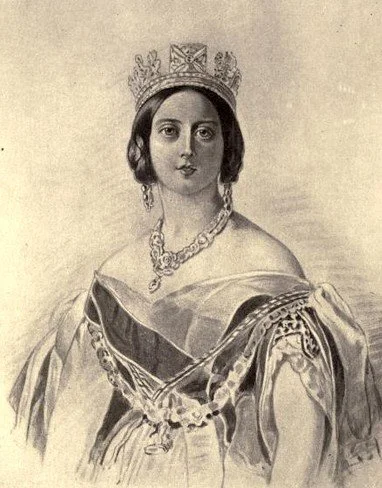
Queen Victoria by Dalton after F Winterhalter from The Girlhood of Queen Victoria (1912)
The birth of Queen Victoria
On 6 November 1817, Princess Charlotte, the future George IV’s only child, died in childbirth.
With the tragic death of Princess Charlotte, the prospects for the monarchy were bleak. Although 12 of George III's 15 children were still living, not a single one of them had a living, legitimate child.
The Duke of York's marriage was childless.
The Duke of Cumberland had married in 1815, but was yet to produce a child.
The Duke of Sussex's marriage had been declared illegal.
The race was on to provide an heir to the throne.
In 1818, the Duke of Clarence, the Duke of Kent and the Duke of Cambridge all got married.
The Duke of Clarence's marriage sadly produced no surviving children, but the Dukes of Cumberland and Cambridge both had sons in 1819 whom they named George.
But as the older brother, any child of the Duke of Kent would stand before them in the line for the throne.
On 24 May 1819, a daughter was born to the Duke of Kent and his wife, Princess Victoria of Saxe-Coburg-Saalfeld.

Edward, Duke of Kent from A Biographical Memoir of Frederick, Duke of York and Albany by John Watkins (1827)
Choosing the names for a future monarch
As a matter of form, the Duke and Duchess of Kent proposed various names to the Regent for him to approve:
Victoire or Victoria after her mother
Georgiana after the Regent
Alexandrina after the Tsar
Charlotte and Augusta, after her aunts, or possibly after her grandmother and great grandmother.
The Regent chooses to be difficult
George chose to be awkward. He announced that he did not like to put his own name before the Tsar’s, but neither did he wish his name to appear after it. He would not contemplate the baby being given the name of his poor dead daughter and declared that Augusta was “too majestic”.

George, Prince Regent, from Memoirs of her late royal highness Charlotte Augusta by Robert Huish (1818)
The christening of Queen Victoria
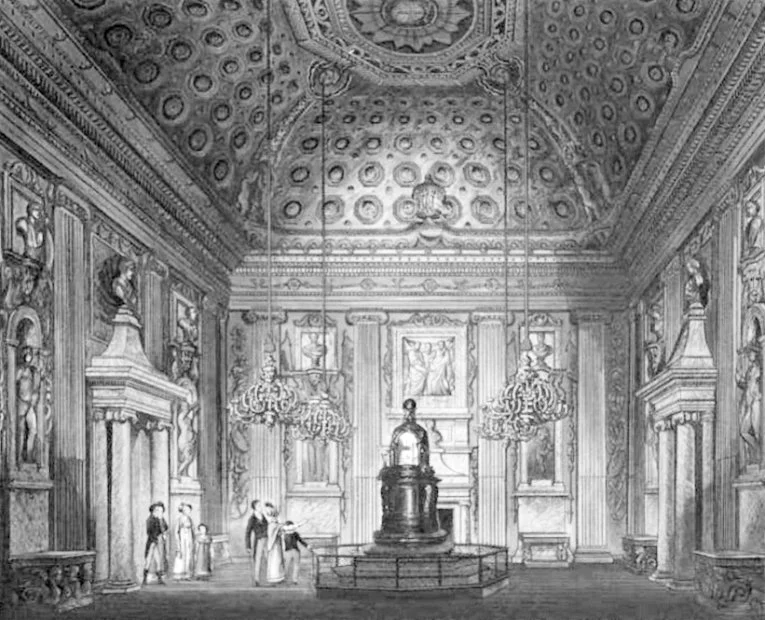
The Cupola Room, Kensington Palace, from The History of the Royal Residences by WH Pyne (1819)
The Regent insisted that the christening should be a strictly private affair to be held in the Cupola Room at Kensington Palace on 24 June 1819 at 3pm. The baby's godparents were the Prince Regent, Tsar Alexander, the Dowager Duchess of Coburg (the baby's grandmother) and the Princess Royal, widow of the King of Württemberg. However, only the Prince Regent was at the christening—the others were represented by the Duke of York, Princess Augusta and Princess Mary, Duchess of Gloucester.
The only other guests were the Duke of Gloucester, the Duchess of York and Prince Leopold, Princess Charlotte's bereaved husband.
When the christening service began, nobody knew what names the baby was to be given. The Archbishop of Canterbury, Charles Manners-Sutton, with the baby in his arms, sought enlightenment from the parents and then the Regent. At length, the Regent declared that the baby was to be called Alexandrina.
The Duke of Kent proposed Elizabeth, but the Regent dismissed that suggestion and reluctantly agreed to the baby being given her mother’s name, though he insisted that it had to follow the name of Tsar. So the baby was named Alexandrina Victoria and as a small girl, she was often called Drina.
"The English like Queens"
The Dowager Duchess of Coburg, the Duchess of Kent’s mother, wrote to her daughter that she hoped she was happy with a girl. “The English like Queens,” she wrote.
The Duke of Kent was delighted, referring to his daughter as his "pocket Hercules". He proudly showed her off, urging people to “look at her well, for she will be Queen of England.”
And he was right.
Rachel Knowles writes faith-based Regency romance and historical non-fiction. She has been sharing her research on this blog since 2011. Rachel lives in the beautiful Georgian seaside town of Weymouth, Dorset, on the south coast of England, with her husband, Andrew, who co-writes this blog.
If you have enjoyed this blog and want to encourage us and help us to keep making our research freely available, please buy us a virtual cup of coffee by clicking the button below.
Sources used include:
Hibbert, Christopher, George IV (1972, Longmans, 1973, Allen Lane, London)
Hibbert, Christopher, Queen Victoria (HarperCollins, 2000, London)
Victoria, Queen, The Girlhood of Queen Victoria, A Selection from Her Majesty's Diaries between the years 1832 and 1840, edited Viscount Esher 2 Volumes (1912)