
Regency promenade dresses

Promenade dresses from The Mirror of the Graces (1811)
The second plate from The Mirror of the Graces; or the English lady's costume is of two carriage or promenade dresses and is accompanied by a full description.
A long purple pelisse à la militaire
The second plate represents two figures in carriage or promenade costumes. The most prominent appears in a long pelisse, à la militaire, which is composed of purple or grey twill sarsnet, or of grass green velvet: an arched collar trimmed with Spanish braiding: the front of the bust ornamented with three rows of silk frogs the colour of the pelisse: arched military cuffs to correspond. The coat confined in the centre of the throat, and at the bottom of the waist, with a brooch and clasps of mother-of-pearl set in gold: a convent mob cap of Paris-net confined under the chin, and ornamented in front with a full flower blended with the curls of the hair; its colours tastefully contrasted with that of the pelisse: half boots or Roman shoes, of purple or buff kid: gloves, a pale lemon colour.
A frog is a decorative braiding used to embellish a garment at the same time as fastening it closed by means of a button and loop.
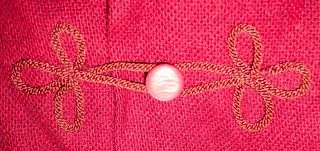
A frog fastening on a cloak (2013)
Pocket-less fashions
The ridicule, when used, should be composed of the same materials as the coat, fixed into a gold lion snap. It is necessary, however, to observe, that this article (though exceedingly convenient, since fashion has excluded the use of the pocket) is considerably on the decline with females of a superior order; but as we hear of no substitute, it can never be completely banished till the fashion of the pocket is revived.

Ridicule for evening wear from La Belle Assemblée (Jan 1812)
The necessity of the ridicule
A ridicule or reticule was a lady’s purse. It was designed to carry around personal items that used to be kept in a pocket underneath a lady’s skirts.
A pocket was a flat bag, tied around the waist, completely separate from the dress, and reached by means of a slit in the side seam of the skirt. Pockets fell out of favour in the early 19th century when fashions became more streamlined and it was no longer possible to hide a bulky bag under your skirts.
Ridicules came into fashion enabling ladies to carry around their belongings without spoiling the line of their dresses. The above description suggests that ridicules were on their way out, but in this instance, convenience seems to have outweighed the fashionable notions of “superior” ladies and ridicules remained in fashion.
A cardinal cloak with high plaited ruff à la Queen Mary
The second figure in the plate appears in a round robe of plain Indian muslin, of a walking length, ornamented at the feet with needlework; a stomacher front, and Spanish cuff of the same: a cardinal cloak of coloured twill sarsnet, or green Merino cloth, with high plaited ruff à la Queen Mary: the cloak trimmed at the bottom with deep lace, or entirely round with fur: a helmet cap of white satin, blended with lace, confined under the chin with two narrow plaitings of net, and ornamented in front with a small cluster of Persian roses in moss: a cameo brooch confines the dress in front of the bosom, or at the throat; and a clasp of the same embraces the bottom of the waist: the gloves are Limerick or French kid.
Limerick gloves
Limerick gloves were named after County Limerick in Ireland where they were first made and were a popular daytime accessory during the Regency period. Although often referred to as 'chicken skin' gloves, they were actually made from the skins of unborn calves. They were usually cream or yellow in colour and were renowned for their superior quality and thinness.
Read about Regency morning gowns in The Mirror of the Graces.
Rachel Knowles writes faith-based Regency romance and historical non-fiction. She has been sharing her research on this blog since 2011. Rachel lives in the beautiful Georgian seaside town of Weymouth, Dorset, on the south coast of England, with her husband, Andrew, who co-writes this blog.
If you have enjoyed this blog and want to encourage us and help us to keep making our research freely available, please buy us a virtual cup of coffee by clicking the button below.
Sources used include:
A lady of distinction, The Mirror of the Graces; or the English lady's costume (1811)