
A genuine Almack's voucher

Ladies' voucher for Almack's - used with kind permission STG Misc. Box 7 (Almack's Voucher) © The Huntington Library, San Marino, CA
Why was an Almack’s voucher so important?
Almack’s Assembly Rooms were the most exclusive venue in Regency London. Almack’s was the place that ladies and gentlemen of quality went to see and be seen in the hopes of finding a suitable marriage partner. But why was it so exclusive? Because you were only admitted if you had a voucher and you could only get a voucher if you were approved by one of the lady patronesses.
What was an Almack’s voucher like?
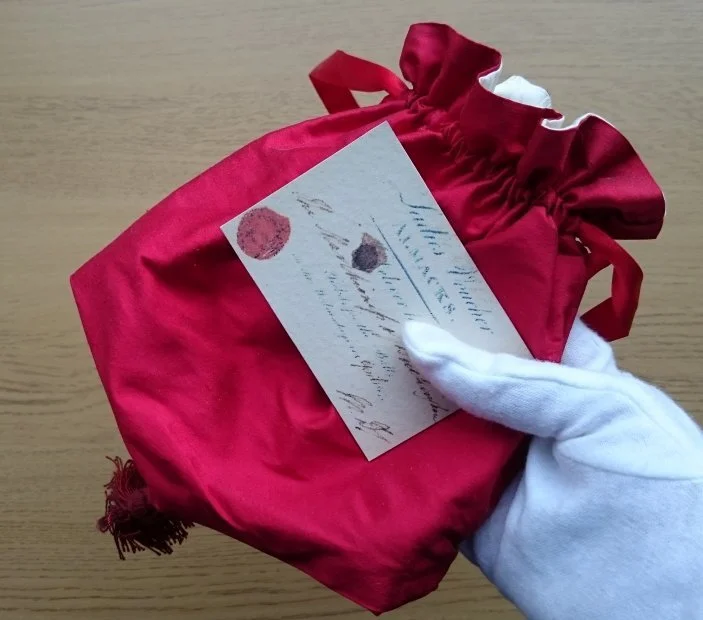
My Regency reticule with a printed copy of the voucher for Almack's - Image of Almack's voucher used with kind permission STG Misc. Box 7 (Almack's Voucher), © The Huntington Library, San Marino, CA
Someone recently asked me whether I knew how big an Almack’s voucher would have been and I had to confess that I did not know. I decided to try and find out.
Fortunately, I knew where to start looking. The only Almack’s voucher that I have ever seen on the internet is part of the Stowe Collection held at the Huntington Library in San Marino, California, USA. It was included in an exhibition in 2011, Revisiting the Regency: England, 1811-1821.
Vanessa Wilkie, Curator of Medieval and British Historical Manuscripts at the Huntington Library, has the voucher in her care and was able to help me.
She told me that the voucher was printed on very strong cardboard and was about the same size as a business card – approximately 2.5 inches by 3.5 inches (or 6.25cm by 8.75cm). To help me get a feel for what this was like, I printed out the image using these dimensions. As you can see from the photograph, it would easily fit inside my Regency reticule.
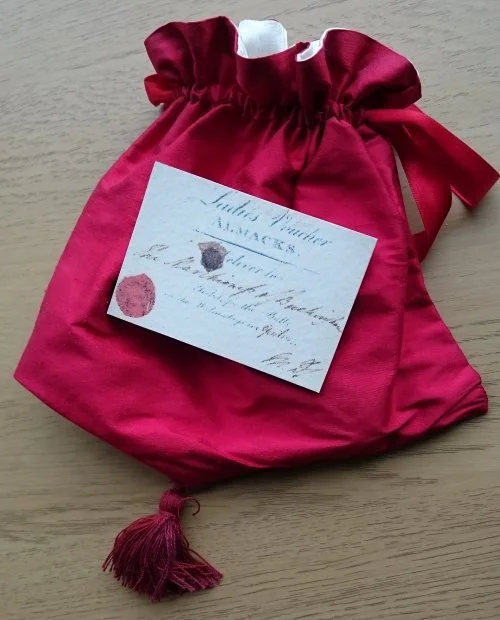
My Regency reticule with a printed copy of the voucher - Image of Almack's voucher used with kind permission STG Misc. Box 7 (Almack's Voucher) © The Huntington Library, San Marino, CA
The Marchioness of Buckingham
The voucher was issued to the Marchioness of Buckingham for the balls on the Wednesdays in April 1817. But who was she?
The Marchioness in question was Anna Elizabeth Temple-Nugent-Brydges-Chandos-Grenville, Duchess of Buckingham and Chandos (1779-1836). Lady Anna Elizabeth Brydges married Richard, Earl Temple, in 1796. He succeeded his father as Marquess of Buckingham in 1813 and was made Duke of Buckingham and Chandos, and Earl Temple of Stowe, in 1822. So in 1817, Anna Elizabeth would have been known as the Marchioness of Buckingham.
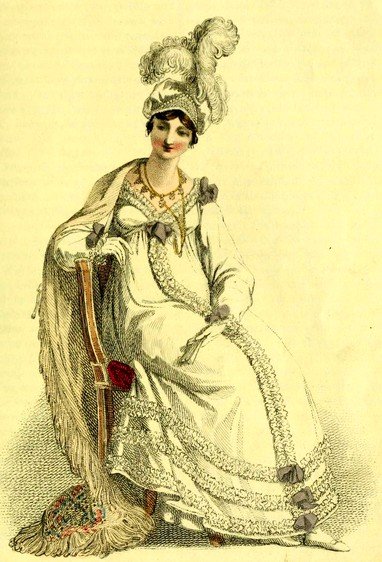
Evening dress from Ackermann's Repository (March 1817)
Anna Elizabeth's husband does not seem to have had a very good reputation. In June 1816, the Times mentioned an affair of honour between the Marquess of Buckingham and Sir Thomas Hardy "in consequence of a dispute at the Opera-house." 1
He has been described as inept, greedy and extravagant, but his wife seems to have been a very capable woman. In 1828, Anna Elizabeth forced her husband to make a resettlement in her favour after he had sold off lands from her marriage settlement in order to pay his debts.
I cannot help wondering whether any of the patronesses of Almack’s would have granted the unsavoury Marquess a voucher or not.
The Marchioness of Downshire
Vanessa told me that her predecessor, Dr Robertson, had noted that the initials in the bottom right-hand corner ‘M.D’ “might be Mary Marchioness of Downshire who may briefly have been a patroness ca. 1816-17.” 2
I have read on several Regency blogs that the Marchioness of Downshire was a patroness of Almack's. This is supported by contemporary correspondence and lists of patronesses in advertisements for the balls at Almack's in the Morning Post. 3
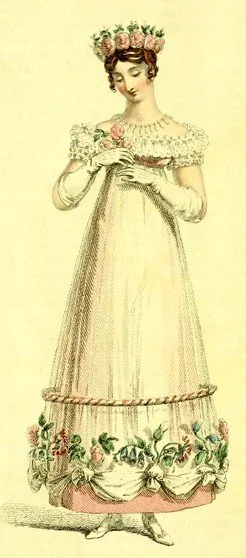
Evening dress from Ackermann's Repository (May 1817)
Mary Hill, Marchioness of Downshire (1764-1836), was a wealthy and politically influential landowner. In 1802, she was made Baroness Sandys of Ombersley in her own right. She managed the family’s estates in Ireland during her son’s minority, but came to England to live in 1812. During a visit to London in 1819, Ticknor wrote “those that interested and pleased me most were the Marchioness of Downshire and her daughters.” 4
What else can we learn from the voucher?
As you can see, there is a red wax seal in the bottom left-hand corner of the card. Vanessa told me that this is intact. Unfortunately the imprint is illegible. 5

Verso of ladies' voucher for Almack's - Used with kind permission STG Misc. Box 7 (Almack's Voucher) © The Huntington Library, San Marino, CA
A new piece of information that I gleaned from Vanessa is that the back of the voucher is inscribed with the words "Pall Mall" (shown above). Is this where the Marchioness of Buckingham was living and the address to which the voucher was to be delivered?
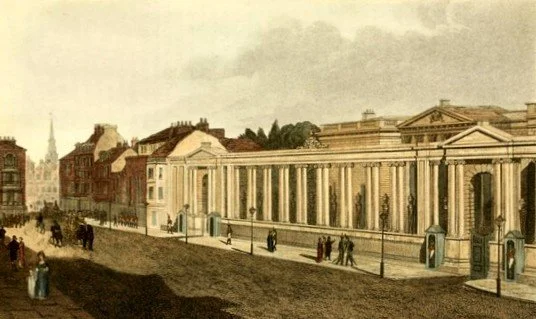
Carlton House, with its main entrance facing Pall Mall from Ackermann's Repository (1809)
The faint words written in brown ink on the top of the card are thought to read ‘Third Set’. 5
Various suggestions have been made as to what these words mean - a third set of vouchers, a third sitting for supper or the third set in a dance? It seems most likely that they refer to the third set of quadrilles being danced at Almack's. What do you think they meant?
Rachel Knowles writes faith-based Regency romance and historical non-fiction. She has been sharing her research on this blog since 2011. Rachel lives in the beautiful Georgian seaside town of Weymouth, Dorset, on the south coast of England, with her husband, Andrew, who co-writes this blog.
If you have enjoyed this blog and want to encourage us and help us to keep making our research freely available, please buy us a virtual cup of coffee by clicking the button below.
Notes
From The Times, London, 18 June 1816, The Times Digital Archive accessed 24 Jan 2015.
From the catalogue notes for the voucher at the Huntington Library.
For example, Jane Austen’s World blog, Candice Hern’s Facebook page and Carolyn Jewel’s comment on the Huntington Library’s Flickr image of the voucher.
From an 1819 entry in Life, Letters and Journals of George Ticknor (1876).
From comments by the Huntington Library on their Flickr image of the voucher.
Sources used include:
Thompson, FML, Grenville, Richard Temple-Nugetn-Brydges-Chandos, 1st Duke of Buckingham and Chandos (1776-1839), Oxford Dictionary of National Biography (Oxford University Press, 2004; online edn May 2009, accessed 24 Jan 2015)
Ticknor, George, Life, Letters, and Journals of George Ticknor (1876)
Richey, Rosemary, Hill, Mary, Marchioness of Downshire and suo jure Baroness Sandys of Ombersley (1764-1836), Oxford Dictionary of National Biography (Oxford University Press, 2004; online edn Jan 2008, accessed 24 Jan 2015)
The image of the Almack's voucher is used with kind permission from the Huntington Library: STG Misc. Box 7 (Almack's Voucher), © The Huntington Library, San Marino, CA.
If you wish to download a low resolution image of the voucher for your personal use, please follow this link to The Huntington Digital Library.