Ballooning Over London in 1814
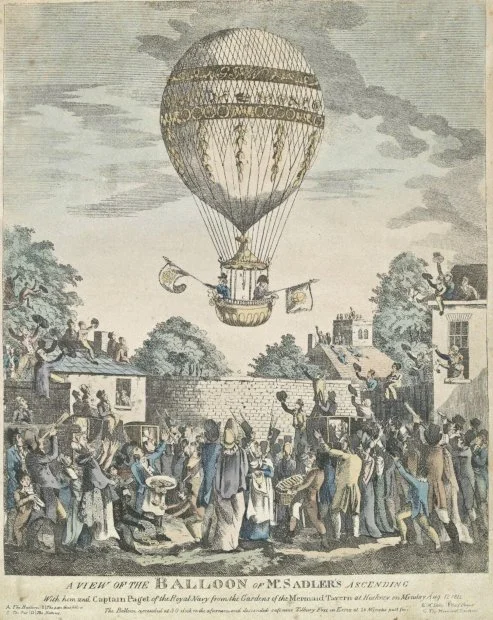
A View of the balloon of Mr Sadler’s Ascending, 1811, from V&A Collection
Regency ballooning expert James Sadler
By the time of the Regency, it was thirty years since the first person had enjoyed a flight in a balloon.
Yet flight was still a novelty for men, almost unheard of for women.
James Sadler was probably Britain’s first expert on balloon ascents. His first successful attempt was in 1784.
In July 1814 London was preparing to celebrate the end of more than twenty years of war with France. There are several accounts of balloon ascents at that time, as part of the nation’s victory party.
On 15 July, James and his son set up their balloon outside Burlington House. He later published the story of their adventure in The Gentleman’s Magazine:
After the Balloon had cleared the East wing of Burlington House, our ascent was slow, and only evidenced by the apparent receding of objects; for it was not we who seemed to rise, but every thing beneath us to retire; in a few minutes we were perpendicular with Leicester-square , and our prospect was at once grand and awful; the whole of London and its magnificent buildings lay below us, with its surrounding fields, canals, and park; the beautiful serpentine form of the River, with its rich shipping, docks, and bridges.
We enjoyed this scenery for about 15 minutes, and, at a quarter before four o'clock, entered a dense cloud, which completely shut us out from all sight of the earth. 1
They were some of the very few people to enjoy the prospect of Regency London spread out beneath them. How marvellous!
Grand Jubilee balloon ascent
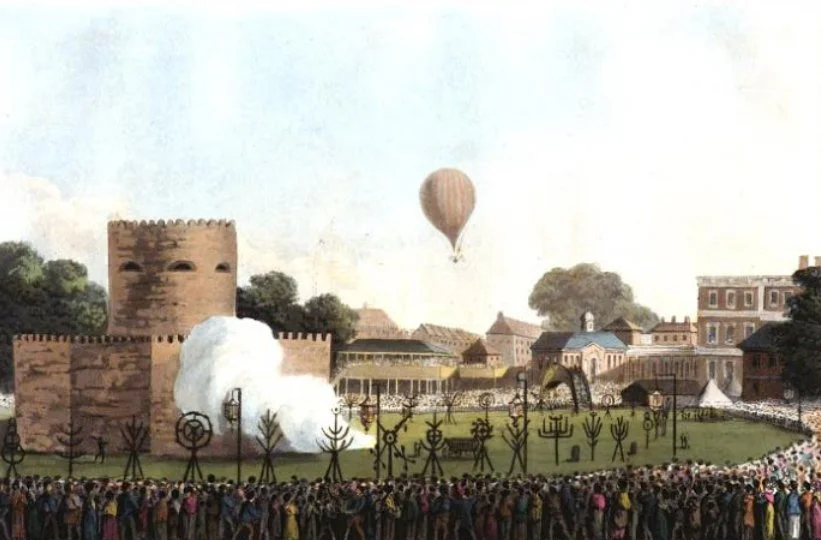
Balloon ascension from the Green Park on 1 August 1814 from An Historical Memento by E Orme (1814)
Another ascent was made on 1 August, the day of the huge peace celebrations in the Royal Parks. The launch, from the Green Park, was delayed to allow Queen Charlotte and her daughters to watch.
This time the pilot was James Sadler’s 17-year-old son, Windham. A Mrs Johnson planned to join, but the Duke of Wellington dissuaded her.
The Gentleman’s Magazine tells us what happened once the balloon launched:
On passing over Deptford, at a considerable height, Mr. Sadler went through a cloud which left behind it on the railing of the car, and on various parts of the balloon, a thick moisture, which soon became frozen; and Mr. Sadler, for a short time, felt the cold as intense as in winter. 2
The young man got into difficulties, as essential parts of the balloon failed.
A sudden shift of wind, whilst the balloon was apparently falling into the middle of the Thames at Sea Reach, carried it about 100 yards over the marshes on the Essex side, when the aeronaut seized the opportunity of making a gash in the balloon with his knife, which the wind considerably widened, and occasioned the escape of the gas in great quantities.
Mr. Sadler's descent on this account was rather more precipitate and violent than he could have wished. He landed however in Mucking Marshes 16 miles below Gravesend, on the Essex coast, without sustaining any other injury than a slight sprain, in about 40 minutes after his departure from the Park. 3
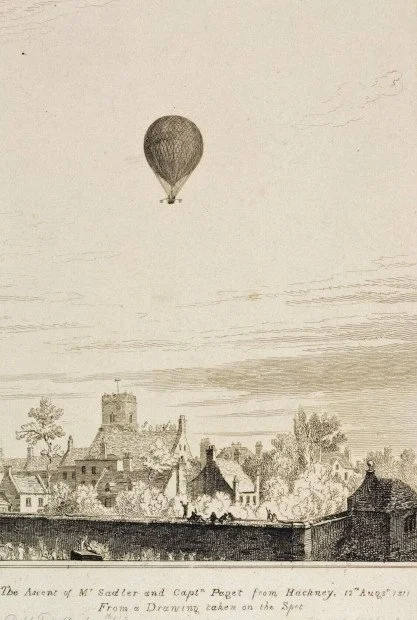
The Ascent of Mr Sadler and Captn Paget from Hackney, 1811 from V&A Collection
A lady balloonist
Did Mrs Johnson, ‘the new aspirant to celestial excursions’ get another chance to ride in a balloon? We don’t know, but a couple of days earlier, a Miss Mary Thompson enjoyed seeing the world from above.
According to a report in the Star newspaper, she’d previously ridden in Sadler’s balloon in Dublin. She was part of his wider family.
On this occasion there was extreme nervousness among the crowd that had gathered. The wind had got up and everyone was worried for the lady.
However, Miss Thompson, ‘dressed in a lilac silk pelisse, with a neat straw hat and feather’, was firm and determined. She’s reported as saying, with a smile, “What man dare I dare!”
Her companion in the balloon was the young Windham. As they rose into the sky, he waved a flag, she her white handkerchief.
The Star goes on to report:
At one o’clock this day no intelligence whatever of the descent of the balloon had reached town, and we regret to add, that fears are entertained for the safety of the aerial voyagers. 4
It tells us that James Sadler, Windham’s father, was worried the high winds may have blown them out to sea. Some had estimated the balloon’s speed to be 50 miles an hour.
However, a footnote to the article then adds:
Since writing the above, we have learnt that a Gentleman has reached Town, who left Dover yesterday , and who saw the Balloon at seven o’clock at night as he passed through Rochester. 5
There’s a further footnote:
We stop the Press to announce that the Balloon and the Aeronauts arrive safely at Half past One o’Clock this Afternoon, at Burlington House, Piccadilly. 6
Of course, we already knew that Windham and Mary Thompson landed safely, because he took that ride over London with his father on 1 August.
Windham survived many aerial adventures. Unfortunately, eleven years after these ascents, his balloon struck a chimney, throwing him from the basket at a height. His injuries were fatal.
We don’t know if Mary Thompson undertook further balloon rides.
Andrew Knowles researches and writes about the late Georgian and Regency period. He’s also a freelance writer and editor for business. He lives with his wife Rachel, co-author of this blog, in the Dorset seaside town of Weymouth.
If you have enjoyed this blog and want to encourage us and help us to keep making our research freely available, please buy us a virtual cup of coffee by clicking the button below.
Notes
The Gentleman’s Magazine, July-Dec 1814.
Ibid.
Ibid.
The Star 30 July 1814.
Ibid.
Ibid.
Sources used include:
The Gentleman’s Magazine, July 1814.
The Star 30 July 1814.
Regency History
by Andrew & Rachel Knowles

We research and write about the late Georgian and Regency period.
Rachel also writes faith-based Regency romance with rich historical detail.