Jane Austen at Carlton House

Jane Austen from A Memoir of Jane Austen by JE Austen Leigh (1871 edition)
How must Jane Austen have felt as she approached the grand entrance to the palace known as Carlton House on a chilly November day in 1815?
Surely it was an awkward moment. The palace was home to the Prince Regent. Two years earlier, Austen wrote of her ‘hate’ for the man, because he’d treated his wife so badly.
Not that the Prince Regent (or PR as she often referred to him in her correspondence), knew what she’d said. Her comment was in a private letter.
The only writing of Austen that the Prince Regent had read were her novels Sense and Sensibility, Pride and Prejudice and Mansfield Park.
But he was a big fan. The Prince Regent’s librarian, James Stanier Clarke, told Austen that ‘the Regent has read & admired all your publications’. Mansfield Park was a particular favourite.
Jane’s ‘hate’ for the Prince Regent

George IV when Prince Regent by Sir Thomas Lawrence (c1814)
Jane’s dislike of the Prince Regent was shared by many others in Britain at the time. He had a reputation for womanising, extravagance and indolence.
He’d abandoned his wife within weeks of their marriage. That they had a child, Princess Charlotte, was incredible. She was born almost exactly nine months after the wedding.
So when Jane was invited to Carlton House, did she consider declining? She perhaps knew there was no likelihood of meeting the Prince Regent himself - her audience was with his librarian, James Stanier Clarke.
The ‘most perfect palace in Europe’
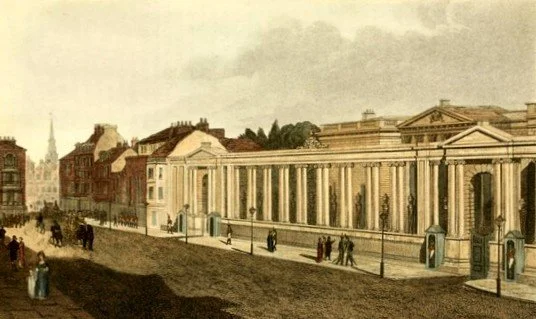
Carlton House from Pall Mall from Ackermann's Repository (1809)
Disappointingly for us, Jane’s impressions of her visit to Carlton House are lost to us. It’s hard to imagine she didn’t describe it in one of her letters, but nothing survives today.
However, we do have a letter from Horace Walpole, from nearly 30 years earlier. He wrote, in 1785:
We went to see the Prince’s new palace in Pall Mall; and were charmed. It will be the most perfect in Europe. There is an august simplicity that astonished me. You cannot call it magnificent; it is the taste and propriety that strike. Every ornament is at a proper distance, and not one too large, but all delicate and new, with more freedom and variety than Greek ornaments.
Sadly, we can’t visit Carlton House today. The Prince Regent became George IV in 1820 and decided to invest in extending what’s now Buckingham Palace. To help raise money he had Carlton House demolished.

The Hall, Carlton House, from The Microcosm of London vol 1 by R Ackermann (1808-10)
Emma and the Prince Regent
We have one tangible remembrance of Jane’s visit to the Prince Regent’s house. His librarian made it clear she was free to dedicate her next book to the man she detested.
This was less an invitation, more a royal command. Two days after her visit Jane wrote to Clarke, effectively to confirm that she’d heard correctly: ‘I am very anxious to be quite certain of what was intended’.
A few weeks after her visit, Jane sent an advance copy of her novel Emma to Carlton House. It included the dedication:
To His Royal Highness, The Prince Regent.
This work is, by his Royal Highness’s permission, most respectfully dedicated
by His Royal Highness’s dutiful and obedient humble servant,
The Author
Given Jane’s reputation for sharp wit, and her dislike for the Prince Regent, you could read irritation and sarcasm in these words. We’ll never know what Jane truly felt as she wrote them.
Would Jane have felt obliged to put similar words into her future books? We’ll never know. She died less than two years after visiting the Prince Regent’s palace. Her last two books were published posthumously.
Andrew Knowles researches and writes about the late Georgian and Regency period. He’s also a freelance writer and editor for business. He lives with his wife Rachel, co-author of this blog, in the Dorset seaside town of Weymouth.
If you have enjoyed this blog and want to encourage us and help us to keep making our research freely available, please buy us a virtual cup of coffee by clicking the button below.
Regency History
by Andrew & Rachel Knowles

We research and write about the late Georgian and Regency period.
Rachel also writes faith-based Regency romance with rich historical detail.