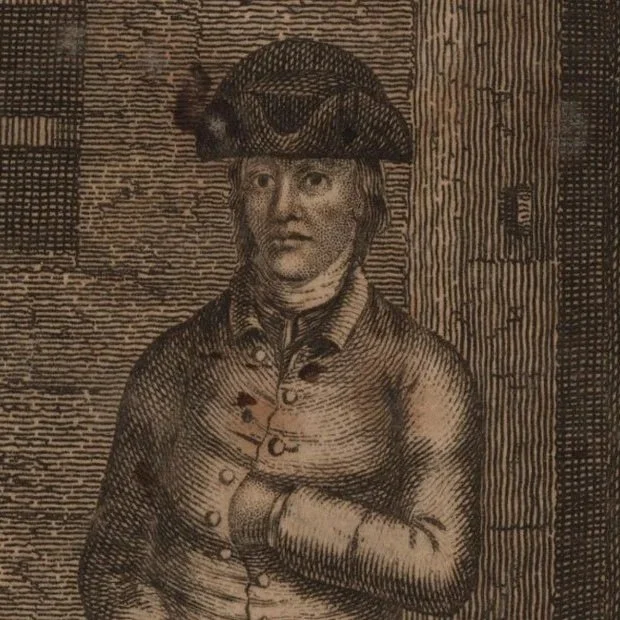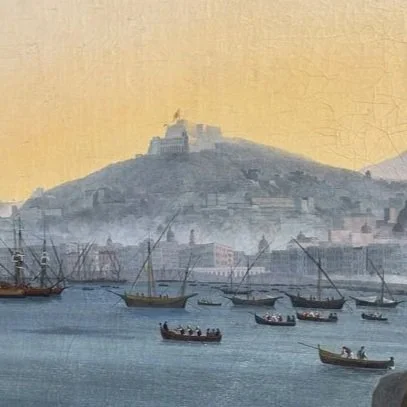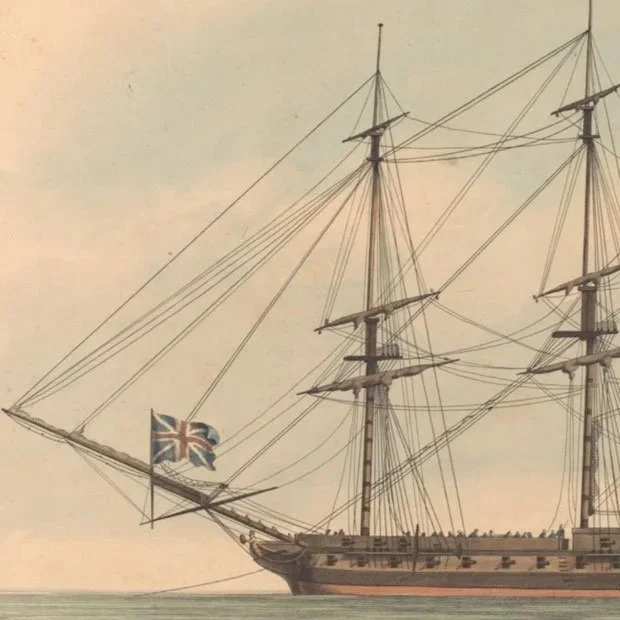
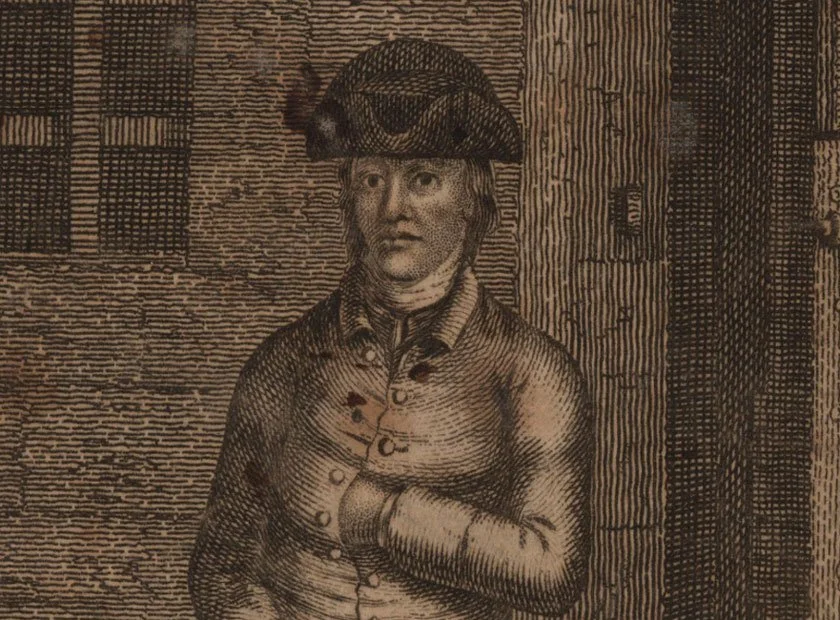
James Aitken pictured in prison, awaiting his fate
In early December 1776 a fire broke out in a rope house in the Royal Navy dockyard, Portsmouth.
Buildings on fire weren’t unusual in Georgian Britain. The naked flame was a common sight, on candles and in fireplaces across the country, often in close proximity to flammable materials.
The Portsmouth fire, however, was no accident. It was an act of sabotage in support of the American War of Independence, and the perpetrator was a Scotsman named James Aitken.
James Aitken aka John the Painter
Aitken left us a detailed confession of his crimes, which went far beyond arson.
The only son of a whitesmith in Edinburgh, James (who seems to have mostly gone by the name of John) was apprenticed to an ‘eminent painter’ at age 15. A whitesmith worked in light-coloured metals such as tin or pewter.
A keen reader, he was influenced by works that provoked resentment towards current forms of government. He also enjoyed reading about classical heroes and ‘I felt from thence the desire of accomplishing some great achievement.’
Aitken claimed to have completed his apprenticeship.
At the expiration of my apprenticeship, having my indentures given me, I set off, with a mind thus prepared, to seek my fortune.
Unfortunately, his father had died and Aitken claimed the circumstances prevented him taking over the whitesmithing business. He then tried to persuade his mother to raise money, through friends and relatives, to buy him a commission in the army. When that didn’t succeed, he went to London in the hope of finding ‘some creditable employ.’
Here, at last, Aitken secured his desired outcome. He got a job ‘in the painting way.’
From painting to pistols
Outside of the workplace, Aitken fell in with a crowd of ‘extravagant young men, by whom I was led into all manner of vice and debauchery.’
Added to this, he found that paid employment was not ‘agreeing with my inclination.’ His expensive lifestyle, combined with the absence of enthusiasm for paid work, drained his finances. He was soon without money and, as a result, deserted by his new friends.
Aitken’s confession states that he then took to the road. Not to go home to Edinburgh, but, having acquired some pistols, to hold up a carriage on Finchley Common.
Perceiving a post chaise, I made up to it, and with a discharge of one of my pistols, demanded them to stop. My success in the first attack tempted me to proceed, so that before midnight came on, I had robbed several carriage and single horsemen, and upon the whole collected a considerable booty.
There followed a life of crime that included shop lifting, theft and more highway robberies. But he was increasingly worried about being caught and so boarded a ship to America. Here he got work ‘in the painting business’ in New York.
Becoming an American patriot
Aitken now lived among colonists, some of whom were increasingly frustrated by rules issued from a distant government in Britain. Boston, in particular, was the scene of multiple confrontations between angry colonists and representatives of the British government.
Despite having escaped his crimes in England, and now enjoying a good income, Aitken’s imagination was stirred.
Upon hearing of the riots at Boston, the restlessness of my disposition would not suffer me to remain any longer at New York; and meeting with a companion whose curiosity was equally excited as my own, we agreed to set out together for that place; and I cannot deny being very active in those riots, particularly in sinking the tea, and insulting the friends of government.
Hearing about the threat of British military action in Boston, Aitken decided to return to England. He landed at Liverpool in May 1775 and embarked on a life of petty crime.
At least twice he signed up to army recruiting parties, received payment in advance, and immediately deserted. He broke into shops and robbed people on the highway. Aitken’s crimes stretched across the country, from Liverpool to London, including Birmingham, Cambridge and Colchester.
After a year of living like this, Aitken fell into conversation about America, and how the king’s power was so dependent on the Royal Navy. He couldn’t shake off the significance of what had been said.
In the night I had a thousand ideas, and all tended to shew how important would be the event in favour of America, provided these dockyards and shipping could be destroyed. The more I considered it, the more plausible was the undertaking, and the more eager I found myself to become the instrument of it.
It became, in his mind, ‘a truly heroic enterprise, such as never would have been equalled to the end of time.’
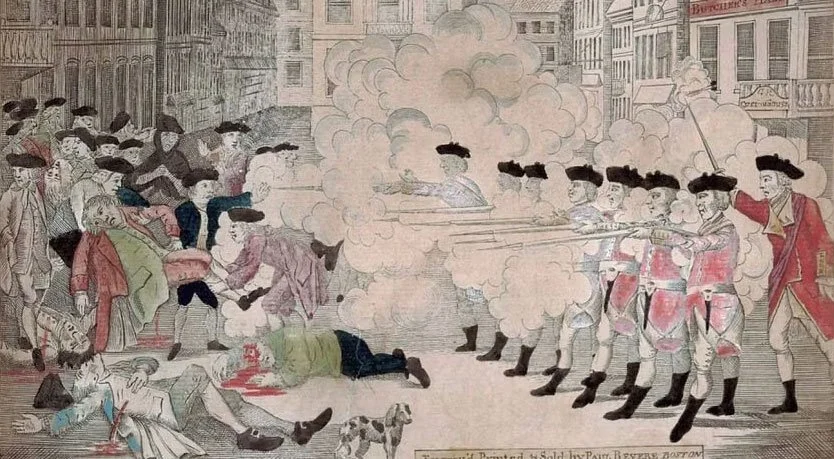
News of confrontations between colonists and British authorities, such as the Boston Massacre, prompted Aitken to get involved (Paul Revere 1770)
In search of American support
Excited by the prospect of glory, Aitken set out for the major naval dockyards at Portsmouth. Aware that gathering information about them would take time, he took on a job with a Mr Golding, a painter at nearby Titchfield.
Over the next few weeks Aitken learned all he could about the layout and security of the dockyard. He also went to Plymouth, Chatham, Woolwich and Deptford, other naval bases in southern England.
Armed with all this detailed intelligence, Aitken tried to get to America, to put his plans before Congress and get their approval for his arson scheme. Unable to secure passage across the Atlantic, he recalled that American representatives, Silas Deane and Benjamin Franklin, were in Paris. So he crossed the English Channel to find them.
Silas Deane had been appointed by Congress to persuade France into providing weapons and money to support the American bid for independence.
Having secured an interview with Deane, Aitken laid out his plans. To make himself ‘of as much consequence as possible, and to appear a little above the common class,’ he claimed to be a plantation owner worried about the British army damaging his property.
He told Deane:
That I was an utter enemy of Great Britain, as I understood he was, and had the interest of America so much at heart, that I would readily undertake any expedition, though ever so dangerous, in its behalf.
Deane’s response, as recorded in Aitken’s confession, was not positive. He saw it as ‘an enterprise bordering upon madness’ and worried that American support, if discovered, would damage the cause of independence.
To allay fears about being captured, Aitken claimed to have invented an incendiary time bomb: ‘a portable machine, of such dimensions as to carry in my pocket.’
Seemingly swayed towards supporting Aitken’s plan, Deane arranged for him to return to England, where a ‘friend in London’ would arrange for payments to support the scheme.
Deane then gave Aitken three pounds in cash and sent him on his way. In a letter written after his visitor’s execution, Deane implies he supported the idea of the attacks, but had no faith in Aitken being able to carry them out.
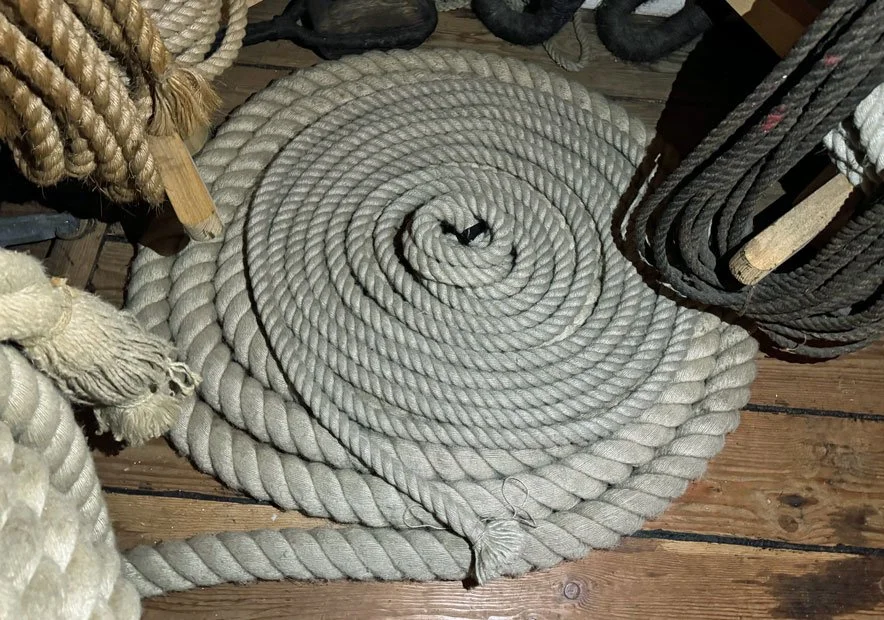
Rope was an essential component on Royal Navy ships. HMS Victory required at least 26 miles of it for rigging, masts and gun cables.
Committing the crime
Back in England, Aitken built at least one of his incendiaries, and set off for Portsmouth. He arrived on 5 December 1776.
He was able to get into the dockyard, and chose to set his device in the hemp house. His ‘machine’, as he called it, needed to be lit manually and he planned to come back to do it later. Before that, he planned to light another fire inside the rope house.
Despite his efforts, the rope house fire did not ignite. Becoming increasingly nervous, he decided to leave, only to find the doors locked, trapping him inside. Attracting the attention of a boy outside, he was eventually let out and, to his surprise, not taken into custody.
The next day he tried to burn down the house where he’d lodged for the night. His host, Mrs Boxell, smelled the smoke and:
In a violent passion burst open the door, asked me whether I was setting the room on fire, and insisted on my leaving her house, saying she was sure I could have no good design.
Getting back into the dockyard, Aitken now lit the candle in his ‘machine’ in the hemp house, and the fuse of the make-shift incendiary he’d set up in the rope house. On leaving the dockyard he was recognised by someone who knew him from Titchfield and, in a panic, he left Portsmouth.
On the road, a few miles from town, he saw a blaze in the dock and felt sure at least one of his fires had taken hold. But he was fearful that both Mrs Boxell and the Titchfield acquaintance could help identify him as the arsonist.
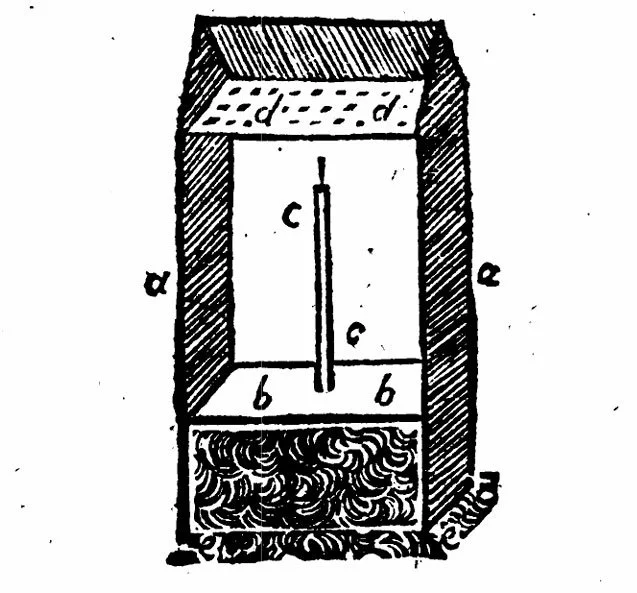
James Aitken’s ‘machine’ - a candle in a box, with combustible material beneath, and open at the base to allow fire to spread.
Disappointed but not deterred
Aitken fled to London where he sought Dr Bencroft, the ‘friend’ Silas Deane had assured would provide financial assistance.
Bencraft acknowledged that he knew Deane, but he ‘appeared somewhat surprised’ when Aitken told him about the fire at Portsmouth. He said Deane had not shared any information about the scheme, nor did he want to have anything to do with it. Bencraft said he would be executed if he got involved, and he advised Aitken not to pursue it.
This was a huge disappointment to the man who felt he was acting on behalf of the Americans, and hoped to get paid for it. However, it did not deter him from continuing his arson campaign. He was emboldened by this report in the newspapers:
Saturday night, about a quarter before five o’clock, the inhabitants of this place, Gosport and the Common, were greatly alarmed by a fire breaking out in his Majesty’s dock-yard here, in three different places in the rope-house, which is occasionally used for the rigging-house. The fire was so fierce that in a few minutes the said house, which was four hundred yards in length, and twenty-one broad, was on fire from one end to the other, and the whole building is entirely consumed; the dock-men were all in the yard, when this shocking accident happened; and had it not been for the immediate assistance given by the workmen, and the marines and invalids of this garrison, the different store-houses, particularly one almost adjacent to it, which is full of hemp, must have shared the same fate. How this accident happened is not yet come to light; but by its breaking out in three different places almost in an instant, gives great room for suspicion.
The newspaper went on to say that prompt action not only saved nearby buildings, but also the entire town of Portsmouth.
The next stop on the trail of destruction was Plymouth. Aitken found security at the dockyard to be much tighter and eventually gave up. He then tried Bristol, where he succeeded in setting a ship on fire, but was disappointed that fires on other vessels did not take hold.
Frustrated, he attempted to ignite several buildings in the town. He only succeeded in burning one, a warehouse belonging to Mr Browne, a bookseller.
Dramatic though these fires were, they failed to reach the scale of destruction Aitken had hoped to deliver for the Americans.
Aitken’s final journey
In late January 1777, advertisements began to appear in newspapers, offering a reward of fifty pounds for information about a man referred to as John, a painter. He was wanted in connection with the fires at Portsmouth and Bristol.
He is about twenty-five or twenty-six years of age, about five feet seven inches high, rather thin in person and thin visaged, smooth faced, of a fair complexion, with whitish eye-lids, wore his own hair, which is of a light sandy colour, neither tied nor curled, he had on a chocolate colour surtout coat faded, a rusty hat, rather smartly cocked, with a fantail behind.
Aitken, or John the Painter as he was becoming known to the public, left Bristol with the intent of getting to Paris. He wanted Silas Deane to know of his early successes as an arsonist, and to alert him to Dr Bencraft’s refusal to help with funds.
Because he had no money, Aitken continued to raise cash by stealing items and selling them on. In Calne, Wiltshire, he walked past a haberdasher’s shop several times, sizing up what he might steal. That night he broke in and took several muslins, and other items.
Going on from there he passed through Andover and then reached Odiham in Hampshire. Here he was apprehended by Mr Dalby, keeper of the house of correction in Andover. He had been told a man answering John the Painter’s description had passed through the town, and set off in pursuit. Shortly after, Mr Lowe, the haberdasher from Calne, arrived. His wife, having seen Aitken passing the shop, had identified him as the probable thief.
From Odiham he was taken to Clerkenwell Prison, to be questioned about the Portsmouth fire. Nothing could be proved until American John Baldwin was introduced, in the hope he could identify Aitken as someone he’d met in America. Baldwin, like the prisoner, had a background as a painter.
He did not recognise Aitken, but the two fell into conversation and the prisoner asked if Baldwin could visit him in prison. He agreed, but unknown to Aitken, he was reporting on their conversations. Within a few days, a confession was extracted.
Aitken was moved to Winchester, where he was tried on 7 March 1777. From here he wrote a short account justifying his setting of fires, which he asked his friend, Mr A Tomkins, to publish after his death. He claimed that had he burned warehouses in France, the British would have called him a hero. However, he said he was proud to die a hero in the eyes of Americans.
While in prison he also told his life story, which was written down in detail and later published ‘at the request of the convict’. It opens with an address by Aitken, which reads:
To the people of Great-Britain this confession is most humbly offered, in detestation of my enormous crimes, particularly against His Majesty’s government, and in hopes of receiving present and future forgiveness - John Aitken Winchester-Gaol, 10th of March 1777.
On that same day, 10 March 1777, 24-year-old James Aitken, aka John the Painter, was taken to Portsmouth and hanged for his crimes.
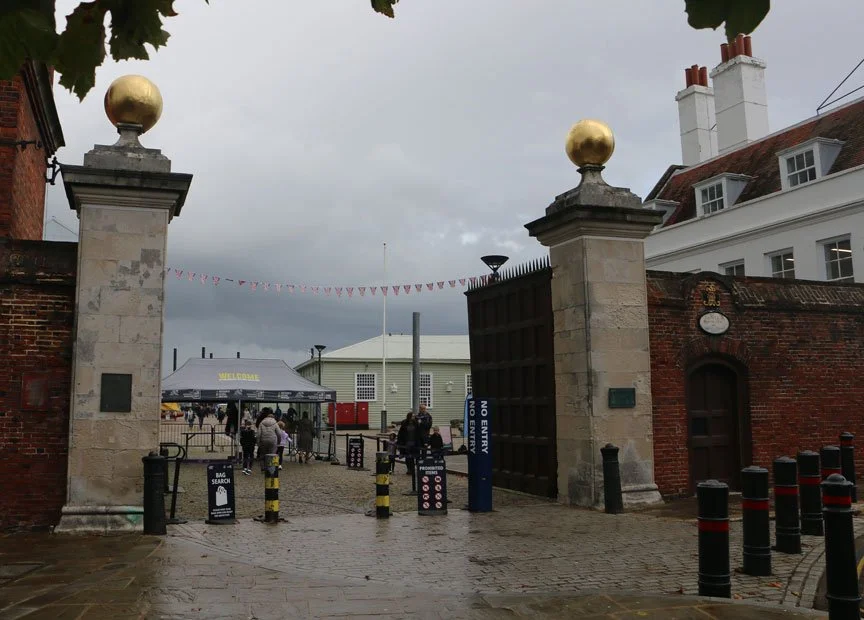
The entrance to the dockyard at Portsmouth. The white plaque to the right announces that the wall was built in 1711.
Andrew Knowles researches and writes about the late Georgian and Regency period. He’s also a freelance writer and editor for business. He lives with his wife Rachel, co-author of this blog, in the Dorset seaside town of Weymouth.
If you have enjoyed this blog and want to encourage us and help us to keep making our research freely available, please buy us a virtual cup of coffee by clicking the button below.
Sources used include:
The Life of James Aitken (1777)
The Hampshire Chronicle
The Pennsylvania Magazine of History and Biography, Volume LXIII (January 1939)
Regency History
by Andrew & Rachel Knowles
We research and write about the late Georgian and Regency period.
Rachel also writes faith-based Regency romance with rich historical detail.