Nelson, Naples and Emma Hamilton
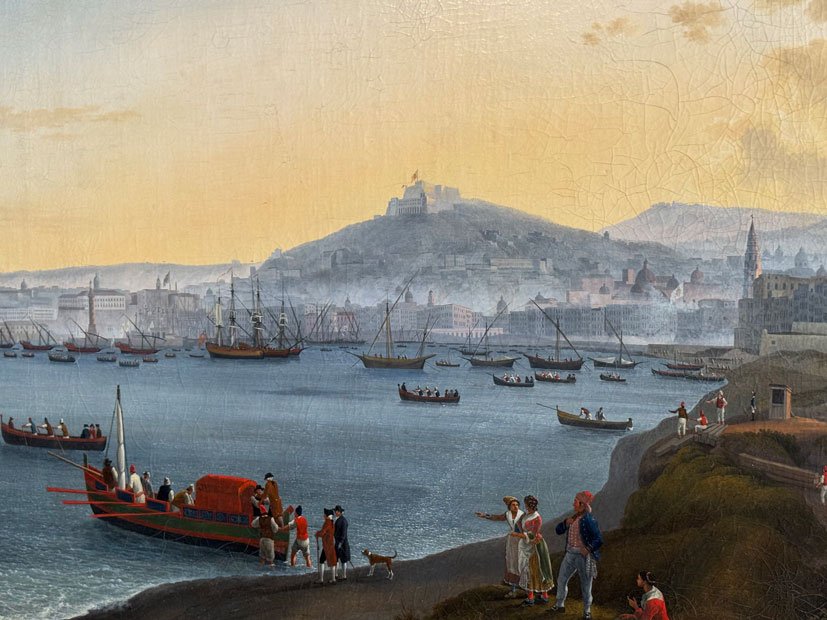
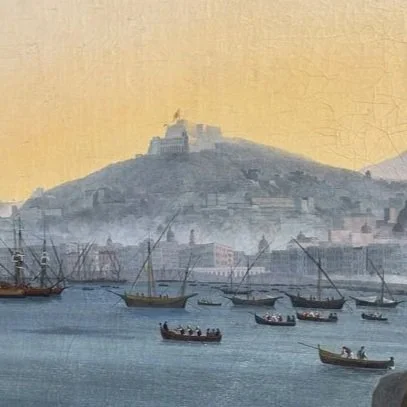
The city of Naples in about 1790 by Jacob Philipp Hackert
In late September 1798, Admiral Nelson sailed into the Bay of Naples, much to the delight of Emma Hamilton.
His momentous victory over the French at the Battle of the Nile, a few weeks earlier, had excited almost everyone in the city.
Her gushing enthusiasm is captured in the letter she sent hom two weeks earlier:
God, what a victory! Never, never has there been anything half so glorious, so compleat. I fainted when I heard the joyfull news, and fell on my side and am hurt, but well of that. I shou’d feil it a glory to die in such a cause. No, I wou’d not like to die till I see and embrace the Victor of the Nile.
She continues, at length, in a similar tone. The letter ends:
My dress from head to foot is alla Nelson. Ask Hoste [one of the young officers sent ahead to Naples, with news of the battle]. Even my shawl is in Blue with gold anchors all over. My earrings are Nelson’s anchors; in short, we are be-Nelsoned all over.
All this excitement was for an officer she barely knew. They had met, briefly, a few years earlier in 1793. At that time he’d lost neither his right eye nor his right hand. However, she would have heard of his reputation as a ladies’ man.
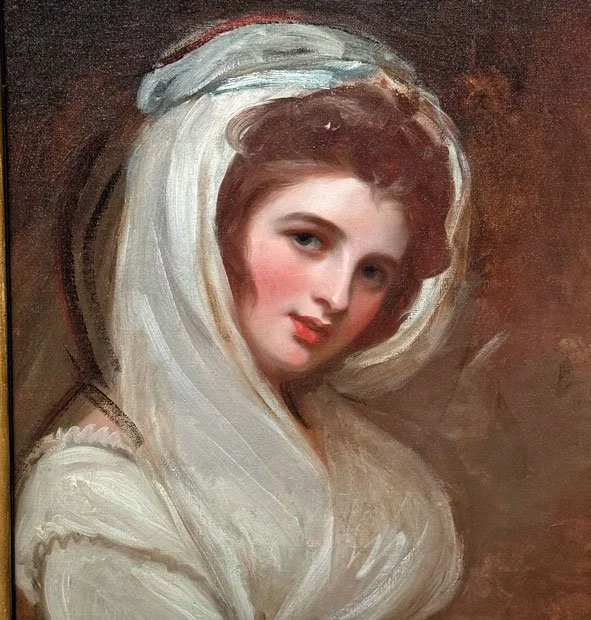
Emma Hart in 1785, about a year before going to Naples. By George Romney who painted her many times.
The hero arrives at Naples
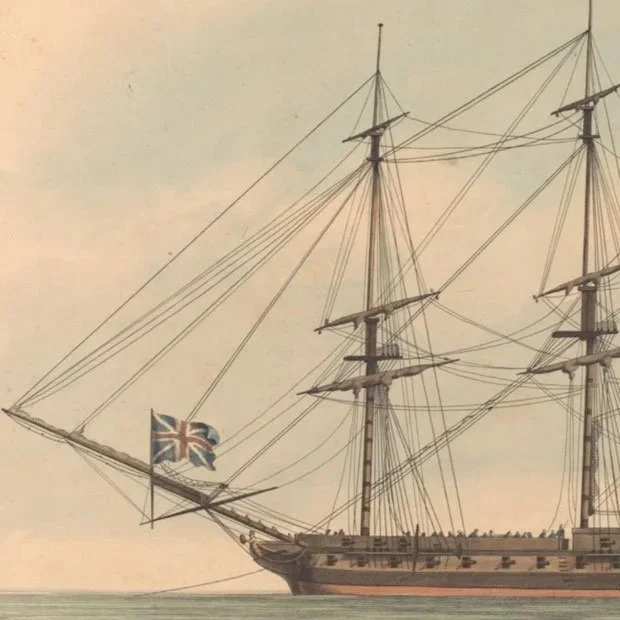
Nelson’s ship, Vanguard, arrived at Naples on 22 September 1798. He was met by King Ferdinand IV of Naples and his Queen, Maria Carolina. They were accompanied by Sir William Hamilton and his wife, Lady Hamilton— all in small boats that sailed out to meet the incoming hero.
The Hamiltons’ boat arrived before the king’s. In a not very tactful letter to his wife, Nelson described the meeting:
Up flew her ladyship and exclaiming: “Oh God is it possible” fell into my arms more dead than alive. Tears however soon set matters to rights, when alongside came the King. The scene was in its way affecting.
Nelson planned to find his own accommodation in the town. However, the Hamiltons insisted he stay with them, in the ambassador’s official residence at Palazzo Sessa.
He had received a head wound at the Battle of the Nile, and was seriously ill with a fever soon after. Lady Hamilton, that is, Emma, became his nurse. He was about to turn 40, she was 33, and losing the looks that had attracted the eye of artists such as George Romney.
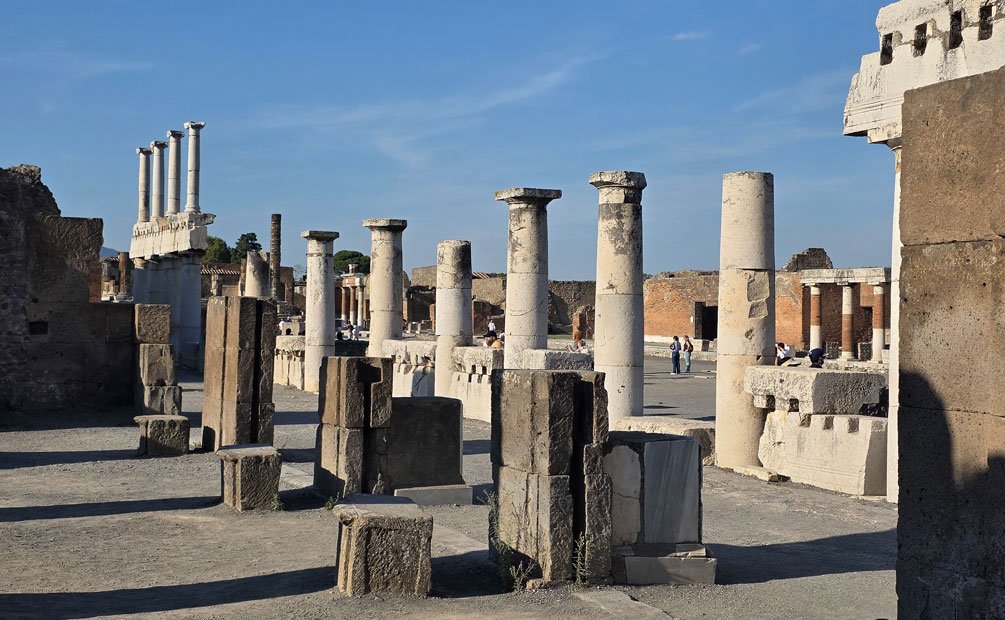
The Forum in Pompeii - excavation of the Roman city made it an exciting attraction for visitors in the late 1700s
A Neapolitan holiday
During the next few weeks Nelson and Emma’s relationship became more intense. He was being entertained by the Hamiltons, and given opportunities to spend time with Neapolitan royalty, at both the royal palace in Naples and that at Caserta, twenty miles north. He also spent time in the various houses of the Hamiltons: besides the official residence they had Villa Emma on the beach, and a house on the slopes of Vesuvius.
Everywhere he went, Nelson was celebrated for his defeat of the French. Cornelia Knight, an English visitor, observed: ‘It was impossible for him to appear in the streets without being surrounded, and followed, by crowds of people, shouting out “Viva Nelson!”’
Despite this attention, Nelson found time to visit the excavations of both Pompeii and Herculaneum, and to go sailing in the bay— all in the company of Emma. He also enjoyed the ‘Attitudes’ for which she was famous. In these she adopted poses drawn from classical art, using lighting, draped material and her increasingly ample curves to dramatic effect. They were living pictures, often performed to guests of Sir William.
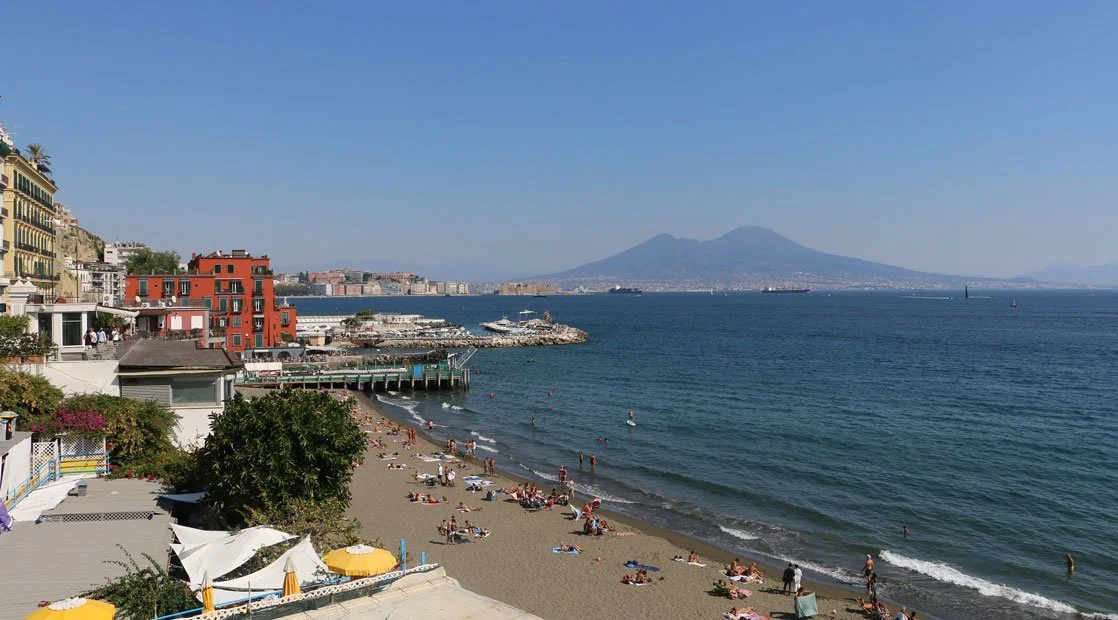
The view over Naples Bay towards Vesuvius, from near Villa Emma, the beach house of Sir William Hamilton, used by Emma and Nelson
Dabbling in the politics of Naples
Naples was the capital of a kingdom that included most of southern Italy. Rome, to the north, was governed by the Pope as part of the Papal States. The French seized Rome in 1798. This meant Naples was now under threat of invasion.
Neapolitans were, for the most part, anti-French. None more so than their Queen, Maria Carolina, sister of the recently executed Marie Antoinette. Maria was considered to be the strongest figure in the government of Naples, and she listened when Sir William Hamilton encouraged Naples to drop its neutral status.
As he spent time with the Hamiltons and the Neapolitan royals, Nelson added his voice to Sir William’s. Emma also chimed in: she had learned the local language and become a close friend of the Queen.
This was an excellent time to attack the French in Rome, particularly as Napoleon was trapped in Egypt.
On 13 October Nelson wrote to his commander, John Jervis, 1st Earl of St Vincent:
General Mack arrived at Caserta on Tuesday: on Thursday I went with Sir William and Lady Hamilton to meet this General at dinner with the King and Queen. Their Majesties introduced us to each other with every expression of esteem and regard: the Queen, however, could not help saying, General, be to us by land, what my hero, Nelson, has been by sea.
In the same letter he said of Emma:
Lady Hamilton is an angel, she has honoured me by being my ambassadress to the Queen; therefore she has my implicit confidence, and is worthy of it.
A few days later Nelson sailed from Naples to join the forces blockading the French on Malta, but he wasn’t away for long.
The Roman misadventure and flight from Naples
In late November the Neapolitan army under General Mack marched into Roman territory, accompanied by King Ferdinand. Nelson supported this by convoying troops from Naples to the port of Livorno (known by the British as Leghorn). In the face of this invasion, the French hurriedly retreated.
Queen Maria Carolina remained in Naples, with the powers of a regent. She was clearly nervous and when Nelson returned to the city, she made him promise not to abandon her or her family until their situation improved.
Her concern was justified. In mid-December it was the turn of the Neapolitan troops to flee from Rome, in the face of the returning French. In Naples, Nelson, Sir William Hamilton and Emma made urgent preparations for the royal family to flee to their other kingdom, the island of Sicily.
To avoid panic in the city, and the wrath of the Neapolitan mob, the escape had to be in secret. According to Nelson, Emma’s role was crucial. She was the essential channel of communication between the ships in the harbour and the royal palace. He wrote:
The whole correspondence relative to this important business, was carried on with the greatest address by Lady Hamilton and the Queen; who having been in constant habits of correspondence, no one could suspect them. It would have been highly imprudent either in Sir William Hamilton, or myself, to have gone to Court, as we know that our movements were watched.
Emma’s role went beyond carrying messages. In a letter to her former lover, Greville, she recalled:
I have been for twelve nights without once closing my eyes, for 6 nights before the embarkation I sat up at my own house receving all the jewells, money & effects of the Royall familly & from thence conveying them on board the Vanguard, living in fear of being torn to pieces by the tumultous mob who suspected our departure, but Sir Wm. & I being beloved in the Country saved ous.
Emma’s role is corroborated by Nelson in his official report.
Lady Hamilton, from that time to the 21st, every night received the jewels of the Royal Family, &c.&c. and such clothes as might be necessary for the very large party about to embark, to the amount I am confident of full two millions five hundred thousand pounds sterling.
Also according to Nelson’s report, on 20 December 1798 the unruly mob ‘insisted that the Royal Family should not leave Naples’. In an attempt to pacify their subjects, the king and Queen addressed them directly. But the next night Nelson led them to the harbour and put them aboard ships.
A fleet of about 20 vessels sailed out of Naples harbour, heading for the safety of Sicily. They also sailed into the worst storm Nelson had ever encountered.
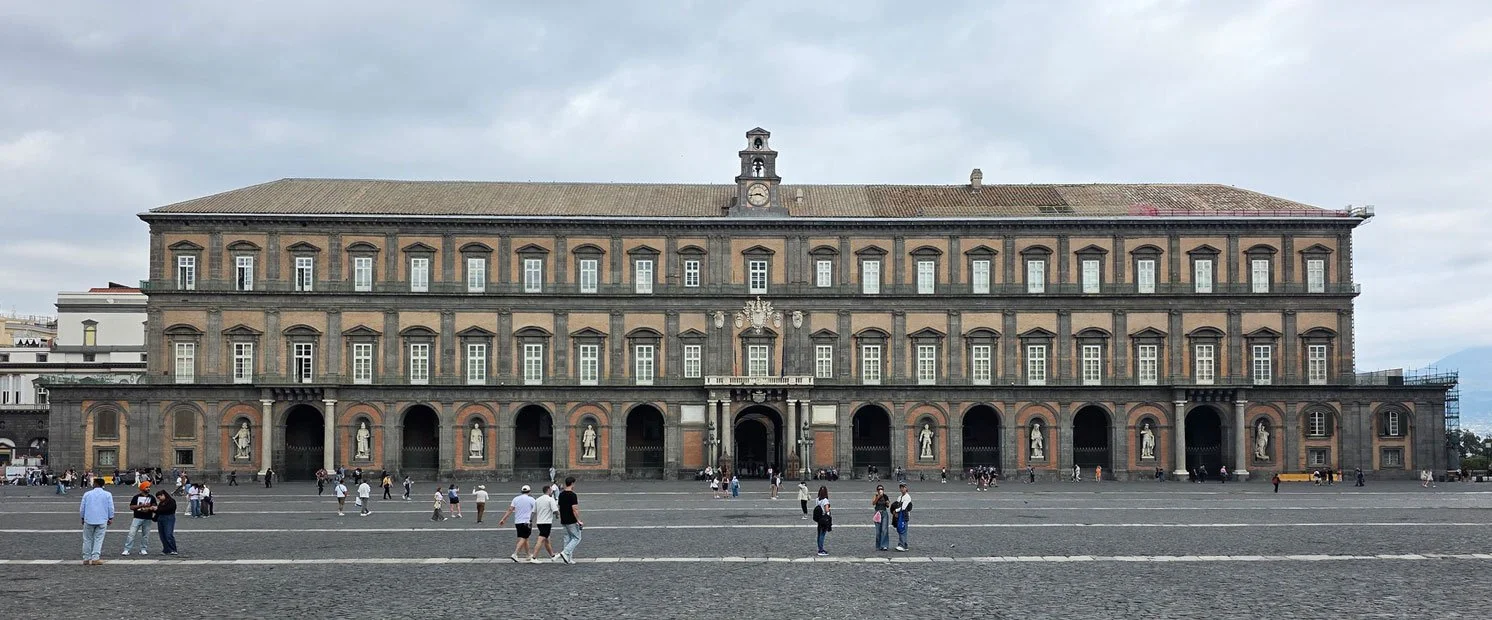
The Palazzo Reale in Naples, home of the royal family. Nelson helped them to flee from here in December 1799.
‘It blew much harder than I ever experienced’
The evacuation fleet carried people of various nationalities, and many women and children. Cornelia Knight, travelling with her mother, described the conditions on board a Portuguese ship. Upon arrival she was:
Ushered into the chief cabin, where we found many ladies of different countries. One only— a Russian lady of high rank and great wealth—had a bed to sleep in, the other being obliged to content themselves with mattresses laid on the floor.
The royal family, and the Hamiltons, were conveyed on Nelson’s ship.
They necessarily came on board without a bed, nor could the least preparations be made for their reception. Lady Hamilton provided her own bed and linen, &c. and became their slave; for, except one man, no person belonging to the court assisted the Royal Family.
During the storm the passengers and crew genuinely feared for their lives. Emma wrote of ‘all our sails torn to pieces’ and sailors ‘ready with their axes to cut away the masts’.
The fearful journey descended into tragedy for the King and Queen of Naples. As Nelson reported, Emma was almost alone in supporting them and their family, which included:
3 young princesses, a baby six weeks old & 2 young princes Leopold & Albert, the last, 6 years old, my favourite, taken with convulsions in the midst of the storm & at 7 in the evening of christmas day expired in my arms, not a soul to help me, as the few women her Majesty brought on board were incapable of helping her or the poor Royal children.
The fleet weathered the storm to straggle, bruised and battered, into the harbour at Palermo, Sicily, on 25 and 26 December.
A pause in Palermo
Despite being among those who abandoned Naples to the incoming French, Nelson and Emma’s connection with the city was not over. Emma continued her close relationship with the Neapolitan royals, and Nelson had his duties as an Admiral in the Royal Navy.
By now, the early months of 1799, it’s clear Emma had an intimate relationship with Nelson. In February, while at sea, he wrote her a letter describing a dream where two women tried to seduce him, but Emma burst in and:
Taking me to your embrace, whispered, ‘I love nothing but you, my Nelson’. I kissed you fervently and we enjoyed the height of love.
His passionate words are in sharp contrast to those he wrote to his wife two months later. He had heard that she was thinking of travelling from their home in Norfolk to be with him in the Mediterranean.
You would by February [because of the news of Naples being evacuated] have seen how unpleasant it would have been had you followed any advice, which carried you from England to a wandering sailor… Nothing but the situation of affairs in this country has kept me from England… Sir William, Lady Hamilton, and myself, are the mainsprings of the machine, which manage what is going on in this country. We are all bound to England when we can quit our posts with propriety…
While Nelson was dealing with the two women in his life, affairs in Naples were moving quickly. The French had established a republic, but it was soon under attack from forces loyal to King Ferdinand. By May 1799 most French troops had left the city, leaving a garrison in at least one of the citadels. The way was opening for the King and Queen to return.
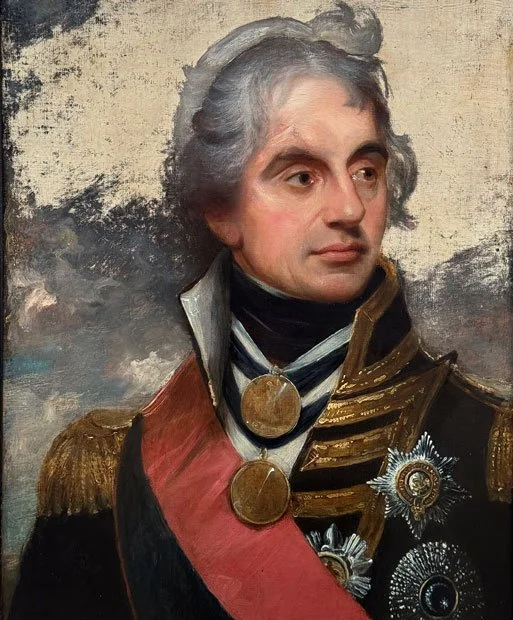
Nelson by Sir William Beechey (1800)
Nelson’s darkest days
On 24 June 1799 Nelson, with the Hamiltons, sailed into the Bay of Naples with a fleet of ships. They arrived at a city in chaos. The remaining French soldiers, and Neapolitan supporters of the French (known as Jacobins), were in the process of surrendering their fortresses. There were mixed opinions about the terms of the surrender and how harshly the Jacobins should be treated. Nelson had nothing but contempt for them.
With the King and Queen still in Sicily, Nelson was at the centre of negotiations between some of the key players, to determine what happened next. The Hamiltons were also involved, both as interpreters, and because of their relationships with the royals. In a letter to Greville, Emma states:
The Queen is not come, she sent me as her deputy for I am very popular, speak the Neapolitan Language & consider’d with Sir W. the friend of the people.
Emma seems to have revelled in her position of authority. She was the personal representative of the Queen of Naples, and the Queen was considered, by many, to be a more effective ruler than the King.
Queen Maria Carolina remained in the security of Sicily, sending letters daily to her deputy. In one such message to Emma she was very clear about what should become of the Jacobins, or rebels, as she called them:
I recommend Lord Nelson to treat Naples as if it were a rebellious city in Ireland…We must have no regard for numbers: several thousands of villains will make France the poorer, and we shall be better off… I recommend to you, dear Milady, the greatest firmness, force, vigour and rigour.
While her good friend, the Queen, stopped short of insisting on executions (she recommended branding and exile), her words, delivered via Emma, did nothing to soften Nelson’s attitude to those considered traitors of Naples.
The events that followed have since been considered a black mark on Nelson’s otherwise glittering career. In particular, the fate of Francisco Caraccioli.
A Neapolitan aristocrat, Caraccioli had served in the Royal Navy, and was a trusted supporter of the King. He remained in Naples after the royal family fled and switched to supporting the French when they arrived. At one point he ordered ships to fire on both the Royal Navy and Neapolitan vessels. He was now considered a traitor to his king.
When Naples was retaken for the royals, Caraccioli was captured as he tried to flee. Nelson swiftly ordered a court martial to take place, aboard the Royal Navy ship Foudroyant. Sentence of death was passed and Nelson ordered it be carried out the same day. Caraccioli asked to be shot but Nelson insisted on hanging. It’s reported that the doomed man sent a messenger to appeal directly to Emma, but he was not able to meet with her.
Nelson’s judgement and haste has since been called into question, regarding the legality and haste of the action.
During this entire episode both Nelson and the Hamiltons remained aboard the Foudroyant, in the Bay of Naples. The city was in such confusion that it was considered too dangerous to go ashore.
Caraccioli was far from the only victim of the Neapolitans’, and Nelson’s, anger at the traitors. Many of the aristocrats and gentry known to the King and Queen, and to Emma and Sir William, had aligned with the French. They now paid the price for betraying their sovereigns. Emma received numerous appeals from old friends, but Nelson had little time for this. In a letter to Emma’s mother he wrote that she was:
Perfectly well but has her time much taken up with excuses from rebels, Jacobins and fools that she is every day most heartily tired.
For weeks a mob witnessed a stream of executions in the Piazza del Mercato, near the harbour. Despite their positions of influence, neither Nelson nor Emma intervened.
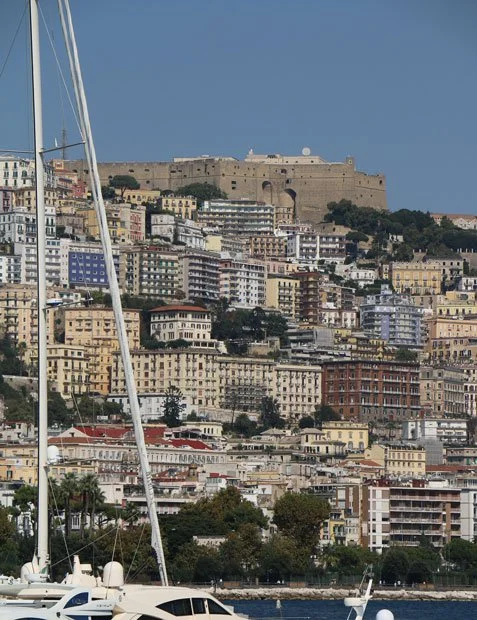
Castel Sant Elmo - the viewpoint over the city from which Emma looked down on the houses she and Sir William had lived in
Farewell to Naples
The summer of 1799 was the beginning of the end of Nelson and Emma’s connection with Naples. It was never entirely severed. As Nelson reported in his memoir, for August 1799:
On the 13th His Sicilian Majesty presented me with a Sword magnificently enriched with diamonds, the title of the Duke of Bronté, and annexed to it the feud of Bronté supposed to be worth 3000l. per annum.
Unsurprisingly, the news of the award was first delivered to him by the King and Queen’s close friend, Emma.
Nelson regularly used the title for the rest of his life, although he never visited the estate he had been given.
The Hamiltons did not return to the several houses they had lived in during their Naples years. In a letter to Greville she wrote:
I have not been on shore but once; the King gave us leave to go as far as St Elmo’s to see the effect of the bombs. I saw at a distance our despoil’d house in town and & Villa Emma that have been plunder’d & Sir Wm’s new appartment, a bomb burst in it but it made me so low-spirited I don’t desire to go again.
For the next year the Hamiltons and Nelson kept up their close relationship with Neapolitan royalty, spending much of their time at Palermo in Sicily. Here Emma developed a reputation for gambling, and some of his officers despaired of his association with her.
By now, news of Nelson’s relationship with Emma was well known across the region. Lady Elgin, in Gibraltar, heard that: ‘He is now completely managed by Lady Hamilton.’ Lady Minto, observing Nelson a few months later, said:
He is devoted to Emma, thinks her quite an angel, and talks of her as such to her face and behind her back, and she leads him about like a keeper with a bear. She must sit by him at dinner to cut his meat, and he carries her pocket-handkerchief.
In the summer of 1800, Sir William, now a sick old man of almost 70, was replaced as ambassador to the Neapolitan court. It was time for him and his wife to return to England, and Nelson chose to accompany them.
Their time in Naples was over. When he had arrived, nearly two years earlier, Nelson and Emma only knew of each other by reputation, and a brief meeting years before. Now, as they embarked on the overland journey to England, she was pregnant with his child.
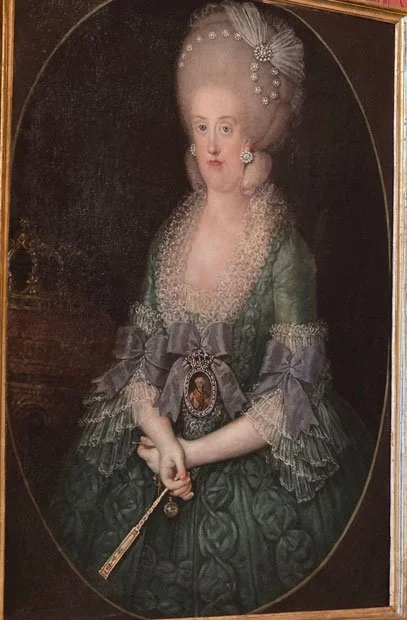
Queen Maria Carolina of Naples, sister of Maria Antoinette and close friend of Emma Hamilton
Andrew Knowles researches and writes about the late Georgian and Regency period. He’s also a freelance writer and editor for business. He lives with his wife Rachel, co-author of this blog, in the Dorset seaside town of Weymouth.
If you have enjoyed this blog and want to encourage us and help us to keep making our research freely available, please buy us a virtual cup of coffee by clicking the button below.
Sources used include:
Nelson: A Personal History by Christopher Hibbert (1994)
Horatio Nelson by Tom Pocock (1988)
The Life and Letters of Emma Hamilton by Hugh Tours (1968)
The Life of Admiral Lord Nelson KB from His Lordship's Manuscripts by JS Clarke and J McArthur (1810)
Autobiography of Miss Cornelia Knight, Lady Companion to the Princess Charlotte of Wales (1861)
Regency History
by Andrew & Rachel Knowles

We research and write about the late Georgian and Regency period.
Rachel also writes faith-based Regency romance with rich historical detail.