Eyewitnesses to the Burning of the White House
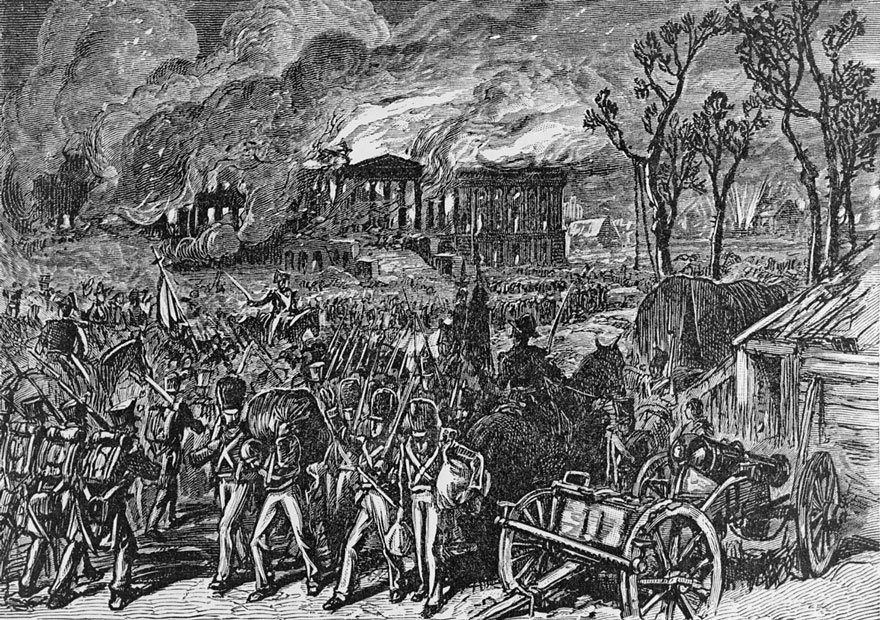
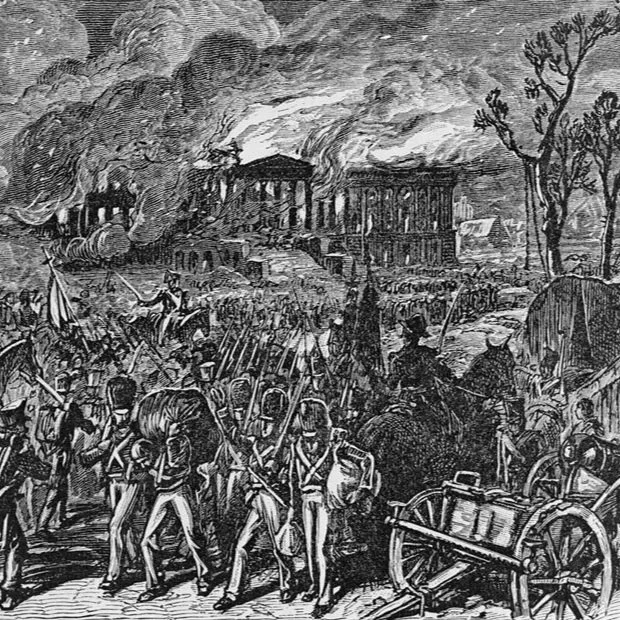
A representation of the 1814 burning of Washington (1876)
If you get the chance to look closely at the White House in Washington DC, you’ll see scorch marks.
They’re reminders that soldiers from Regency Britain captured, and burned down, what’s now a symbol of American authority.
This act of destruction was part of what some call the ‘Second War of American Independence’. It was a conflict between America and Britain that began in 1812 and formally ended in early 1815.
We’re telling the story through the eyes of two witnesses—one an American slave, another a British army officer.
The slave was Paul Jennings. He was born into slavery, and the ownership of James Madison, in 1799. Ten years later Madison became the 4th President of the United States.
Jennings served in Madison’s close household, which put him inside the White House. He was there in August 1814 when battle-hardened British soldiers arrived to fight in America. Having survived the Peninsular War in Europe, they’d been shipped across the Atlantic to take on a new enemy.
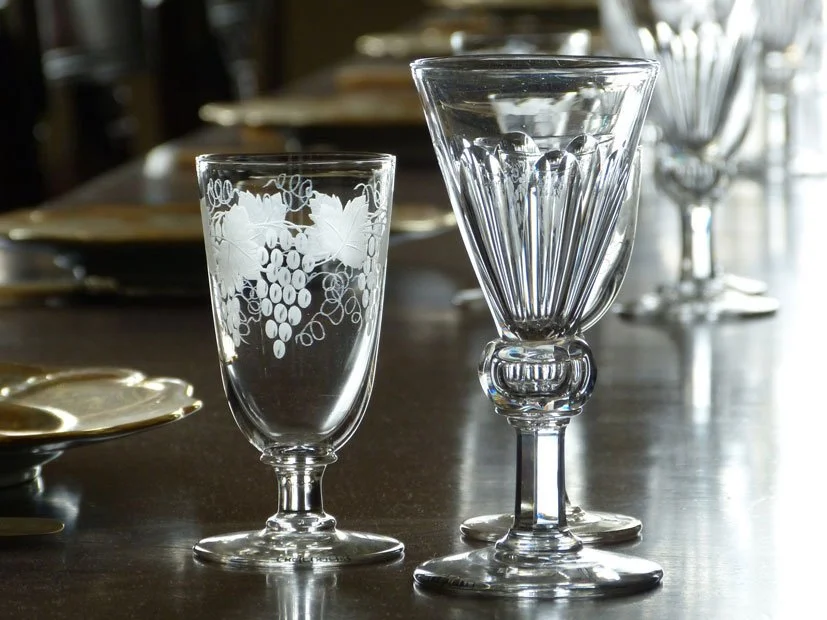
On 24 August 1814 the White House table was set for dinner. But who would be eating and drinking?
Paul Jenning’s account
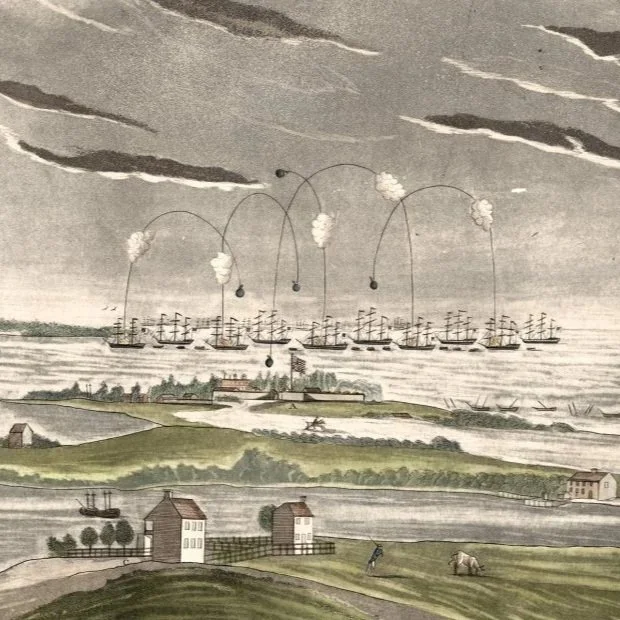
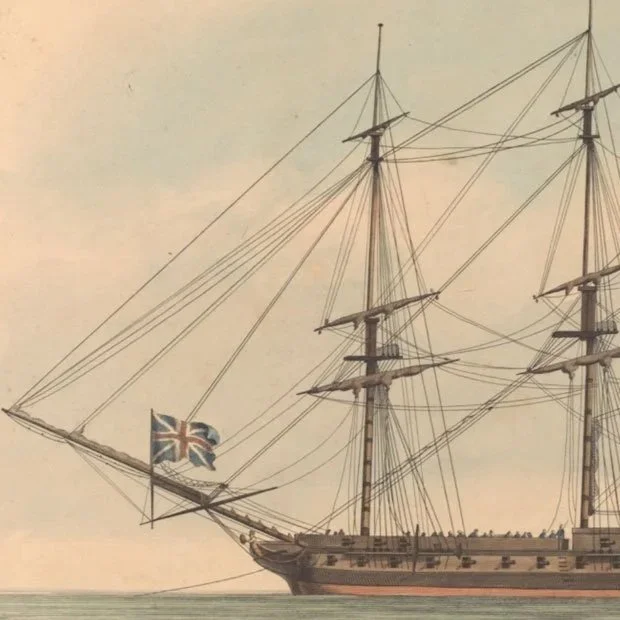
After the war had been going on for a couple of years, the people of Washington began to be alarmed for the safety of the city, as the British held Chesapeake Bay with a powerful fleet and army.
On 19 August a force of around 4,500 British troops, led by Major General Ross, landed at Chesapeake Bay. They advanced on Washington.
Well, on the 24th of August, sure enough, the British reached Bladensburg, and the fight began between 11 and 12. Even that very morning General Armstrong assured Mrs. Madison there was no danger.
Mrs Madison ordered that dinner be prepared in the White House at the usual time of 3pm. Her husband, and other members of the US government, rode out to Bladensburg to observe the battle.
Jennings set the table. At 3pm, dinner time, a messenger:
Gallopped up to the house, waving his hat, and cried out, "Clear out, clear out ! General Armstrong has ordered a retreat !" All then was confusion. Mrs. Madison ordered her carriage, and passing through the dining-room, caught up what silver she could crowd into her old-fashioned reticule, and then jumped into the chariot with her servant girl Sukey.
The Americans were defeated at Bladensburg, with many fleeing the battlefield in disorder.
I will here mention that although the British were expected every minute, they did not arrive for some hours; in the mean time, a rabble, taking advantage of the confusion, ran all over the White House, and stole lots of silver and whatever they could lay their hands on.
Rescue of George Washington portrait
A story told after the war was that Mrs Madison didn’t just rescue some of the White House silver. She also cut a portrait of George Washington out of its frame.
Jennings, in his account given decades later, declared this to be ‘totally false’.
She had no time for doing it. It would have required a ladder to get it down. All she carried off was the silver in her reticule, as the British were thought to be but a few squares off, and were expected every moment. John Suse (a Frenchman, then door-keeper, and still living) and Magraw, the President's gardener, took it down and sent it off on a wagon, with some large silver urns and such other valuables as could be hastily got hold of.
The dinner that Mrs Madison had ordered did not go to waste.
When the British did arrive, they ate up the very dinner, and drank the wines, &c, that I had prepared for the President's party.
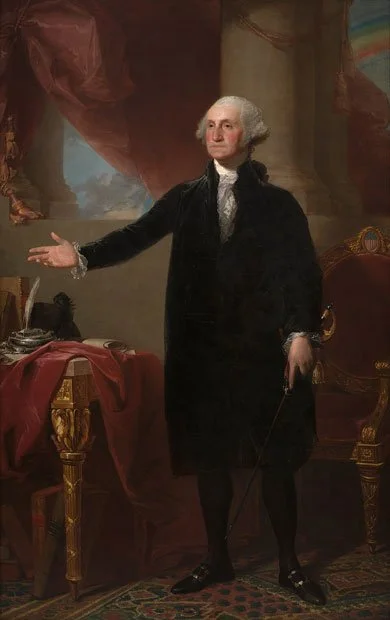
The portrait of George Washington rescued from the White House. It’s of several copies by Gilbert Stuart in 1796.
George Gleig’s account
We now switch to a British point of view. This is an eye-witness account by an anonymous junior army officer:
The destruction of Washington, or rather of the stores or public buildings in Washington, had already begun; and the heavy explosions which from time to time occurred, the sheets of fire which quivered through the air—the very waving of the flames heard in the stillness of night to an extraordinary distance—formed altogether such a scene as I have no words adequate to describe.
Another officer, George Gleig, gives us more details. He tells us that the British raised a flag of truce before entering the city, but shots were then fired from a private house. These killed the horse ridden by Major General Ross, an act that provoked destruction of the house and then public buildings.
A noble library, several printing offices, and all the national archives were likewise committed to the flames.
He’s given us a vivid description of the scene, which was played as the final sections of the British army arrived in Washington. By now, night had fallen.
The work of destruction had also begun in the city, before they quitted their ground; and the blazing of houses, ships, and stores, the report of exploding magazines, and the crash of falling roofs, informed them, as they proceeded, of what was going forward. It would be difficult to conceive a finer spectacle than that which presented itself as they approached the town. The sky was brilliantly illumined by the different conflagrations; and a dark red light was thrown upon the road, sufficient to permit each man to view distinctly his comrade's face.
Gleig assures his readers that private houses, other than that first one, were spared from destruction. Many were still inhabited, the residents having been confident that the American troops would have held the British back.
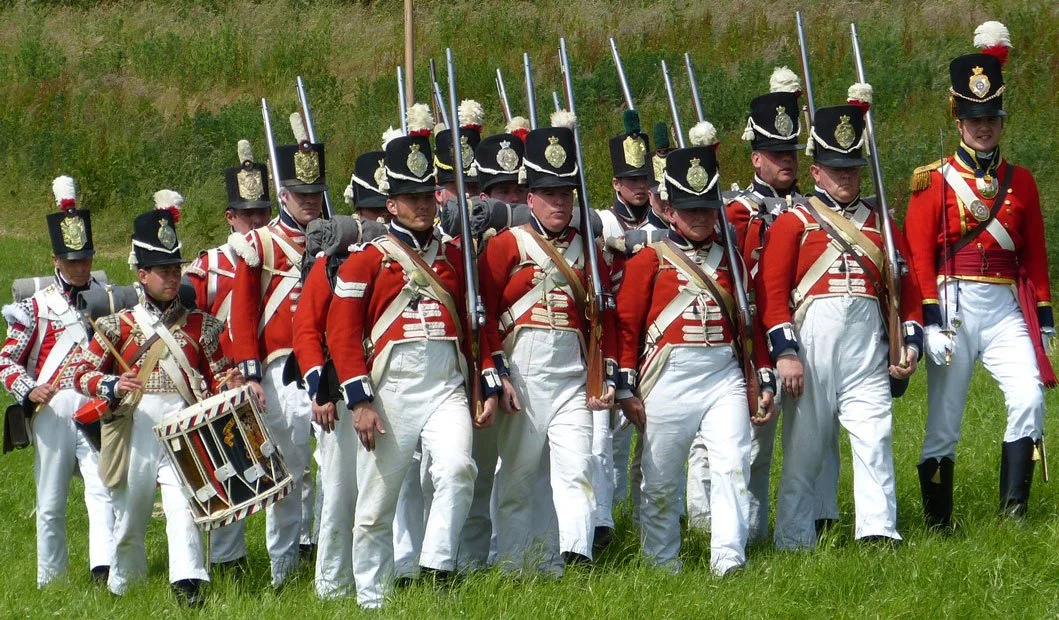
The thousands of British troops who marched into Washington were veterans of the Peninsula War against the French
British soldiers in the White House
President Madison’s house, being a public building, was not safe. Nor was the dinner that Jennings described as having been prepared. Gleig tells us:
When the detachment, sent out to destroy Mr. Maddison's house, entered his dining parlour, they found a dinner table spread, and covers laid for forty guests. Several kinds of wine, in handsome cut-glass decanters, were cooling on the sideboard; plate-holders stood by the fire-place, filled with dishes and plates; knives, forks and spoons, were arranged for immediate use; everything in short was ready for the entertainment of a ceremonious party. Such were the arrangements in the dining-room, whilst in the kitchen were others answerable to them in every respect. Spits, loaded with joints of various sorts, turned before the fire; pots, saucepans, and other culinary utensils, stood upon the grate; and all the other requisites for an elegant and substantial repast, were in the exact state which indicated that they had been lately and precipitately abandoned.
The house may have been stripped of silverware and that painting of George Washington, but to a party of hungry soldiers, the feast was a greater prize.
An elegant dinner, even though considerably over-dressed, was a luxury to which few of them, at least for some time back, had been accustomed; and which, after the dangers and fatigues of the day, appeared peculiarly inviting. They sat down to it, therefore, not indeed in the most orderly manner, but with countenances which would not have disgraced a party of aldermen at a civic feast; and having satisfied their appetites with fewer complaints than would have probably escaped their rival gourmands, and partaken pretty freely of the wines.
The soldiers were a detachment of Royal Sappers—military engineers—under Captain Blanshard.
Having eaten and drunk all they could, the men set about the task they had been given: ‘by setting fire to the house which had so liberally entertained them.’
And so the President’s House, which by then some had begun to refer to as the White House, was burned.

The burnt-out shell of the White House in 1814
After the burning
Having achieved their objective, of burning the government buildings in Washington, the British troops retraced their steps. The Americans reclaimed their capital and began the process of restoration.
It took around three years to make the White House habitable once more. There’s a story that the building acquired its name at this time, because it was painted white to cover the marks from the burning. However, it had always been whitewashed and there’s evidence of congressmen referring to it as ‘the White House’ in letters before 1814.
In the late 20th, century restoration work uncovered scorch marks on the exterior of the building. They have been left visible, as a reminder that over 200 years ago, soldiers from Regency Britain set fire to the White House.
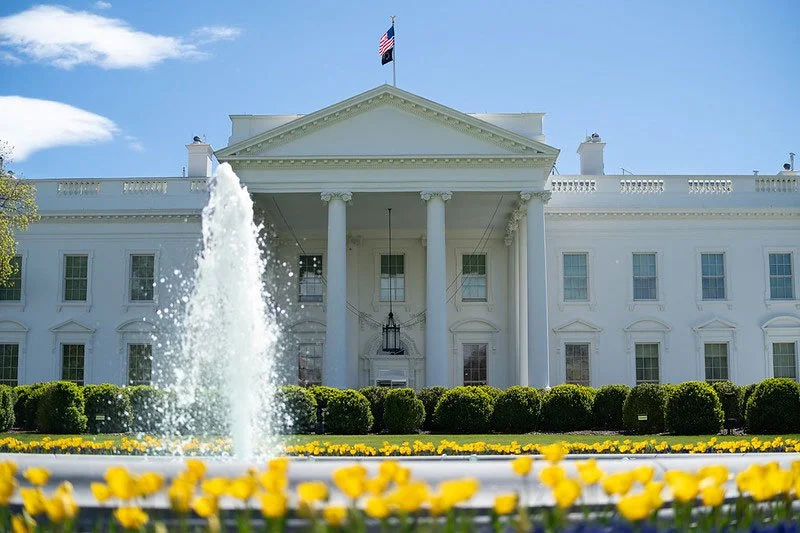
The White House, Washington DC, in 2020. It’s undergone many changes since 1814.
Andrew Knowles researches and writes about the late Georgian and Regency period. He’s also a freelance writer and editor for business. He lives with his wife Rachel, co-author of this blog, in the Dorset seaside town of Weymouth.
If you have enjoyed this blog and want to encourage us and help us to keep making our research freely available, please buy us a virtual cup of coffee by clicking the button below.
Sources used include:
History of the Royal Sappers and Miners Vol 1 (1857)
Memoir of Paul Jennings
The Campaigns of the British Army at Washington and New Orleans 1814-1814, GR Gleig (1832)
Regency History
by Andrew & Rachel Knowles
We research and write about the late Georgian and Regency period.
Rachel also writes faith-based Regency romance with rich historical detail.