Annapolis Tea Party and First Continenal Congress

Anthony Stewart, co-owner of the Peggy Stewart. The ship was named after his daughter.
‘We… do severally acknowledge that we have committed a most daring insult, an act of the most pernicious tendency to the liberties of America.’
What act had James and Joseph Williams, and Anthony Stewart committed that prompted such a confession?
In October 1774 they brought a cargo of tea to Annapolis in the USA, aboard the ship Peggy Stewart.
The Americans were increasingly boycotting British imports. The colonists were unhappy about what they considered poor treatment by the British government. The people of Boston were under particular pressure.
At the same time that the Peggy Stewart moored off Annapolis, delegates from the colonies were discussing their grievances in Philadelphia. This was the First Continental Congress.
What to do with ‘that detestable weed’?
Tea was only a small part of the Peggy Stewart’s cargo. However, the presence of any tea from Britain was enough to incur the wrath of many local people.
The importers admitted they had ‘deservedly incurred the displeasure of the people’ and asked for pardon.
A committee of ‘very respectable gentlemen’ was convened, and given the job of determining what was to become of the tea.
A crowd gathered near the Peggy Stewart to watch the outcome. The importers and owners of the tea:
Went on board said vessel with her sails and colours flying, and voluntarily set fire to the tea, and in a few hours, the whole, together with the vessel, was consumed in the presence of a great number of spectators.
This has since become known as the Annapolis Tea Party.
Since researching this incident, we’ve discovered there were up to 17 separate ‘tea parties’ in various ports, up to 1774. All involved the destruction of imported tea.
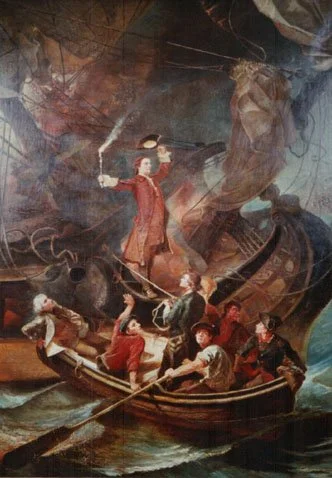
A Victorian interpretation of the burning of the Peggy Stewart, by Francis Blackwell Mayer
The First Continental Congress
One hundred miles from where the Peggy Stewart was burning, representatives from twelve of the thirteen American colonies were debating how to respond to the British government.
The gathering concluded on 26 October 1774. From it came two documents: Declaration and Resolves, and the Continental Association.
The Declaration and Resolves was a statement of rights on behalf of the people of North America.
These rights included:
Entitlement to life, liberty and property.
Entitlement to rights, liberties and immunities of natural born subjects within the realm of England.
Right to peaceably assemble, consider their grievances and petition the king.
They also resolved that the keeping of an army in the colonies, in peacetime, without approval of local government, was against the law. This was directed at the presence of the British army.
The Continental Association
The Continental Association was an agreement that the colonies would work together. They resolved:
We will not import into British America, from Great Britain or Ireland, any goods, wares or merchandize whatsoever, or from any other place, any such goods, wares, or merchandize, as shall have been exported from Great Britain or Ireland.
Their second resolution was:
We will neither import, nor purchase any slave imported, after the 1st day of December next; after which time, we will wholly discontinue the slave trade.
Within a few weeks the full text of the resolutions was published in British newspapers. It prompted Samuel Johnson to write Taxation no Tyranny, which fuelled the debate over how British power should be exercised in North America.
One of those who attended the First Continental Congress was George Washington. He was also helping to train local militias, drawing on his military experience fighting the French.
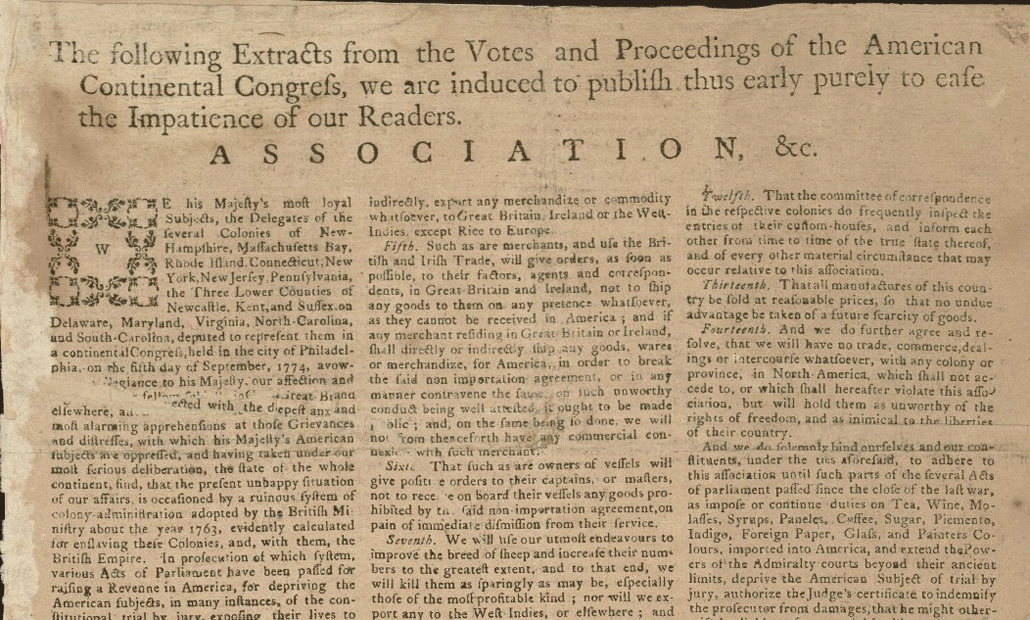
Opening of the Continental Association (Library of Congress)
Andrew Knowles researches and writes about the late Georgian and Regency period. He’s also a freelance writer and editor for business. He lives with his wife Rachel, co-author of this blog, in the Dorset seaside town of Weymouth.
If you have enjoyed this blog and want to encourage us and help us to keep making our research freely available, please buy us a virtual cup of coffee by clicking the button below.
Regency History
by Andrew & Rachel Knowles

We research and write about the late Georgian and Regency period.
Rachel also writes faith-based Regency romance with rich historical detail.