Lexington and Concord: Beginning of the American War of Independence
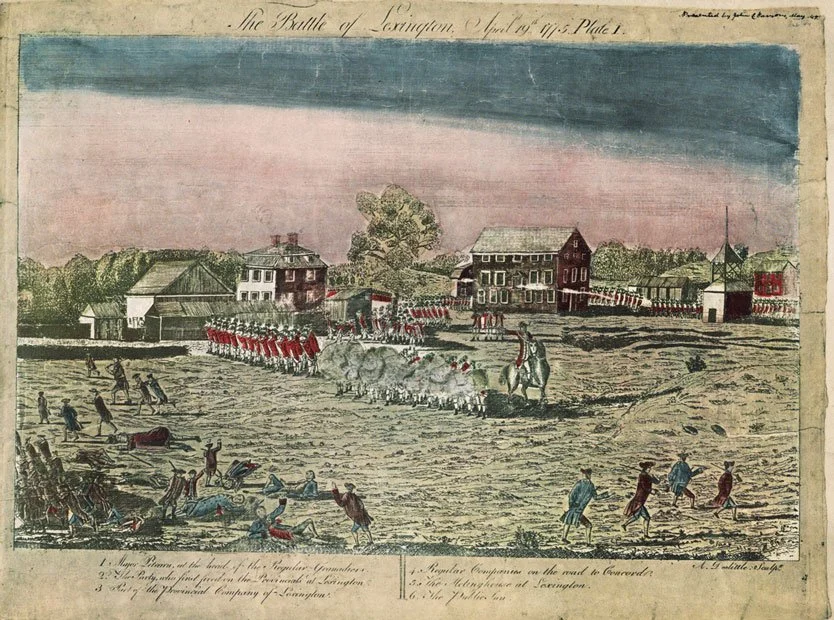
A contemporary image of the fighting at Lexington
Who fired the first shot?
My research into the events of April 1775 suggests this is a subject of perennial debate.
Those shooting at each other were, of course, the American colonists and the British Army. The shot, whoever fired it, was the first in the American War of Independence. It crackled through the Massachusetts air on 19 April 1775.
Frustrations lead to gunfire
Relations between the colonists and Great Britain had become increasingly difficult in the preceding year. The thirteen colonies complained they had no voice in the British parliament that imposed taxes on them. Protests against taxes and British imports led to draconian laws and a stronger presence by the army.
In September and October 1774 representatives of the colonies met in the First Continental Congress. This reinforced their shared sense of frustration with the British government, and spurred some to strengthen their local militias.
The colonists had a history of coming together to defend themselves. Over the winter of 1774-75 their militias trained for the possibility of war.
On 18 April 1775 British troops left Boston for Concord, where the militias had a store of weapons. The colonists knew they were coming, and assembled a small force at Lexington.
When the British arrived at Lexington early on 19 April, the militiamen were seriously outnumbered.
A British perspective on the first shot
A few days after that first shot was fired, Major W Souter of the Marines recorded the events in a letter:
We marched all Night without molestation, and about daylight in marching thro’ a Village called Lexington, the Van Comp’y of the Light Troops was staggered by seeing a Flash in a Pan from a man with Arms, and soon after a Report and whistling of two Balls first on it, on which the Light Company rushed forward and saw a dozen or eighteen Men drawn up with Arms, the Light Companies on hearing a shout from the leading Company, immediately formed and a fire was given on their running off which killed most of them…
From this unhappy Accident the Americans have plunged themselves into the Horrors and Miseries of a Civil War.[1]
The expression ‘civil war’ is often used at that time, to describe the conflict. Not to be confused with the American Civil War of the 1860s.
A civil war is a conflict between citizens of the same nation, hence the use of the term.
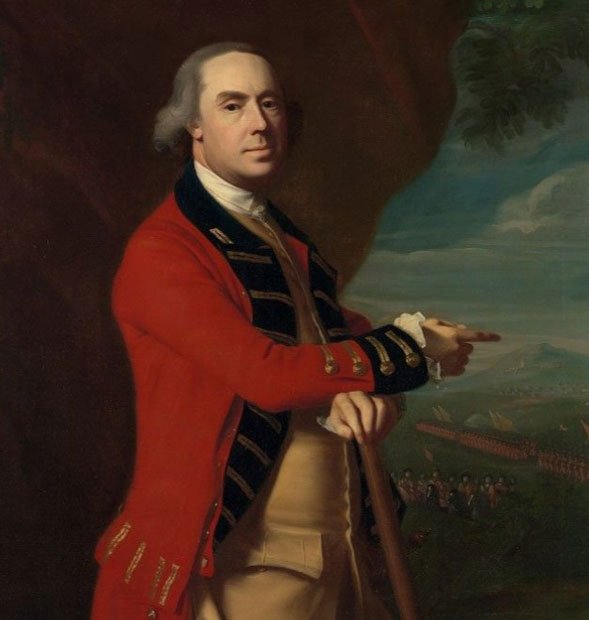
General Thomas Gage, commander of the British forces in America in 1775.
An American perspective on the first shot
Sylvanus Wood, a militiaman, told his version of the story in 1826:
The British troops approached us rapidly in platoons, with a general officer on horseback at their head. The officer came up to within about two rods of the centre of the company, where I stood, the first platoon being about three rods distant. They there halted. The officer then swung his sword, and said, “Lay down your arms, you damned rebels, or you are all dead men—Fire!” Some guns were fired by the British at us from the first platoon, but no person was killed or hurt, being probably charged only with powder.
Just at this time, Captain Parker ordered every man to take care of himself. The company immediately dispersed; and while the company was dispersing and leaping over the wall, the second platoon of the British fired, and killed some of our men. There was not a gun fired by any of Captain Parker’s company, within my knowledge.[2]
Not a battle at Lexington
The engagement on 19 April was not a battle. However it began, there was a brief exchange of gunfire. It’s reported that eight colonists and one British soldier died.
There was, however, a more sustained engagement in Concord, where a larger force of militiamen fired on the British troops. There were dozens of casualties on both sides.
The ‘shot heard around the world’
In 1836 Ralph Waldo Emerson wrote a poem for the dedication of the Concord Monument, which commemorated the events of 19 April 1775.
The first verse is:
By the rude bridge that arched the flood,
Their flag to April’s breeze unfurled,
Here once the embattled farmers stood,
And fired the shot heard around the world.
Apparently there are several eye-witness accounts of what happened at Lexington. They differ in who is blamed for firing the first shot. We’ll probably never know for sure.
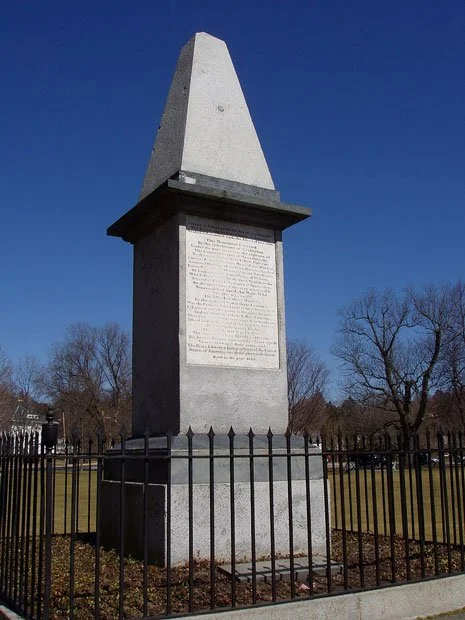
The Lexington Battle Green monument, built in 1799
Andrew Knowles researches and writes about the late Georgian and Regency period. He’s also a freelance writer and editor for business. He lives with his wife Rachel, co-author of this blog, in the Dorset seaside town of Weymouth.
If you have enjoyed this blog and want to encourage us and help us to keep making our research freely available, please buy us a virtual cup of coffee by clicking the button below.
Sources
Letter from Major W Soutar, 22 April 1775, from Echoes of Old Wars by Colonel C Field (1934).
A History of the Fight at Concord, 1827 by Ezra Ripley.
Regency History
by Andrew & Rachel Knowles

We research and write about the late Georgian and Regency period.
Rachel also writes faith-based Regency romance with rich historical detail.