Book Review: Prince George and Master Frederick
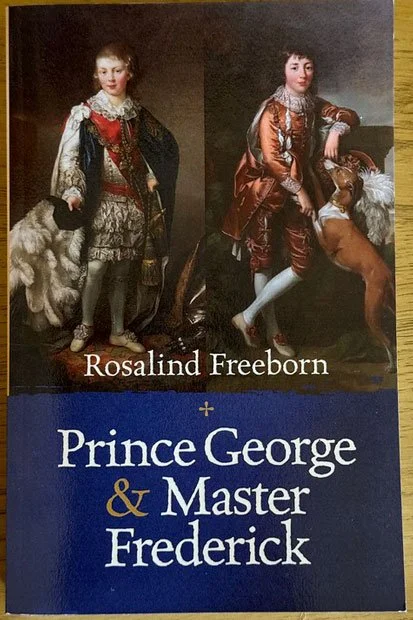
A novelised history of George IV’s older brother
Because I live in Weymouth, the seaside town made popular by King George III’s visits, I often hear references to his secret love life.
Everyone, it seems, knows about the tunnels from his house on the seafront to the home of his mistress.
Yet George III’s views on morality stand him apart from the other three kings of the same name and era. There’s no record of any mistresses, nor evidence of tunnels connecting his bedroom to theirs.
Which is why I was intrigued when I was offered the opportunity to review Rosalind Freeborn’s novel, Prince George and Master Frederick. It’s inspired by a family story about George III siring a son with a commoner, before his marriage. It felt like a tale I should know more about, and this fictional account presented an opportunity to do that.

George IV when he was the Prince of Wales
The story behind the story
The novel explores Frederick Blomberg’s brotherly relationship with George, Prince of Wales, later George IV.
That Frederick grew up with George is a matter of historical record, as the boy was adopted into George III’s family in 1765.
What’s not known, and is therefore open to speculation, is why the king chose to adopt a young boy aged a little year older than his first-born son, George.
Rosalind Freeborn was drawn to this story because some in her family believed they were related to George III. The connection was possibly through Frederick Blomberg, who some said was an illegitimate child of the king.
As Freeborn explains in a note at the end of her novel, Frederick died childless, eliminating the possibility of her family being descendants. The family story may have sprung from her great-grandfather purchasing the estate that Frederick had been gifted by George IV.
Despite eliminating the possibility of her family having royal ancestry, Freeborn still wanted to tell Frederick’s story. She decided to share it in the form of a novel.
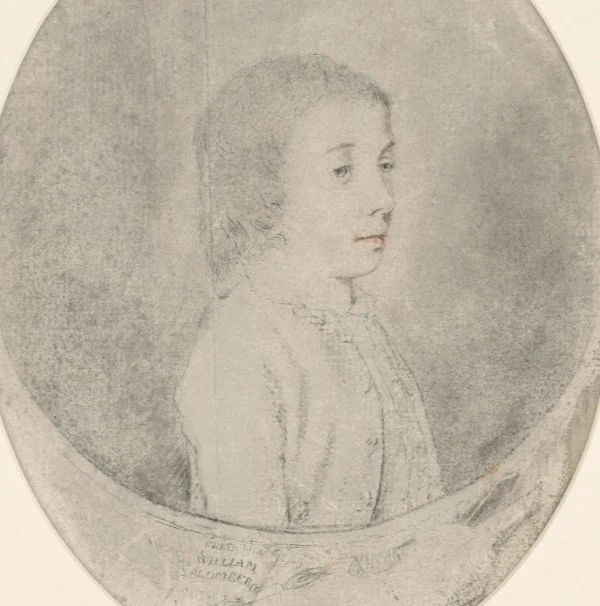
William Blomberg in 1769, aged about 7, by Hugh Hamilton. This image was acquired by the Royal Collection Trust in 2023.
The ghostly messenger
The tale of Frederick’s connection with George III is given extra spice by a ghost story, apparently first published in a newspaper in 1765, the year the young Frederick Blomberg was adopted by the king. It’s repeated, decades later, in other newspapers.
The details of the ghost story change over time, but in essence, it tells how two English officers in the Caribbean in 1764 were surprised to meet their friend, Major Blomberg. He told them to inform King George III of the location of his young son, whose mother had died.
The twist was that when the message was delivered, Major Blomberg was dead and the child was now an orphan.
No version of this ghost story suggests that George III, not Blomberg, was the boy’s true father. However, the king seemed keen to adopt young Frederick. Some of the events in Freeborn’s novel are based on evidence she discovered of Frederick growing up alongside the royal children.
A different perspective on Regency history
In Freeborn’s own words, ‘at the heart of the story is the ‘bromance’ between two men, half-brothers, who happened to have had a king for a father.’ In giving this account of Frederick and Prince George, she’s exploring a tale that doesn’t feature in non-fiction accounts of George IV’s life.
The story begins in 1765 with Frederick’s adoption and it ends with George IV’s death in 1830. The book dips into incidents in Blomberg’s life, many of which are encounters with the boy he grew up with, Prince George. It charts Frederick’s career, from orphan to a respected clergyman and chaplain to the royal family.
The author believes that Frederick was indeed the offspring of a brief relationship enjoyed by George III a few months before he married in 1761.
The evidence is circumstantial, and it’s at odds with George III’s reputation for being morally upright.
That said, it’s intriguing as to why Frederick joined the royal household as a child. No other child was adopted in this way.
In 2023 the Royal Collection Trust purchased a drawing of Frederick as a boy (above).
On her website, Freeborn states:
When I discovered that this portrait of Frederick Blomberg had come up for auction recently and had been bought by King Charles III for the Royal Collection Trust, I realised that Frederick Blomberg was being acknowledged as a royal child. I was so delighted to visit the Print Room at Windsor Castle and see the portrait of Frederick lined up with the matching portraits of his royal siblings.
A fiction with some basis in fact
Being a novel, the book has no index or footnotes. The brief epilogue and postscript provide some insights into the story’s origins and factual basis.
This book could be for you if you enjoy reading novelised history, or if you’re curious to know more about Frederick Blomberg and his relationship with the royal family, particularly George, Prince of Wales, who became George IV.
Just remember it’s a blend of fact and fiction, and the boundaries between are blurred.
Prince George and Master Frederick is by Rosalind Freeborn and published by Alliance Publishing Press.
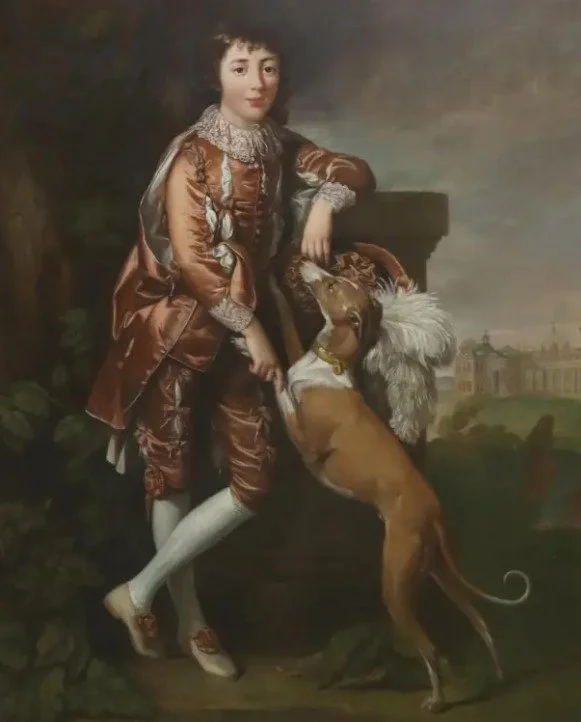
Another portrait of Frederick Blomberg as a boy, possibly by Richard Brompton. In the background is Buckingham House.
Andrew Knowles researches and writes about the late Georgian and Regency period. He’s also a freelance writer and editor for business. He lives with his wife Rachel, co-author of this blog, in the Dorset seaside town of Weymouth.
If you have enjoyed this blog and want to encourage us and help us to keep making our research freely available, please buy us a virtual cup of coffee by clicking the button below.
Regency History
by Andrew & Rachel Knowles

We research and write about the late Georgian and Regency period.
Rachel also writes faith-based Regency romance with rich historical detail.