Wilful Murder in Georgian Weymouth
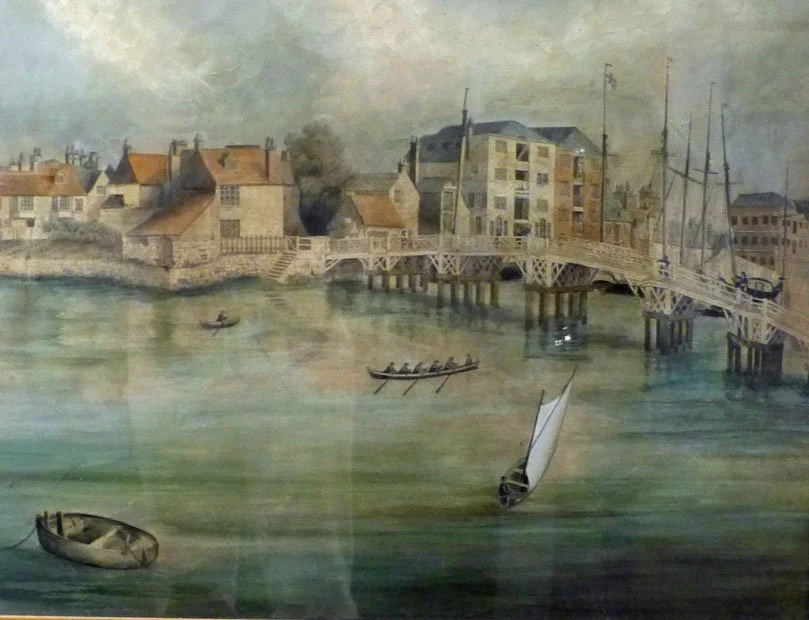
Weymouth harbour bridge c1820 by an unknown artist (Weymouth Museum)
Early on a spring morning in 1792, a workman in Melcombe Regis, Dorset, made a gruesome discovery.
An adult human body, wrapped in a blood-stained sheet, had been abandoned on the town bridge.
It was that of Thomas Lloyd Morgan, a 22-year-old jeweller and engraver from Leominster in Herefordshire. His skull had been fractured by a blow from a heavy object.
A coroner’s inquest was quickly organised, where the verdict of wilful murder was brought.
Who killed Thomas Morgan?
The murderers seemed to have made an elementary mistake. Blood had dripped from the body as they carried it across town at night. It didn’t take much detective work to trace their route back from the bridge. It led, perhaps not surprisingly, to the town’s ‘house of ill fame’.
Four people were arrested: two women and two men. At their trial one of the men, a farmer named Hardy, provided evidence of his innocence. At the time the crime was supposed to have been committed, he was at home in bed. A servant confirmed this - she had checked the clock in the house, so was confident he was at home that evening.
In the absence of compelling evidence, the suspects were released. No one was convicted of the murder of Thomas Morgan, or Ffloyd as he seems to have been known.
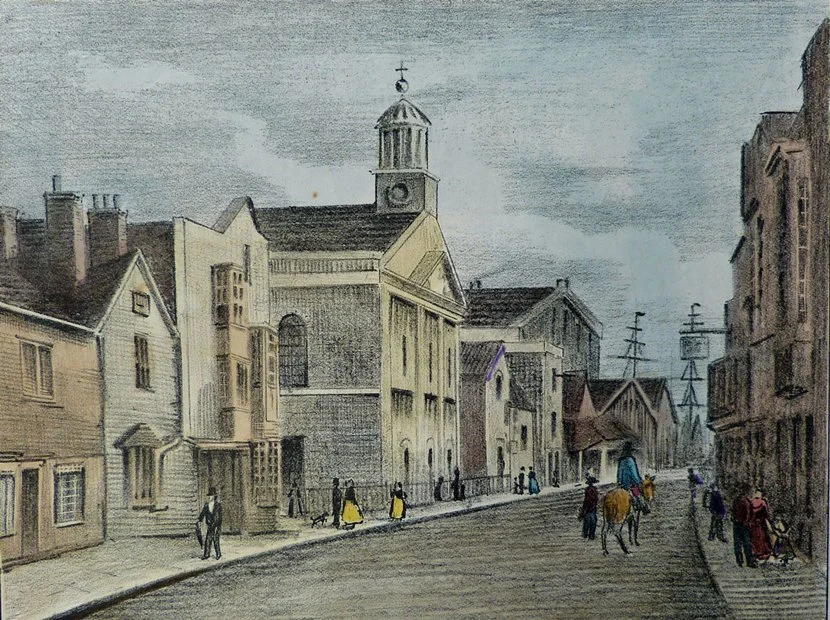
St Mary Street, Melcombe Regis, with St Mary's Church. View looks towards the harbour.
A pauper’s burial
The unfortunate young man was laid to rest in the churchyard of St Mary’s, Melcombe Regis. While the burial record registers him as a pauper, he had enough friends in town that a headstone was erected. It reads:
This stone
was erected
by public subscription
in remembrance of
the cruel murder
committed on the body
of Ffloyd Morgan
(who lies here)
on the 27th of April 1792
aged 22
Here mingling with my fellow clay,
I wait the awful judgement day,
And there my murderer shall appear,
Although escaped from justice here.
The woman in a truly frightful state of mind
Sixty-five years later, in 1857, the murder of Thomas Lloyd Morgan was once again the talk of the town. Newspaper from the time report that a 90-year-old woman, Pricilla Guppy, made a confession ‘on her death bed’, where ‘her state of mind was truly frightful.’ 1
She admitted that in 1792 she had struck the young man on the head with a heavy flat iron.
The precise circumstances of Morgan’s death are lost to us now. He was perhaps lured to the ‘house of ill-fame’ under false pretences. That evening there was an argument with Hardy, Guppy and at least one other man.
It led to him being hit on the head and killed.
It was decided to throw the body into the nearby harbour. They wrapped Morgan in a sheet, slung the body over Hardy’s horse, and made their way, in darkness, towards the quayside.
Their route required crossing the harbour bridge. There were houses at either end and, perhaps unsurprisingly, they heard voices in the gloom. Nervous of being discovered with their incriminating burden, they abandoned the body and fled into the night.
Which is why, on the following morning, Morgan’s remains were discovered at one end of the bridge.
Guppy’s deathbed testimony included a couple of other details. She claimed to have hidden Morgan’s gold watch and chain in her hair, during her arrest and trial.
She also said that Hardy, one of those present at the murder, made a plan to escape justice. Immediately after abandoning the body he’d rushed home and retired to rest. A short time later he woke a servant and asked her to go downstairs and check the time on the clock.
The servant didn’t know he’d deliberately put the clock back two hours. This gave the impression he had arrived home earlier than he actually did. According to Guppy, the servant’s innocent testimony at the trial, about when Hardy was at home, contributed to him being acquitted.
By the time of Guppy’s deathbed confession in 1857, all the other participants in the murder had died. The woman ‘implored the Divine Creator to have mercy on her soul and forgive the sins she had committed.’ 2
No one was ever convicted of Morgan’s murder.
Today the tombstone is inside, not outside, St Mary’s Church. In the 1920s the small graveyard was cleared of headstones and some, including this one, were laid into the floor.
The story of Morgan’s murder was widely reported in the newspapers in 1792, as was the deathbed confession in 1857.
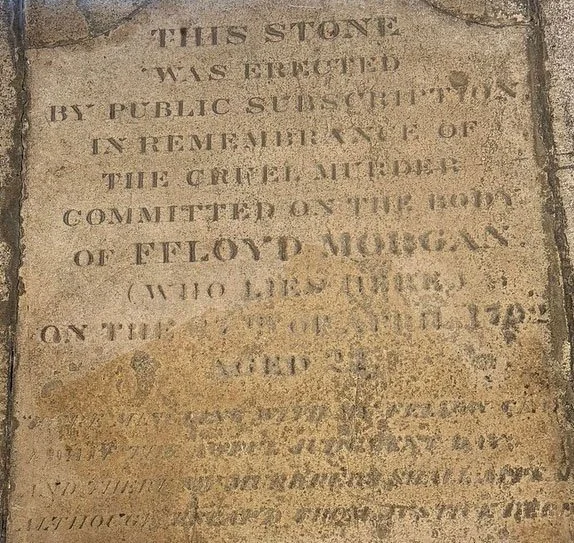
The headstone erected for Ffloyd Morgan, now set into the floor of St Mary's Church, Weymouth (2024)
Why Melcombe Regis is also called Weymouth
The town of Weymouth, in Dorset, is a popular seaside town. What’s now known as Weymouth used to be two towns, one either side of the harbour.
Weymouth was on the south side. It’s here that Ffloyd Morgan was murdered. St Mary’s Church, were he’s buried, is on the north side. This was the town of Melcombe Regis.
Today the entire town is called Weymouth, although the name Melcombe Regis is sometimes used to indicate the area north of the harbour.
Andrew Knowles researches and writes about the late Georgian and Regency period. He’s also a freelance writer and editor for business. He lives with his wife Rachel, co-author of this blog, in the Dorset seaside town of Weymouth.
If you have enjoyed this blog and want to encourage us and help us to keep making our research freely available, please buy us a virtual cup of coffee by clicking the button below.
Notes
The Hampshire Advertiser, Saturday November 28 1857
Ibid.
Sources used include:
The Hampshire Advertiser, Saturday November 28 1857
The Hampshire Chronicle, Monday May 7 1792
Regency History
by Andrew & Rachel Knowles

We research and write about the late Georgian and Regency period.
Rachel also writes faith-based Regency romance with rich historical detail.