
Party in the parks: Grand Jubilee of 1814

The Temple of Concord in the Green Park on 1 August 1814 from An Historical Memento by E Orme (1814)
For many in Britain, there was a party mood in the summer of 1814.
The war against France was finally over. The two nations had been locked in conflict almost continually since 1793 - over twenty years earlier.
Napoleon abdicated in April. The Treaty of Paris was signed on 30 May. The big party was booked for 1 August 1814. The Bristol Mirror reports:
The First of August is the day fixed for the Grand Jubilee, in celebration of the late Glorious Peace. It is the centenary of the accession of the Brunswick Family to the Crown of England, and it is moreover the anniversary of the glorious victory of the Nile. 1
The Brunswick reference is to George I, who became king in 1714. The Battle of the Nile was when Nelson smashed a French fleet in 1798.
The centre of celebration was to be the Royal Parks in London.
An exciting day out for crowds of Londoners
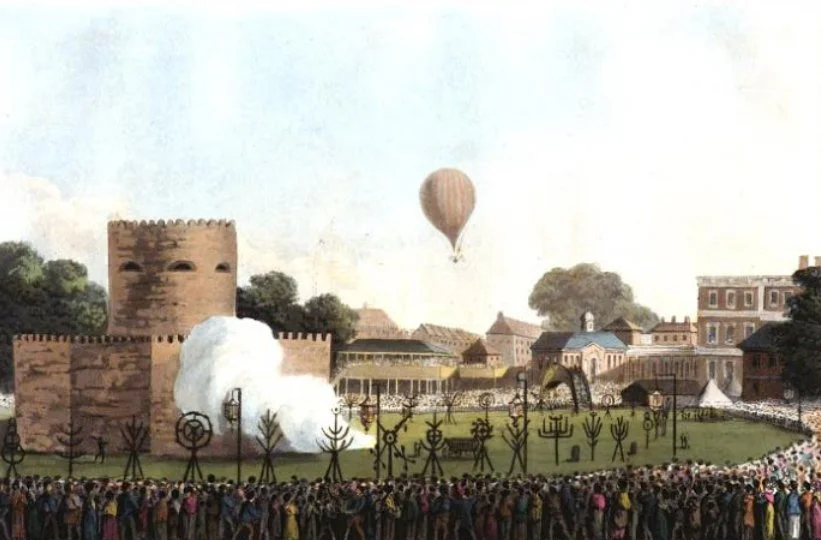
Balloon ascension in the Green Park on 1 August 1814 from An Historical Memento by E Orme (1814)
Many were ‘determined to have a day of it’ reports the Morning Chronicle, the day after the party. Despite early uncertainty about the weather, crowds were seen:
Flocking, at an early hour, to the Parks. At length the firing on cannon announced that the day was considered favourable, and that the Jubilee would commence. The population of the metropolis then poured forth in a continual stream, or rather flood, to witness the exhibition. 2
Much of London shut down for the day.
Shops were shut, business was suspended, houses were left to take care of themselves, and the Strand, Oxford street, and Piccadilly, were nearly blocked up by masses of people of all descriptions, including many women with infants in their arms all hurrying to see the shew. 3
There was plenty to see.
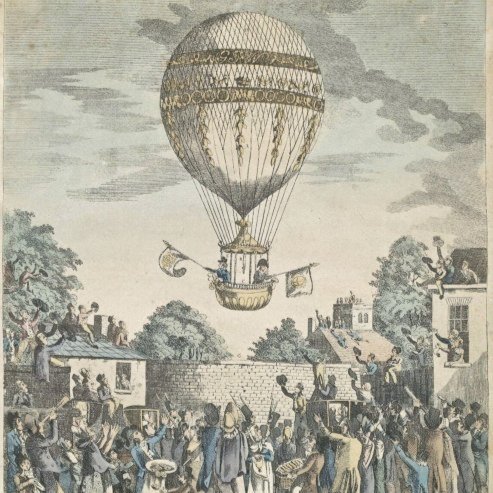
On the commencement of the grand shew, the first object of attraction was the ascent of a Balloon. 4
James Sadler and his son, Windham, were pioneers of balloon flight in late Georgian Britain. It took all day to fill the balloon, which rose above the crowds just after six in the evening. It was one of several balloon flights made over the capital that summer.
Naval battles recreated in Hyde Park

The Fleet on the Serpentine River on 1 August 1814 from An Historical Memento by E Orme (1814)
The balloon ascent was followed by a naval reenactment.
Between eight and nine o’clock the Grand Sea Fight took place on the Serpentine River, where ships of the line in miniature manoeuvred and engaged, and where the Battle of the Nile was represented in little. 5
The Serpentine is the long lake in Hyde Park. According to Bell’s Weekly, the spectacle was ‘imposingly grand’.
A large expanse of brilliant light on the water, a huge column of flame, crowned by pillars of smoke, the red and radiant reflection of the flames, diffused over ten thousand countenances, together with the explosion of magazines, the falling of masts, and exposure of ribs and timbers enveloped in flame, formed a combination little inferior in grandeur to the scene of which it was but mimickry. 6
The parks were crowded with marquees, booths and stalls. Trees were decorated with banners and lanterns. People were buying food, listening to music and dancing.

Chinese Bridge and Pagoda, St James's Park, in 1814 from An Historical Memento by E Orme (1814)
In St James’s Park watermen raced boats along the canal. The park was also the site of a Chinese bridge and pagoda, built specially for the occasion. As daylight faded, these were brightly illuminated.
It is scarcely possible to give a just description of the effulgence produced by this magnificent structure. All that we have read or seen, with respect to brilliancy, falls very short indeed of these luminous objects. 7
As night fell completely, it was lit up by fireworks.
At one moment rockets rapidly pursued each other, and burst at such extraordinary height in the air, that, in some instances, the explosion was scarcely heard. Again there appeared copious and magnificent clusters of rockets, stunning the ear with rapid and irregular explosions, varying in colour and in splendour, and intersecting each other in numberless irregular lines. 8

Chinese Bridge and Pagoda illuminated, St James's Park, on 1 August 1814 from An Historical Memento by E Orme (1814)
Tragic end to a busy day
Unfortunately, in the midst of this excitement the pagoda caught fire. This added a dramatic twist to the entertainment, and resulted in the death of at least one person.
The party in the parks lasted until long after midnight.
The peace that it celebrated lasted a few months longer. Early in 1815 Bonaparte returned to Paris, and Britain was again facing war with France.
Andrew Knowles researches and writes about the late Georgian and Regency period. He’s also a freelance writer and editor for business. He lives with his wife Rachel, co-author of this blog, in the Dorset seaside town of Weymouth.
If you have enjoyed this blog and want to encourage us and help us to keep making our research freely available, please buy us a virtual cup of coffee by clicking the button below.
Notes
The Bristol Mirror, Saturday 30 July 1814.
The Morning Chronicle, Tuesday 2 August 1814.
Ibid.
Ibid.
Ibid.
Bell’s Weekly Messenger, Sunday 7 October 1814.
Ibid.
Ibid.
Sources used include:
Bell’s Weekly Messenger, Sunday 7 October 1814
Orme, Edward (ed), An Historical Memento representing the different scenes of public rejoicing, which took place the first of August, in St James's and Hyde Parks, London, in celebration of the Glorious Peace of 1814, and of the Centenary of the Accession of the Illustrious House of Brunswick (1814)
The Bristol Mirror, Saturday 30 July 1814
The Morning Chronicle, Tuesday 2 August 1814
Regency History
by Andrew & Rachel Knowles

We research and write about the late Georgian and Regency period.
Rachel also writes faith-based Regency romance with rich historical detail.



Party in the Parks: Grand Jubilee of 1814