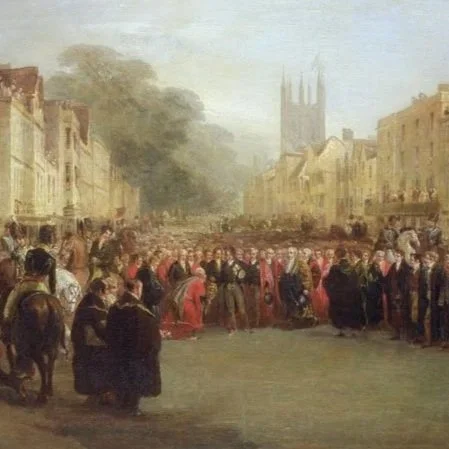
Head Vs Heart: Thomas Jefferson’s Frustrated Romance with Maria Cosway
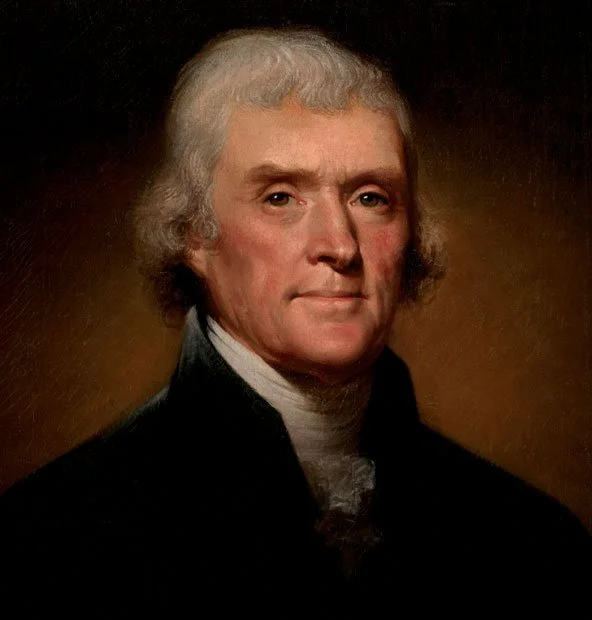
Thomas Jefferson in his official portrait as President of the United States. He was third president, from 1801 to 1809.
On 12 October 1786 Thomas Jefferson, in France to support American diplomacy, penned what became known as the ‘Head and Heart’ letter.
According to the USA Founders Archives, it’s one of the most notable love letters in the English language.
Thomas, who went on to become the third president of the United States, was 18 years older than Maria Cosway when they met in Paris in 1786. He was a widower and a lover of architecture.
Maria Cosway, in her mid-twenties, was an accomplished artist and society hostess. She was also the wife of painter Richard Cosway. The couple first met Jefferson on a visit to the Halle aux blés in Paris, renowned for its domed design.
Shared passions
Immediately infatuated with Maria, Thomas immediately cancelled other engagements in order to spend more time with the Cosways. Richard Cosway had portrait commissions to work on, which left his wife free to explore Paris with the American.
Maria and Thomas shared a love for the arts, and there was no shortage of places to visit, in Paris and beyond. They also shared a passion for music.
It’s easy to assume that because they spent so much time together (albeit, usually accompanied by servants) that their relationship became an affair. Correspondence reveals their affection ran deep, and Maria knew her husband had little respect for the sanctity of marriage.
However, Maria was deeply religious. And they both knew the risks associated with taking their relationship too far - Maria was entirely dependent on her husband for financial support.

Maria Cosway by her husband, Richard, a few years after their marriage in 1781. He was nearly 20 years older, with a reputation at a libertine.
The Head and Heart letter
Having weeks together, Thomas and Maria were forced to part. The Cosways left Paris, for London, on 12 October 1786. That’s the same day Thomas wrote his now famous letter to Maria. It begins:
Having performed the last sad office of handing you into your carriage at the Pavillon de St. Denis, and seen the wheels get actually into motion, I turned on my heel and walked, more dead than alive, to the opposite door, where my own was awaiting me.
Going home, he wrote: ‘Seated by my fire side, solitary and sad, the following dialogue took place between my Head and my Heart.’
I have edited Thomas’s 5,000 words into something shorter:
Head. Well, friend, you seem to be in a pretty trim.
Heart. I am indeed the most wretched of all earthly beings. Overwhelmed with grief, every fibre of my frame distended beyond it’s natural powers to bear, I would willingly meet whatever catastrophe should leave me no more to feel or to fear.
Head. These are the eternal consequences of your warmth and precipitation. This is one of the scrapes into which you are ever leading us.
Heart. Oh my friend! This is no moment to upbraid my foibles. I am rent into fragments by the force of my grief! If you have any balm, pour it into my wounds: if none, do not harrow them by new torments.
Head. Harsh therefore as the medecine may be, it is my office to administer it… I never ceased whispering to you that we had no occasion for new acquaintance; that the greater their merit and talents, the more dangerous their friendship to our tranquillity, because the regret at parting would be greater.
Heart. Sir, this acquaintance was not the consequence of my doings. It was one of your projects which threw us in the way of it.
It was, he complains, the head’s idea that they look at the ‘wonderful piece of architecture’. The result was that they saw ‘the most superb thing on earth!’ While the head admired the structure, the heart’s delight was in ‘the lady and gentleman to whom we had been presented.’
You then, Sir, and not I, have been the cause of the present distress.
The head agrees that the architecture was wonderful, but:
Head. …While I was occupied with these objects, you were dilating with your new acquaintances, and contriving how to prevent a separation from them.
The head then lists how the heart cancelled engagements in order to spend time with the Cosways.
Heart. Oh! my dear friend, how you have revived me by recalling to my mind the transactions of that day!
Now it’s the heart’s turn to list all that which made ‘a mass of happiness’.
Head. Thou art the most incorrigible of all the beings that ever sinned! I reminded you of the follies of the first day, intending to deduce from thence some useful lessons for you, but instead of listening to these, you kindle at the recollection, you retrace the whole series with a fondness which shews you want nothing but the opportunity to act it over again. I often told you… that the lady had moreover qualities and accomplishments, belonging to her sex, which might form a chapter apart for her: such as music, modesty, beauty, and that softness of disposition which is the ornament of her sex and charm of ours. But… you rack our whole system when you are parted from those you love, complaining that such a separation is worse than death… and that the separation would in this instance be the more severe as you would probably never see them again.
Heart. But they told me they would come back again the next year.
Head. But in the mean time see what you suffer… Upon the whole it is improbable and therefore you should abandon the idea of ever seeing them again.
Heart. May heaven abandon me if I do!
Head. Very well. Suppose then they come back. They are to stay here two months, and when these are expired, what is to follow? Perhaps you flatter yourself they may come to America?
Heart. God only knows what is to happen. I see nothing impossible in that supposition, and I see things wonderfully contrived sometimes to make us happy.
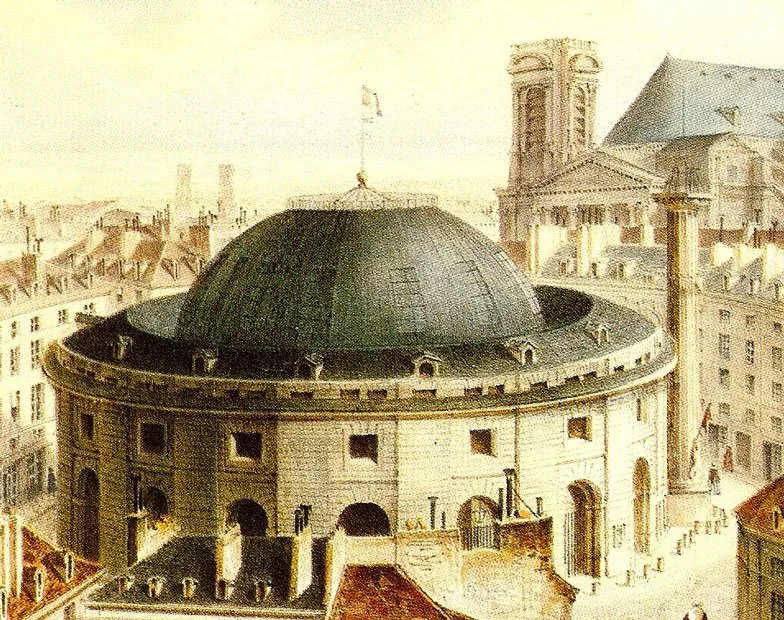
The Halle aux blés in Paris, where Thomas first met Maria. A place of commerce, it was considered an architectural marvel. It’s now the Bourse de Commerce, has been substantially rebuilt, but is still capped with a dome.
The heart then lists some of the many wonders the lady ‘who paints landscape so inimitably’ could render immortal.
Heart. Let us turn over another leaf, for this has distracted me.
Head. Well… When you consider the character which is given of our country by the lying newspapers of London… how can you expect that any reasonable creature would venture among us?
Heart. But you and I know that all this is false: that there is not a country on earth where there is greater tranquillity, where the laws are milder, or better obeyed: where every one is more attentive to his own business, or meddles less with that of others: where strangers are better received, more hospitably treated, and with a more sacred respect.
Head. True, you and I know this, but your friends do not know it.
Heart. But they are sensible people who think for themselves.
The heart now lists the many positive developments taking place in America.
They will…judge I say for themselves whether these are not the occupations of a people at their ease, whether this is not better evidence of our true state than a London newspaper, hired to lie…
Head. I did not begin this lecture my friend with a view to learn from you what America is doing. Let us return then to our point… Remember the last night. You knew your friends were to leave Paris to-day. This was enough to throw you into agonies. All night you tossed us from one side of the bed to the other. No sleep, no rest… The art of life is the art of avoiding pain: and he is the best pilot who steers clearest of the rocks and shoals with which it is beset. Pleasure is always before us; but misfortune is at our side: while running after that, this arrests us.
The head expounds on the advantage of intellectual pleasures over personal relationships.
The heart has the final word. Friendship, it says, gives rise to the most ‘sublime delight’, even when it means enduring painful emotions:
Friendship is precious not only in the shade but in the sunshine of life: and thanks to a benevolent arrangement of things, the greater part of life is sunshine.
The heart tells stories of how, when a poor person asked for help, the head had a rational argument for refusing charity. But when the heart overruled, the result was positive.
Heart. If our country… had been governed by its heads instead of its hearts, where should we have been now?
You began to calculate and to compare wealth and numbers: we threw up a few pulsations of our warmest blood: we supplied enthusiasm against wealth and numbers: we put our existence to the hazard, when the hazard seemed against us, and we saved our country… In short, my friend, as far as my recollection serves me, I do not know that I ever did a good thing on your suggestion, or a dirty one without it.
The heart finishes by fixing on the Cosway’s promise to return the next year:
Hope is sweeter than despair, and they were too good to mean to deceive me. In the summer, said the gentleman; but in the spring, said the lady: and I should love her forever, were it only for that!
Richard Cosway had no interest in returning to Paris in 1787, but he permitted his wife to go. She was in the city for four months and spent time with Thomas. His official duties kept him busier than he would have liked, so they spent less time together.
Shortly before Maria left Paris, Thomas threw a dinner in her honour. On 8 December 1787, the day set for Maria’s departure for England, they had agreed to meet for breakfast. But when Thomas arrived, she was gone. There was a note:
I cannot breakfast with you tomorrow; to bid you adieu once is sufficiently painful, for I leave you with very melancholy ideas.
The couple continued to exchange letters for more than 30 years. The last, sent by Maria in 1824, had no reply. Thomas Jefferson, now in his 80s, was very unwell. He died two years later.
In the words Diane Boucher, in a recent biography of Maria Cosway, the letters:
Reveal how much their mutual affection and respect persisted, but also convey the regret - on both sides - that a closer relationship had never been attainable.
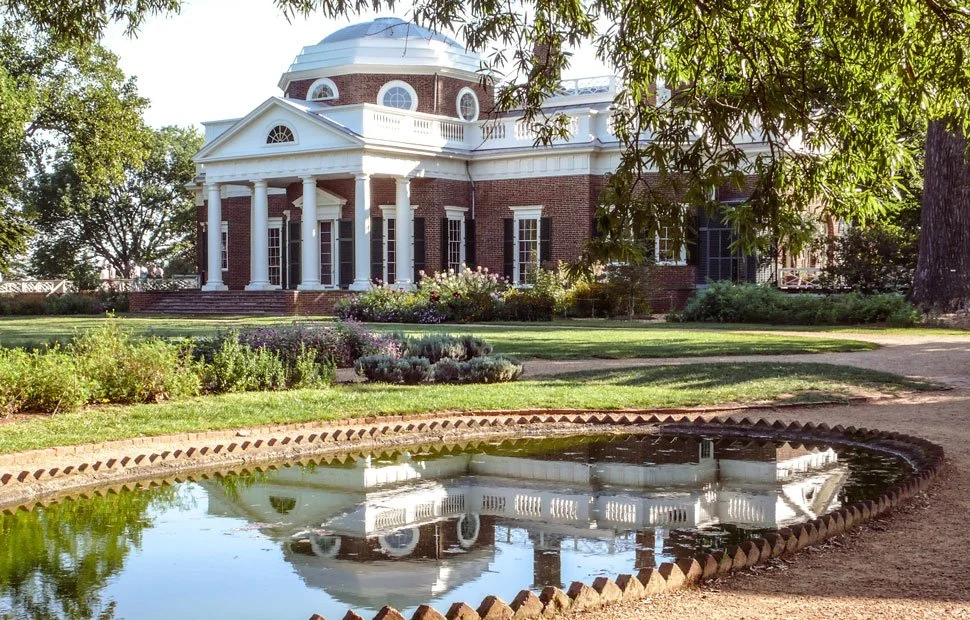
Monticello, Thomas Jefferson’s home in Virginia. He encouraged Maria to visit but she never did.
Andrew Knowles researches and writes about the late Georgian and Regency period. He’s also a freelance writer and editor for business. He lives with his wife Rachel, co-author of this blog, in the Dorset seaside town of Weymouth.
If you have enjoyed this blog and want to encourage us and help us to keep making our research freely available, please buy us a virtual cup of coffee by clicking the button below.
Sources include:
Out of the Shadows: Rediscovering Maria Cosway by Diane Boucher (Unicorn, 2025)
Founders Online, US National Archives
Regency History
by Andrew & Rachel Knowles

We research and write about the late Georgian and Regency period.
Rachel also writes faith-based Regency romance with rich historical detail.