Regency Newspapers: Feeding a News-Hungry Nation
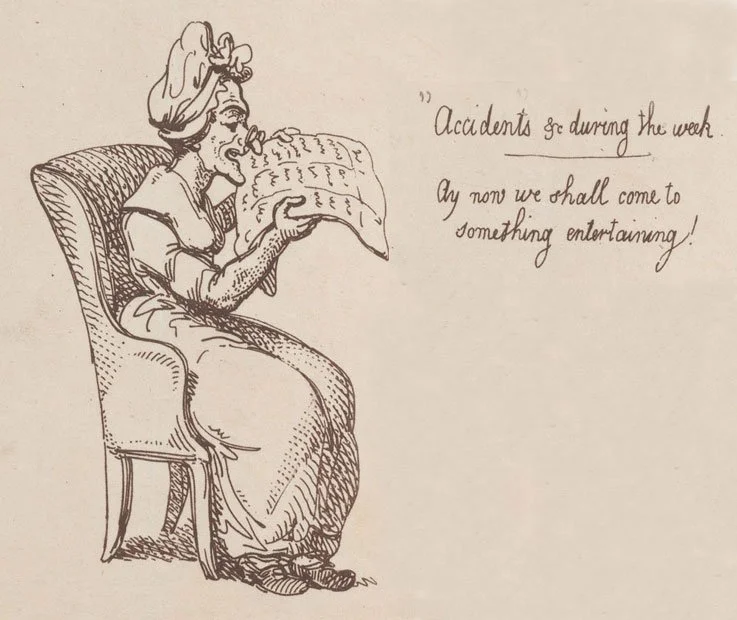
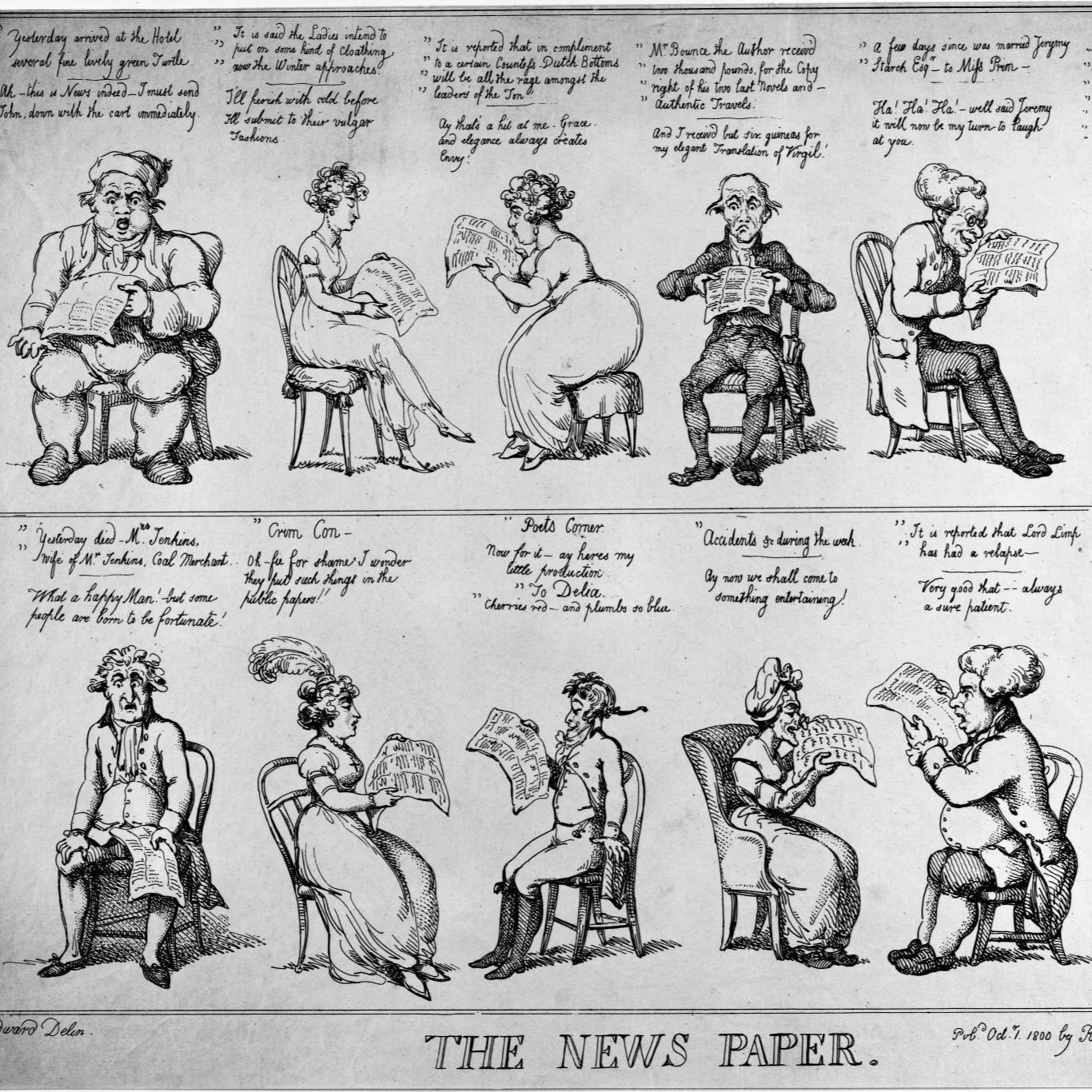
A keen reader of the newspaper by Thomas Rowlandson
“Four-and-twenty hours later, and I should only have been a gallant Captain Wentworth, in a small paragraph at one corner of the newspapers.”
In our world of smartphones, social media and streaming, it’s easy to forget how important newspapers were in Regency England. They were one of the main sources of information and entertainment.
Newspapers feature in all Jane Austen’s novels. In Mansfield Park she writes:
A clergyman has nothing to do but be slovenly and selfish—read the newspaper, watch the weather, and quarrel with his wife.
In Sense and Sensibility Mr Palmer uses the newspaper to escape from his day-to-day life. In Persuasion Anne Elliot’s only sources of information about Captain Wentworth were the newspapers, along with the navy lists.
In her world of Regency gentry, newspapers are lying around in every household. How different were they to newspapers of today?
Firstly, they had many fewer pages. A typical newspaper had four pages - it was a single large sheet, folded in half.
No pictures in Regency newspapers
Today’s newspapers use a mix of text and photographs to convey information. Dramatic cover pictures are intended to catch our attention and make us read.
Photographs started to appear in newspapers in the late 1840s, but their use was unusual. The Illustrated London News, launched in 1842, was the first news publication to drive the use of pictures. It began with engravings, not photos.
The newspapers read by the Austens were text only. There may have been a few graphic flourishes, around the title and perhaps elsewhere. These were ornamental, not informational.
One of the papers Jane may have seen was The Bath Chronicle. In the four pages of a 1799 edition, it has a graphic in the title, and three small graphics throughout its pages.
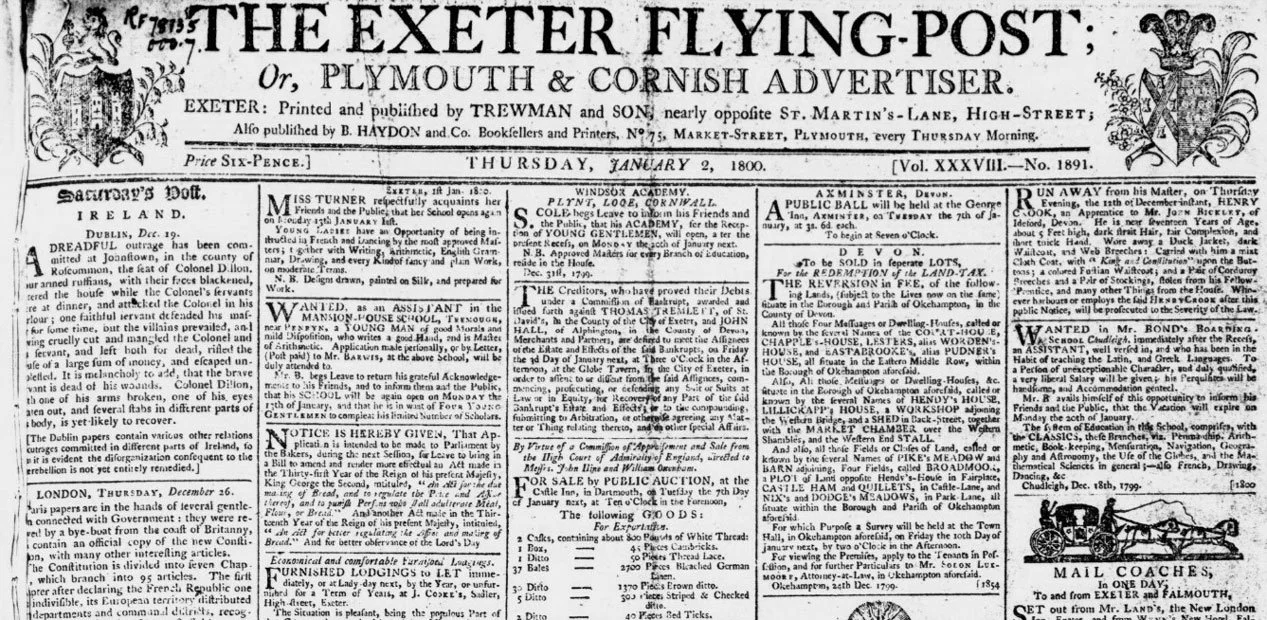
The Exeter Flying Post was one of the more graphically-rich newspapers
Layout of Regency newspapers
Bold headlines are a feature of today’s newspapers. Like photos, they grab attention. Headlines are also used to break up the sections of a newspaper, marking features and topics that particular readers are looking for.
This is very different from a Regency newspaper. These don’t have large headlines that stretch across multiple columns. Nothing shouts ‘read this part first’.
Let’s examine the front page of The Bath Chronicle for 24 January, 1799. It’s laid out in five columns, all the way down the page.
The first article is titled: Friday and Saturday’s Posts: London, Friday Jan. 18. It fills an entire column with news taken from London newspapers, beginning with information about European powers taking action against France. It ends with a grim description of a gunpowder mill explosion at Dartford.
The rest of the front page is given over to announcements and advertisements.
This layout is in common with other newspapers. What we might now call the classified or small ads occupied much of the space.
Further into the paper, other news items seem to be added as they came in. Short stories of incidents, some quite trivial, are mixed up with announcements of marriages, deaths and bankruptcies.
We are yet to find a single example of an engagement being announced in the Regency newspapers.
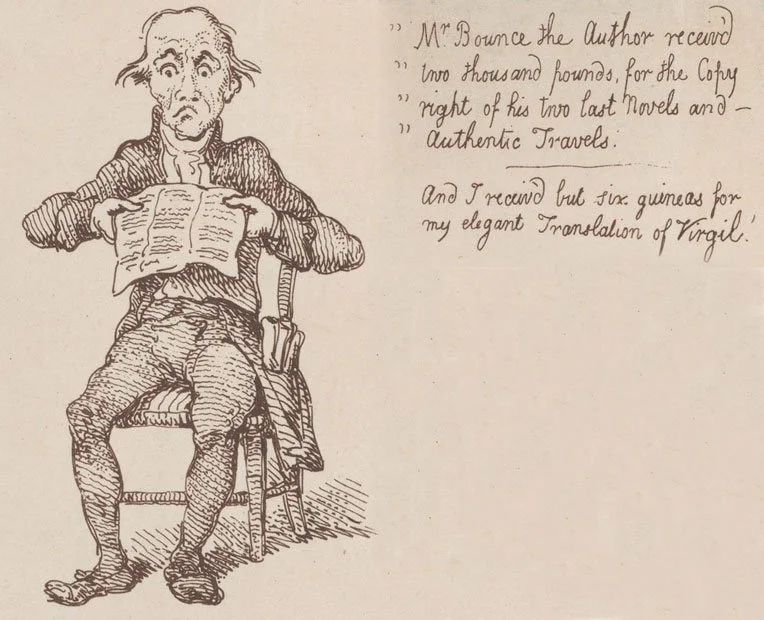
Not everyone was happy about what they read in the papers
Sources for Regency newspapers
The first section of The Bath Chronicle is open about drawing its information from the London papers. Some of what’s printed is probably a word for word copy from the source.
Letters were a common source of news. Again, they were often printed as written, and clearly headed up as being a letter.
It was not unusual for a newspaper to include a poem or two.
Did Regency newspapers have dedicated journalists? The word ‘journalist’ was in common use, referring to the author of news reported in the papers. Today’s concept of the journalist as a professional newsgatherer and reporter developed later in the nineteenth century.
I hope this has given you some insight into the world of Regency newspapers. They were one of the main sources of entertainment at that time, particularly for gentlemen.
Jane Austen, in Persuasion, ranks ‘horses, dogs and newspapers’ as the primary amusements for the Mr Musgroves.
Andrew Knowles researches and writes about the late Georgian and Regency period. He’s also a freelance writer and editor for business. He lives with his wife Rachel, co-author of this blog, in the Dorset seaside town of Weymouth.
If you have enjoyed this blog and want to encourage us and help us to keep making our research freely available, please buy us a virtual cup of coffee by clicking the button below.
Regency History
by Andrew & Rachel Knowles

We research and write about the late Georgian and Regency period.
Rachel also writes faith-based Regency romance with rich historical detail.