The Parish and Church in the Regency English Village

All Saints Church, Burnham Thorpe, Norfolk, where Horatio Nelson’s father was rector (2019)
The church is the most prominent feature in almost every English village. It’s also perhaps the most misunderstood.
That’s the conclusion we’ve come to, after years of research and reading about Regency England. We struggle with the language and structure of the Church of England today - and so do many writers when featuring it in their Regency novels.
The church dominated the Regency landscape
The church towered over village life in the Regency, physically and metaphorically. Churches were usually the tallest building in the area. Churches also controlled many of the festivals and rules that shaped peoples lives.
This is our quick guide to the church in a Regency village. It summarises what anyone researching or writing about rural Regency England needs to know.
It’s important to remember that these are all generalisations. Custom and practice varied from place to place.
The importance of the parish
Everyone in England had someone with responsibility for protecting their soul. That person was the parish priest and their responsibility was the ‘cure of souls’, or spiritual care.
The parish was the area for which the priest had responsibility. The boundaries were ancient, laid down by centuries of custom. It was traditional for the parish priest and others to ‘beat the bounds’ of a parish every year - that is, to walk around its boundary. Typically this was on Rogationtide, the fifth week after Easter.
The parish had a practical responsibility. It had to take care of its own poor, which is why it was important that people knew which was their home parish.
The business of the parish was managed by the vestry, a meeting of all the parishioners who paid the church rate - that is, a local tax. The vestry set the poor rate, another local tax, that was used to care for the most destitute in the parish.
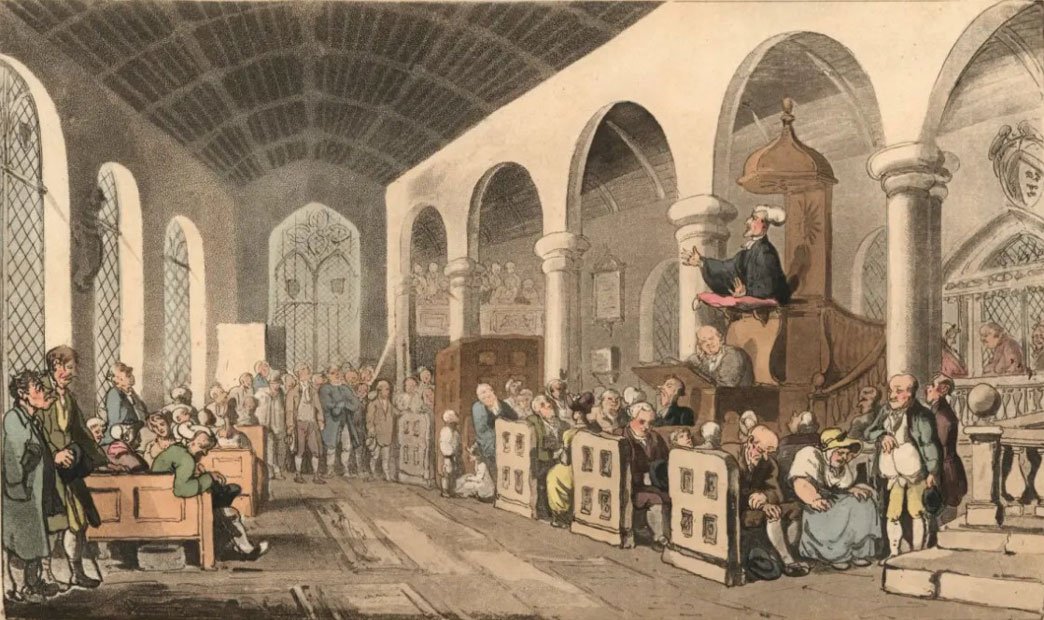
Doctor Syntax preaching by Rowlandson, 1812. A character in a comic poem, he was a poorly-paid rural clergyman.
The people of the parish church
Any one of three different roles had responsibility for cure of souls in a parish, and for taking services, officiating at marriages and the like. They were always men.
Rector - The one responsible for the parish church. Some were ordained ministers; others were laymen and could not lead services.
How could a layman become responsible for a church? Again, it was down to the history and custom related to a particular parish. This history determined who had responsibility for appointing the rector.
The rector was entitled to tithes paid by the parishioners and to farm church land in the parish. Jane Austen’s father was an ordained rector. Some rectors simply took the income from the parish and left the business of the church to a vicar.
In some legal books of the period a rector was also referred to as a parson.
Vicar - The ordained minister who officiated in a parish, representing the rector. Sometimes they were paid a salary, but more often their income was from some of the tithes.
Curate - Typically employed on a salary by the rector or Vvcar to officiate at services, often providing support in smaller chapels in parts of the parish some distance from the main church.
Parish clerk - Responsible for assisting the parish priest, the role gave someone an income and a degree of local prestige.
Sexton - Technically the ‘keeper of the holy things’, they were responsible for practical tasks in and around the church building, including maintenance.
Churchwarden - Laymen who carried out a variety of administrative and practical tasks in the parish. They were appointed annually, sometimes by election by the parishioners.
Churchwardens worked alongside another role appointed annually, that of overseer of the poor. Men in both roles had responsibility for providing work and support for those lacking the money to provide for themselves.
The politics of the parish
This variety of roles, with their differing degrees of status and entitlements to payment, inevitably gave rise to a degree of local politics.
Books on church law record many different disputes within local communities over who was entitled to which role, and what to do with people judged to have failed in their duties.

Tithes
The rector and vicar were paid in tithes. The system of tithing was complex and detailed but suffice to say, most people had to give a tenth of what they earned or grew to the church.
They were divided into great tithes (paid to the rector) and small tithes (paid to the vicar if one was appointed). Again, local custom and practice varied as to who got what. To judge from the volume of legal cases, there were many disputes about what tithes were due on different items in varying circumstances.
The parish register
Every family historian knows the importance of the register. It was the book in which every baptism, marriage and burial was recorded in a prescribed fashion.
The book was so important that the priest kept it close to them. It was often stored at home rather than in the church building, where it was at risk from mould and thieves. There were significant penalties for falsifying or adjusting entries in the register.
If an event wasn’t in the register, it hadn’t happened.
There’s a lot more to Regency village church life - this is simply an introduction.
For more information take a look at Fashionable Goodness: Christianity in Jane Austen’s England.
Andrew Knowles researches and writes about the late Georgian and Regency period. He’s also a freelance writer and editor for business. He lives with his wife Rachel, co-author of this blog, in the Dorset seaside town of Weymouth.
If you have enjoyed this blog and want to encourage us and help us to keep making our research freely available, please buy us a virtual cup of coffee by clicking the button below.
Regency History
by Andrew & Rachel Knowles

We research and write about the late Georgian and Regency period.
Rachel also writes faith-based Regency romance with rich historical detail.