Inuit Visitors to Georgian England
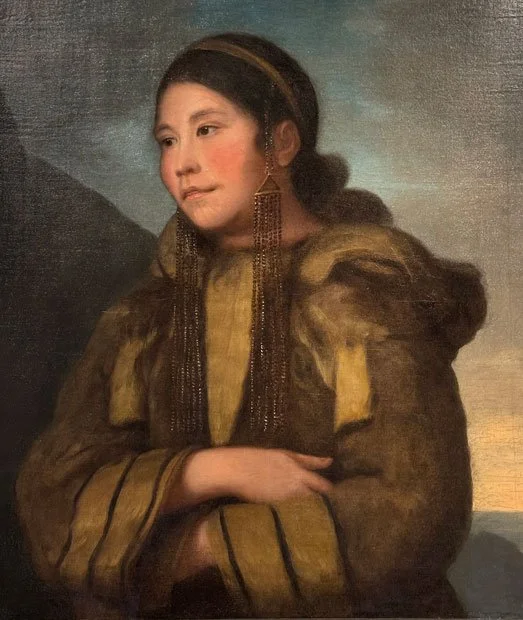
The Woman of Labrador, displayed in the Hunterian Museum
The Woman of Labrador, a portrait displayed, in the Hunterian Museum, London, is probably a depiction of one of the first Inuit to visit England.
She was a 17-year old called Caubvick. The wife of Tooklavinia, she and her husband (aged 19) were both members of a small party of five Inuit brought to London in 1772 by traveller George Cartwright. Their native home was the coast of Labrador, in modern Canada.
Cartwright’s sister gives us this description of Caubvick as:
My favorite of favorites, she is 17 & has the complexion of a bright-brown hassle Nut, & almost by every body thought extremely handsome… She has a happy manner that engages you at once in her favor and there is in her face sense & sensibility, sprightliness, softness, humour, and good humour, conscious innocence, modesty, youthful vivacity, & native worth; & in every action, every attitude, ease, elegance, & fashion.
It seems the Inuit were as keen to visit England as Cartwright was to bring them.
Who are the Inuit?
The Inuit have lived in the coldest areas of North America for at least a thousand years. The term covers a variety of different people groups who share a similar culture.
They are semi-nomadic, moving from place to place to hunt and fish. Cartwright comments in his journal that they were unfamiliar with cultivating crops.
In his writings, Cartwright describes the Inuit either as ‘Indians’ or ‘Esquimaux’. In her letters his sister, Catherine, calls them: ‘the enchanting Innuets (for that is what they call themselves & not Esquimaux).’
Today, the term Eskimo is considered offensive to some.
Caubvick and her party were not the very first Inuit to visit England, but they were certainly among the first.
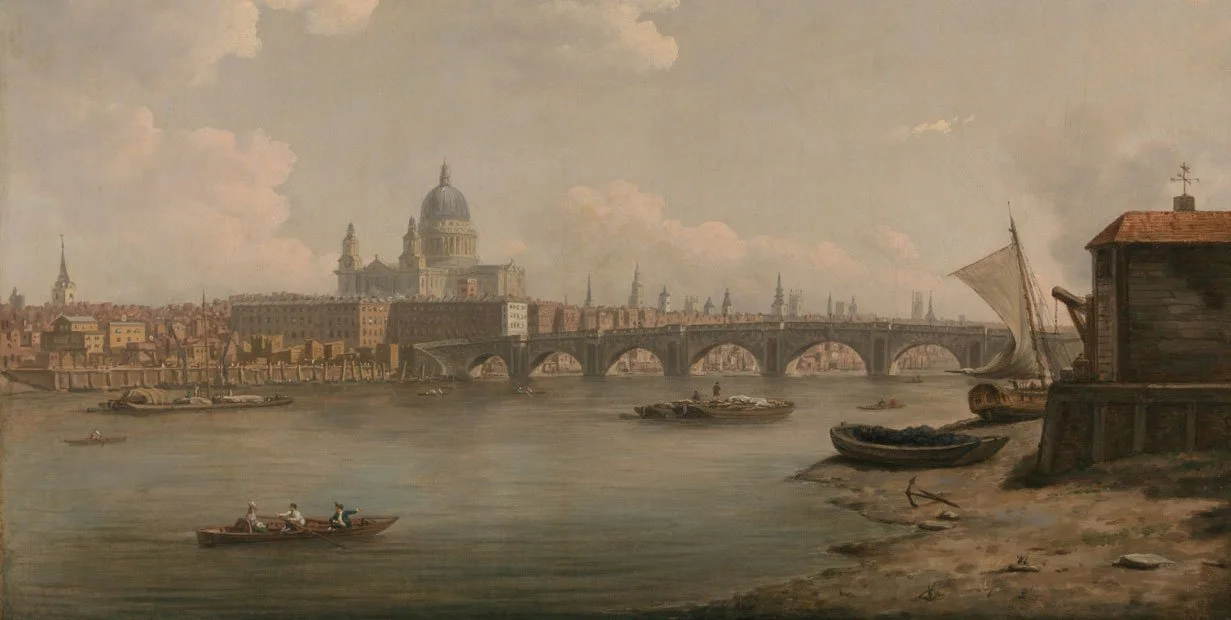
Blackfriars Bridge and St Paul’s Cathedral, London, in the early 1770s, by William Marlow
The Inuit in England
Arriving in London with the Inuit in December 1772, Cartwright immediately hired rooms where people could visit them. This was common practice, as so many were curious to see the inhabitants of distant lands. He took them to the opera, where they were ‘received with a thundering applause.’
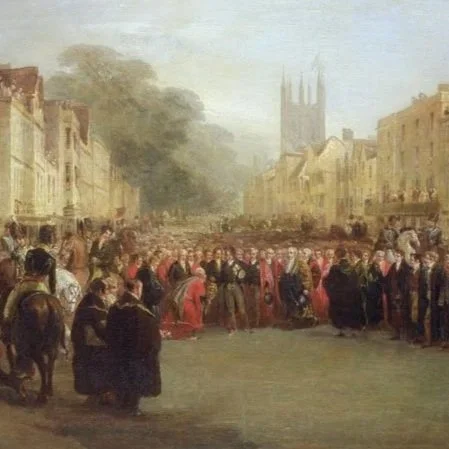
On another occasion, spotting the King inspecting a group of soldiers, Cartwright took his visitors to watch the proceedings.
So great a crowd had gathered round us, as incommoded our view of the troops, and attracted the notice of the King, who then sent general Harvey to order me with the Indians, into the vacant space between the regiment and the recruits. Here his Majesty rode slowly past them, and condescended to salute them by taking off his hat, accompanied with a gracious smile; honours which they were highly pleased with, and often mentioned afterwards with great exultation.
Cartwright was also keen to show off London to his visitors. He arranged for one of the men to wear clothing that allowed them to travel unrecognised, so that he might give a tour of the Tower of London.
Encountering a very different culture
It’s unfortunate that we do not have an account of the Inuit visit to England from their perspective. This would allow us to hear what they thought about the differences between they world and the one Cartwright presented to them.
All we have is his, and Catherine’s, observations. He recorded that they could only count to 21, and they initially believed bridges over the River Thames were natural rock structures, as was St Paul’s Cathedral.
He also commented that their clothes, made from animal skins, ‘had a dirty appearance and an offensive smell’. He arranged a supply a broadcloth, flannel and other material, for the women to make new clothes:
And being excellent taylors, soon clothed them all anew; preserving their own cut of their garments.
While he may have considered their culture to be relatively primitive, he did not insist that they adopted Georgian fashion.
Cartwright did note down a few words from Attuiock, the other Inuit male in the party. After a day being shown various sights in London, he’s recorded as saying:
I am tired; here are too many houses; too much smoke; too many people; Labrador is very good; seals are plentiful there; I wish I was back again.
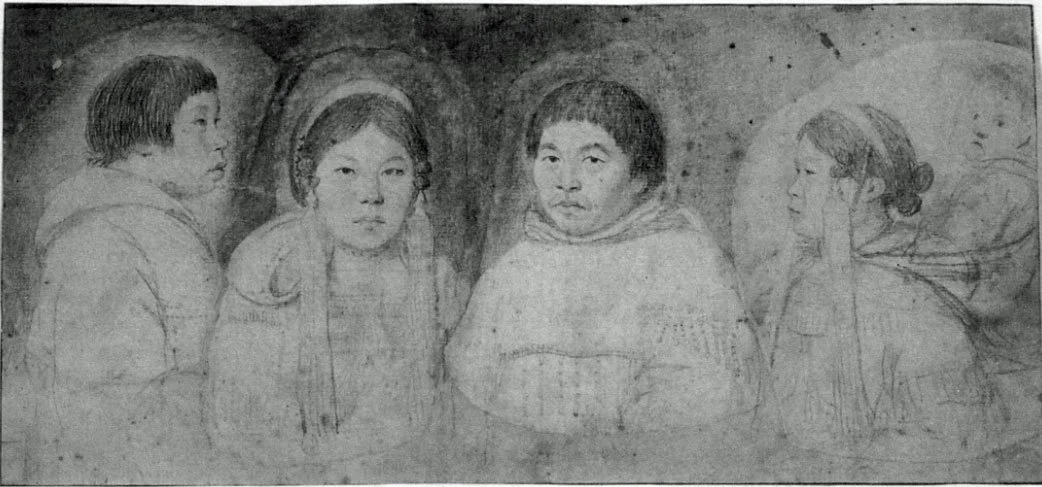
The five Inuit who travelled to London with George Cartwright - two couples and a small child
A frightening moment with John Hunter
Cartwright took the Inuit to visit surgeon John Hunter. His anatomical collection is now the Hunterian Museum in London, where Caubvick’s portrait hangs. Hunter was insatiably curious, particularly about anatomy, and a keen collector of specimens.
He was keen to meet people from different races and to capture their likeness, which is probably why the portrait was made.
During the visit Attuiock went to explore Hunter’s premises, and came back ‘with evident marks of terror’. According to Cartwright:
He seized hold of my hand, and eagerly pressed me to go along with him. I asked the cause of his emotion, but could get nothing more from him than “Come along, come along with me,” and he hastily led me into a room in the yard, in which stood a glass case containing many human bones. “Look there,” says he, with more horror and consternation in his countenance, than I ever beheld in that of man before, “are those the bones of Esquimaux whom Mr. Hunter has killed and eaten? Are we to be killed? Will he eat us, and put our bones there?“
This threw all the Inuit into a panic, while the English present broke out ‘into a sudden and hearty laugh’.
I explained to them that those were the bones of our own people, who had been executed for certain crimes committed by them, and were preserved there, that Mr. Hunter might better know how to set those of the living, in case any of them should chance to be broken; which often happened in so populous a country.
The Inuit in Nottinghamshire
After a few weeks in London, Cartwright took his visitors to Marnham, in Nottinghamshire. It was here that his sister, Catherine, met them and noted that ‘we devoted our whole time & attention to the enchanting Innuets’.
She wrote of how the Inuit loved music and were fond of dancing.
Particularly Caubvic who dances as genteel a Country dance & moves thro’ the figure of minuet as most you will meet with.
Catherine Cartwright noted that the Inuit were fast learners. Having adopted European behaviours such as eating with a knife and fork, they were ‘much genteeler than many ladies & Gentlemen indeed nobody can exceed them in those respects.’
But there was a sadness to Caubvick. She was at her most relaxed, and ‘quite enchanting’ only when the other Inuit were not around. It seems her husband’s clan had stolen her, to marry against her wishes.
When it was time to begin the journey home, Caubvick ‘look’d as if a hand of cold iron had slowly grasp’d her heart.’ She made a point of taking leave of all the servants individually.
A tragic end to their journey
In May 1773 Cartwright had commenced the journey taking the Inuit back across the Atlantic when Caubvick fell sick with smallpox.
So soon as Caubvic's disorder was discover'd, the others were kept upon deck & prepared for inoculation & were very conformable to rule, but the day the operation was to be perform'd Econgoke [another Inuit] began to complain which shew'd the infection was spreading of itself.
Caubvick recovered but the rest of her party died. It’s likely they were cremated on a beach near Plymouth.
Cartwright took Caubvick back to Labrador, where she rejoined her people. What became of her after that we do not know.
She bore the scars of smallpox and I’d like to think she was treated with respect by her fellow Inuit. Perhaps she spent many evenings entertaining them with tales of her time in a world very different to theirs—that of Georgian London.
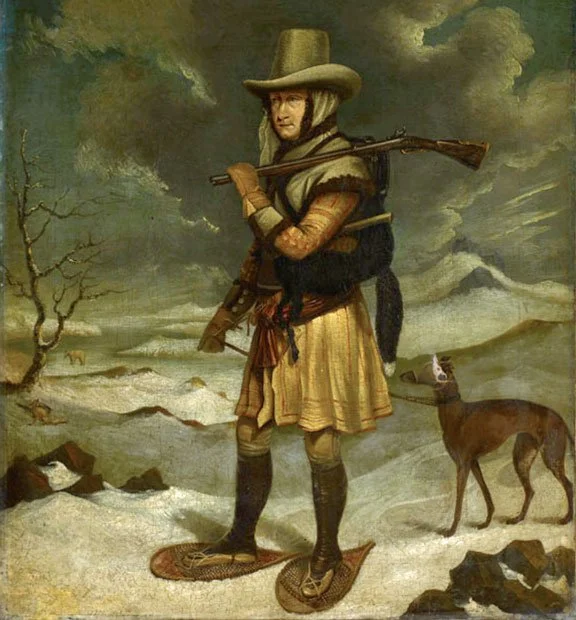
Captain George Cartwright, trader and explorer
Andrew Knowles researches and writes about the late Georgian and Regency period. He’s also a freelance writer and editor for business. He lives with his wife Rachel, co-author of this blog, in the Dorset seaside town of Weymouth.
If you have enjoyed this blog and want to encourage us and help us to keep making our research freely available, please buy us a virtual cup of coffee by clicking the button below.
Sources
A journal of transactions and events during a residence of nearly sixteen years on the coast of Labrador by George Cartwright (1792)
‘Our Amazing Visitors’: Catherine Cartwright’s Account of Labrador Inuit in England by M Stopp and G Mitchell, Artic, December 2010
Regency History
by Andrew & Rachel Knowles

We research and write about the late Georgian and Regency period.
Rachel also writes faith-based Regency romance with rich historical detail.