Recruitment Stories of Regular Soldiers in the British Army
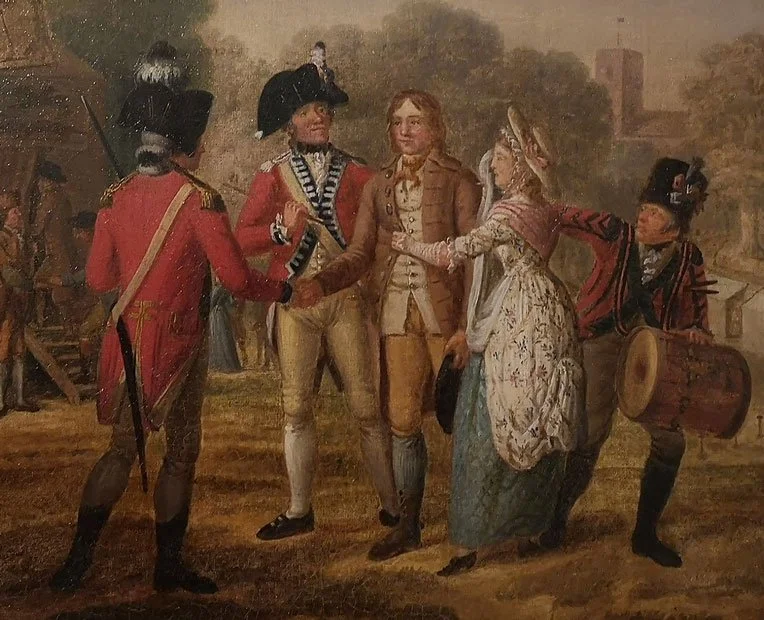
A young man agrees to ‘take the King’s shilling’, despite pleas from a young woman.
Almost one million men served in the British Army during the long years of war against the French, from 1793 to 1815.
Most were regular soldiers who often endured a hard life, particularly on campaign. They might be required to sleep outdoors in atrocious weather, scavenge for food, and march and fight barefoot having lost (another) pair of shoes or boots.
What motivated so many young men to join up for a life of harsh discipline, enforced travel and—above all—the increased risk of death or injury?
Every one of those million or so soldiers had their own reasons. Most of their stories are lost to us, but not all. Here are two that I’ve become aware of.
A soldier of the 71st Regiment Highland Light Infantry
This story was first told in 1819, with the publication of an account by a soldier known only as Thomas, born about 1790.
I was born of poor but respectable parents, in Edinburgh, who bestowed upon me an education superior to my rank in life. It was their ambition to educate me for one of the learned professions; my mother wishing me to be a clergyman, my father, to be a writer. They kept from themselves many comforts, that I might appear genteel, and attend the best schools: my brothers and sister did not appear to belong to the same family.
Thomas’s father became sick. The cut in the family income lost Thomas some of his ‘usual comforts’, and in frustration he gave up on education. He made new acquaintances who ‘had formed themselves into a spouting club, where plays were acted to small parties of friends’.
From stage to parade ground
Encouraged by his new associates, Thomas determined to become an actor and secured a trial opportunity at an Edinburgh theatre.
I was born of poor but respectable parents, in Edinburgh, who bestowed upon me an education superior to my rank in life. It was their ambition to educate me for one of the learned professions; my mother wishing me to be a clergyman, my father, to be a writer. They kept from themselves many comforts, that I might appear genteel, and attend the best schools: my brothers and sister did not appear to belong to the same family.
Thomas’s father became sick. The cut in family income lost Thomas some of his ‘usual comforts’, and in frustration he gave up on education. He made new acquaintances who ‘had formed themselves into a spouting club, where plays were acted to small parties of friends’.
Encouraged by his new associates, Thomas determined to become an actor and secured a trial opportunity at an Edinburgh theatre.
Intoxicated with joy, I went home to my parents. Never shall the agony of their looks be effaced from my memory. My mother's grief was loud and heart-rending, but my father's harrowed up my very soul. It was the look of despair - the expression of his blasted prospects.
Ignoring his parents’ disapproval, Thomas persisted in taking to the stage to prove his acting capabilities. He took his place in front of a packed house:
I came upon the stage with a fluttering heart, amidst universal silence. I bowed, and attempted to speak; my lips obeyed the impulse, but my voice had fled.
Silenced by stage fright, he fled and wandered the streets all night: ‘bewildered, and in a state of despair’.
In the early hours of the morning, he met a party of army recruits about to board a ship for the south of England. He rashly offered to join them and so, in July 1806, aged 16, he began his life as a regular soldier.
According to his published account, Thomas saw service in South America, in the Peninsula War and at Waterloo.
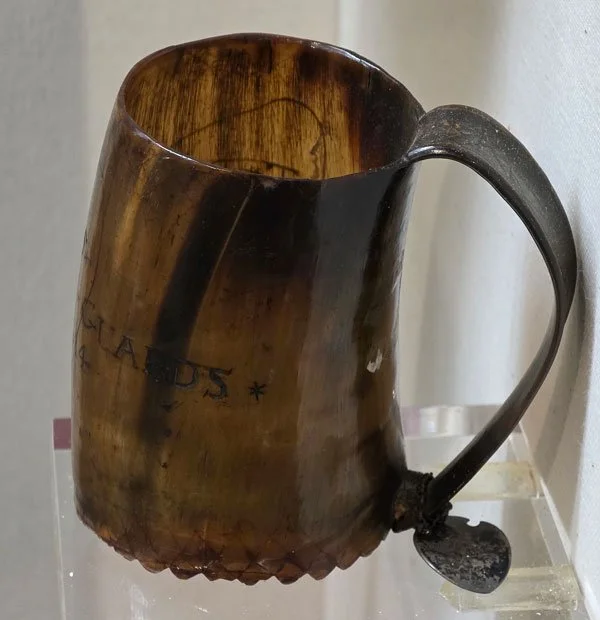
A rare survivor - the horn mug of a British private soldier from France 1814. Men had to carry all their possessions on their travels.
The recruitment of Rifleman Harris
The second story of a young man who became a soldier begins at the other end of Great Britain, in Dorset. Here, in one of England’s southern-most counties, he worked with his father.
My father was a shepherd, and I was a sheep-boy from my earliest youth.
While his full name is not given in his account, others have researched Harris and established his first name was Benjamin, and he was born in October 1781.
Whilst I continued to tend the flocks and herds under my charge, and occasionally (in the long winter nights) to learn the art of making shoes, I grew a hardy little chap, and was one fine day in the year 1802 drawn as a soldier for the Army of Reserve.
While the British Army relied on volunteers for its overseas campaigns, there were not enough men to fill the ranks of the militia - troops responsible for local defence.
The Militia Act of 1802 allowed authorities in each county to draft men into uniform for a term of five years. Benjamin Harris was one of these.
It was possible to buy yourself out of the draft, by paying for a substitute. Benjamin’s father tried to do this, and also claimed his son was maimed, having broken a finger as a child. I assume it healed badly, and the damage remained visible.
However, the recruiting sergeant of the 66th Regiment of Foot insisted Benjamin ‘was just the sort of little chap he wanted’.
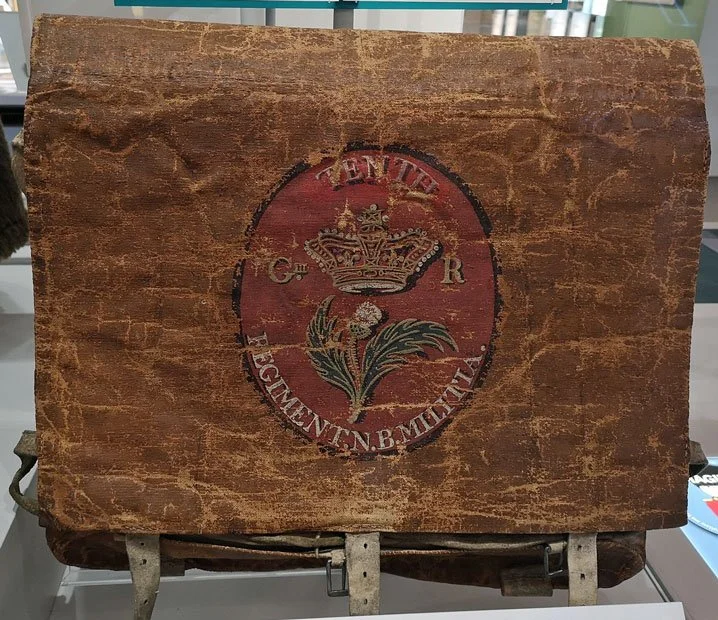
Benjamin may have been issued with a knapsack such as this one, in which to carry all his possessions.
From militia man to regular soldier
Benjamin’s regiment was soon sent to Ireland. By now he’d become used to military life and was perhaps bored with his experience in the militia.
Whilst in Dublin, I one day saw a corps of the 95th Rifles, and fell so in love with their smart, dashing and devil-may-care appearance, that nothing would serve me till I was a Rifleman myself.
Recruiting regular soldiers from the militia was not unusual. Benjamin’s new associates in the 95th were all Irish, and many were drawn from the local militia.
His military service in the 95th Rifles included action in Denmark, the early Peninsular War and the Walcheren campaign of 1809. Benjamin was one of the many who became sick during that last expedition and, like many, he never fully recovered. This put an end to his campaigning days.

British soldiers from the Napoleonic period, as portrayed by re-enactors.
Andrew Knowles researches and writes about the late Georgian and Regency period. He’s also a freelance writer and editor for business. He lives with his wife Rachel, co-author of this blog, in the Dorset seaside town of Weymouth.
If you have enjoyed this blog and want to encourage us and help us to keep making our research freely available, please buy us a virtual cup of coffee by clicking the button below.
Sources
A Soldier of the Seventy First by Joseph Sinclair (1819)
The Recollections of Rifleman Harris edited by Christopher Hibbert (1970)
Regency History
by Andrew & Rachel Knowles

We research and write about the late Georgian and Regency period.
Rachel also writes faith-based Regency romance with rich historical detail.