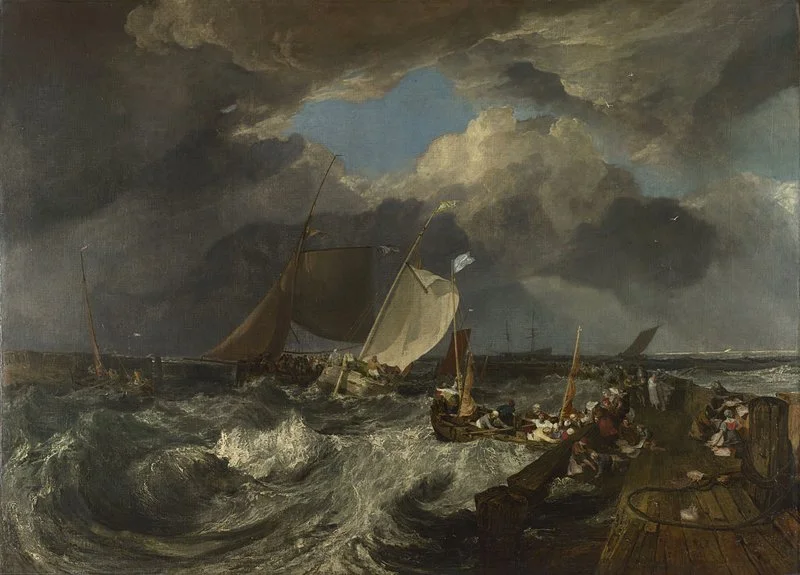
Calais Pier by JMW Turner, 1803. Lots of Grand Tourists began their journey here, including the artist himself.
When you visit almost any historic house in England, you’re likely to be shown souvenirs from a previous owner’s Grand Tour.
Almost every aristocratic young man of the Georgian era seems to have made that educational trip into Europe.
Rachel, co-author of this site, loves to read Regency romances. A host of the heroes in these novels have also taken the Grand Tour.
But was the tour possible for young men of the Regency era? From 1793 through to the Battle of Waterloo, in June 1815, Britain was almost continuously at war with France. This prevented the relatively easy travel into Europe that facilitated the Grand Tour of the eighteenth century.
Hence the questions: did Regency gentlemen (and indeed, ladies), take the tour, and if so, where did they go?
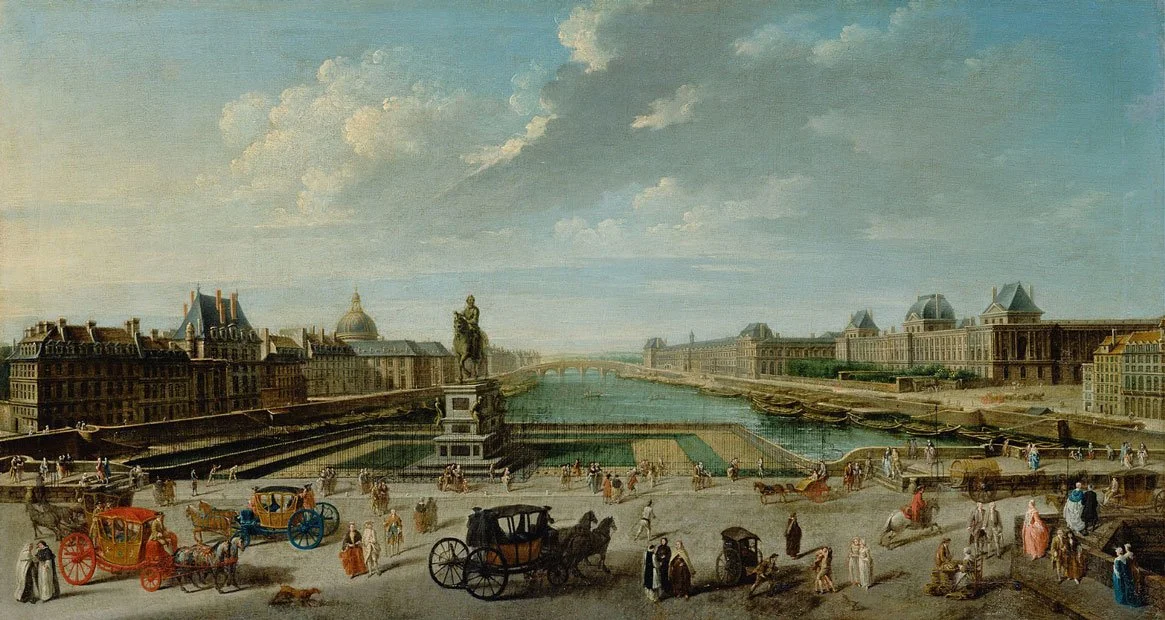
Paris in 1760, looking along the River Seine from the western end of the Île de la Citié. Paris was major stopover on the Grand Tour until the French Revolution.
The heyday of the Grand Tour
For generations before the Georgian era, the wealthy had sent some of their young men to be educated in Europe. The trip became so well known that in a book published in 1670, Richard Lassels referred to ‘the Grand Tour of France, and the Giro of Italy’.
Eighty years later, in 1749, Thomas Nugent published his four-volume guide titled ‘The Grand Tour’. The mid to late eighteenth century saw a surge of travellers crossing the Channel to explore Europe, with most heading for Paris and then Rome.
This is Hester Thrale’s summary of Paris, written during her visit in 1775:
The Extremes of Magnificence & Meanness meet at Paris: Extremes of every sort are likewise perpetually meeting.
Yesterday I was shewn a Femme Publique dress'd out in a Theatrical Manner for the Purpose of attracting the Men with a Crucifix on her Bosom; & today I walked among the beautiful Statues of the Tuileries, a Place which for Magnificence most resembles the Pictures of Solomon's Temple, where the Gravel is loose like the Beach at Brighthelmstone, the Water in the Basin Royale cover'd with Duck Weed, & some wooden Netting in the Taste of our low Junketting Houses at Islington dropping to Pieces with Rottenness & Age.
For many, the climax of their Grand Tour was to reach Rome. Historian Edward Gibbon, who visited in the 1760s, described it as ‘the great objective of our pilgrimage’. Writing a quarter of a century after his visit, he said: ‘I can neither forget nor express the strong emotions which agitated my mind as I first approached and entered the eternal city’.
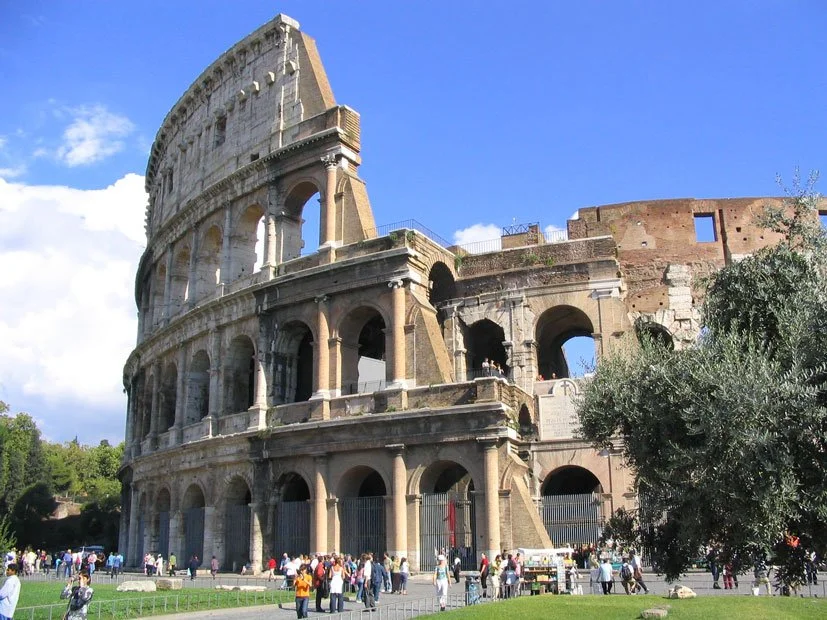
Most Grand Tourists had their sights set on making it to the Eternal City - Rome
The Tour disrupted by revolution
The French Revolution of 1789 made travel through France a much more daunting prospect. It became almost impossible from 1793, when Britain joined the war against its revolutionary neighbour. This war ran almost continuously until 1815, when it ended at Napoleon’s defeat at Waterloo.
There were two brief interludes of peace, during which the British flocked to Paris and beyond. The first was in 1802-3, the second in 1814-15. At the end of both, British tourists had to flee. Not all escaped, becoming trapped in France. Maria Edgeworth’s brother was captured in 1803 and held prisoner for over ten years. Others, like Bertie Greatheed, were more fortunate.
But these wars didn’t stop travellers from finding their way to Europe, by going around France.
A selection of Regency tourists
Thomas Noel Hill, 2nd Baron Berwick of Attingham, travelled to Germany, Switzerland and Italy in 1792-94.
Edward Daniel Clerk, clergyman and naturalist, travelled with Baron Berwick in the early 1790s. In 1799 he took another tour, beginning in Scandinavia and taking in Russia and, eventually, Egypt.
Mariana Starke went to Italy, via France, and spent much of the 1790s in the country. She made a second visit in 1817-1819.
Henry Greville, 3rd Earl of Warwick, took a tour from 1801, also starting in Scandinavia. He found his way to Italy in 1803.
George Hamilton-Gordon, 4th Earl of Aberdeen, took advantage of the peace of 1802 to begin his travels in Europe. He’s said to have met Napoleon.
Rev. John Eustace took a long tour in Italy in 1802-3, having crossed into the country from Austria.
Lord Byron sailed to Portugal in 1809 to begin his tour of the Mediterranean. He got as far as Constantinople (today called Istanbul) before coming home in 1811. He returned to mainland Europe in 1816 and never returned to Britain.
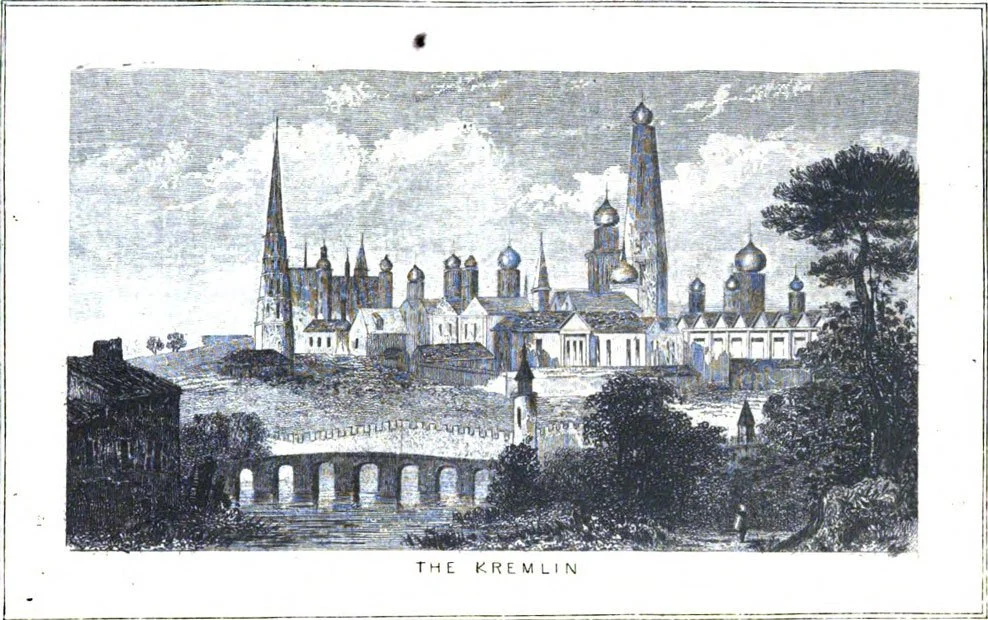
The Kremlin, Moscow, from Edward Clarke’s Travels in Russia, Tartary and Turkey, which recounts part of his trip in the early 1800s. This wasn’t on the itinerary for most Grand Tourists.
A Tour through Italy during the war years
In 1813, when Britain was still at war with France, John Eustace published the first of his books ‘A Tour Through Italy’. He starts by giving lots of advice to other travellers, including a suggested route. Begin, he says, in Brussels, then head east towards Germany, then south through the Alps to Italy.
He included this warning about Italian inns:
A few words upon the inns and accommodations in Italy will be sufficient. An English traveller must the very instant he embarks for the Continent resign many of the comforts and conveniences which he enjoys at home and which he does not sufficiently prize because he is seldom in the way of learning their value by privation. Great will be his disappointment if on his arrival he expects a warm room, a newspaper and a well stored larder. These advantages are common enough at home but they are not to be found in any inn on the Continent.
Eustace began his own tour in 1801. Through his books he makes many references to the ‘recent spoliations of the French’. Over and over he laments how the invaders destroyed or stole historic art and artifacts.
Yes, the Grand Tour was possible during the Regency era
While many were deterred from travel during the war years, it’s clear that it didn’t stop the more intrepid. Paris and other French cities were off the itinerary, but there was still plenty to see in northern and eastern Europe, along with Italy, Greece and Egypt.
There was always the slight risk of encountering a French army. But that was just one additional hazard alongside thieves, bandits, shipwreck and, of course, those uncomfortable Continental inns.
Andrew Knowles researches and writes about the late Georgian and Regency period. He’s also a freelance writer and editor for business. He lives with his wife Rachel, co-author of this blog, in the Dorset seaside town of Weymouth.
If you have enjoyed this blog and want to encourage us and help us to keep making our research freely available, please buy us a virtual cup of coffee by clicking the button below.
Sources include:
The Grand Tour by Thomas Nugent (1749)
A Classical Tour Through Italy by John Eustace (4 vols, 1813-1817)
Memoirs of the Life of Edward Gibbon (1900)
The French Journals of Mrs Thrale and Doctor Johnson (1932)
Regency History
by Andrew & Rachel Knowles

We research and write about the late Georgian and Regency period.
Rachel also writes faith-based Regency romance with rich historical detail.