Book Review: Neighbours and Rivals
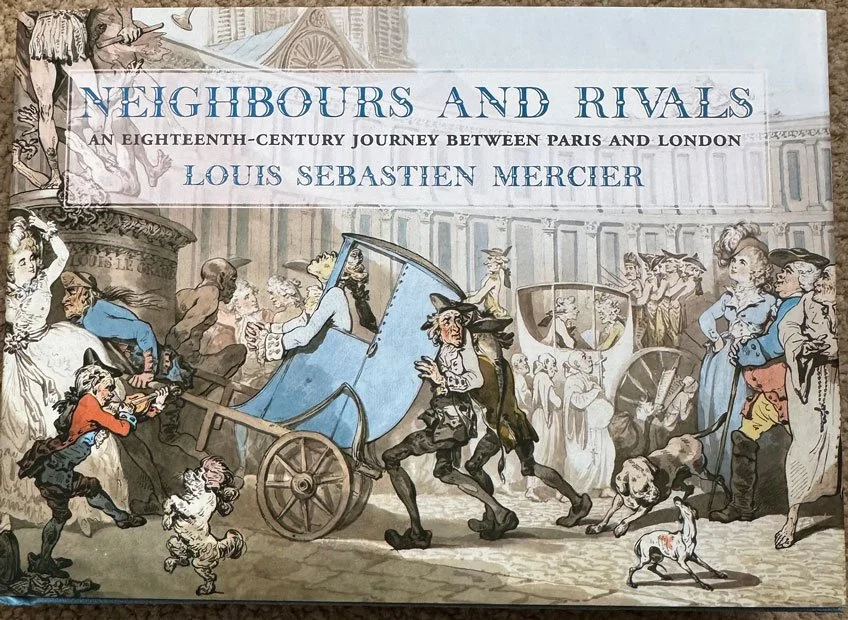
An 18th century journey between Paris and London
Louis Sebastien Mercier
Edited by Jonathan Conlin and Laurent Turcot
Published by Pallas Athene
The subtitle of this delightful book is a little misleading. Louis Sebastien Mercier didn’t describe a journey between Paris and London. In this work he makes many different comparisons between the two cities, looking at subjects such as theatres, hospitals, what happens on a Sunday and even the number of animals.
Neighbours and Rivals was written around 1780. Mercier didn’t give it a title, nor was it published. It was first printed, in French, in 1982. This is the first English translation.
Mercier’s comparison of Paris and London is no set of stiff statistics, lifeless lists and dry observations. It’s a lively and opinionated romp through two similar, yet different, capital cities, made all the more accessible through being presented in modern English.
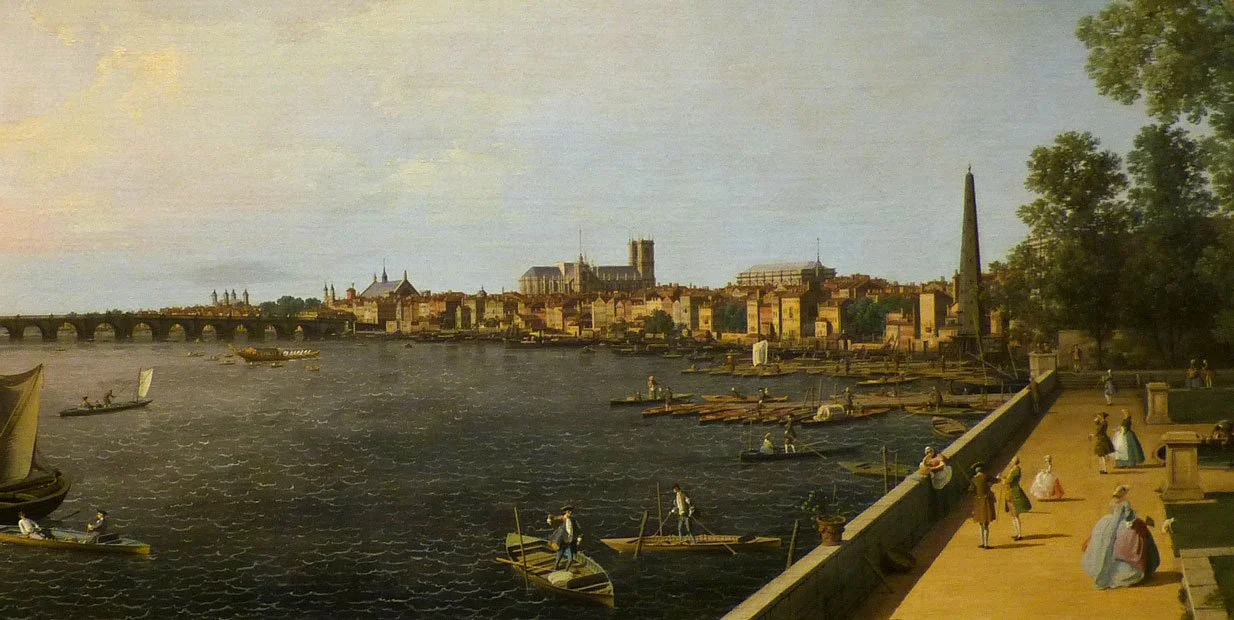
London, viewed from Somerset House, by Canaletto c.1750
The author: Louis Sebastien Mercier
LSM, as he’s called in the footnotes, was a prolific French writer. He was a Parisian, born in 1740 and dying in his home city in 1814.
An author of pamphlets, plays and novels from an early age, he became well known after publishing a fantasy set in the far future, the year 2440. It was one of the creative ways he used to criticise the society he observed.
In the 1780s, LSM published 12 volumes of Le Tableau de Paris, a detailed portrait of day-to-day life in the great French city, in the final years before the Revolution. Unlike so many other books from that time, it’s not a guide to the buildings and monuments—but an opinionated study of a cross-section of urban society, from nobles and priests to street peddlers and criminals.
It’s a similar style to that of Neighbours and Rivals—and it got him into trouble. It seems that early volumes of Le Tableau met with official disapproval, and LBS had to complete that work in Switzerland.
The editors of Neighbours and Rivals suggest that LSM may have never published his comparison because it took his criticism even further, by being too anglophile.
The book certainly existed in a form that LSM could have published. The introduction asserts that ‘the state of the manuscript reproduced here certainly suggests it was the product of careful thought, rather than a series of notes made on the spot.’
Those notes, which he must have made, were taken in 1780 when LSM visited London. The precise dates of his trip are unknown, but references to the Gordon Riots, in June of that year, suggest he was an eye-witness.
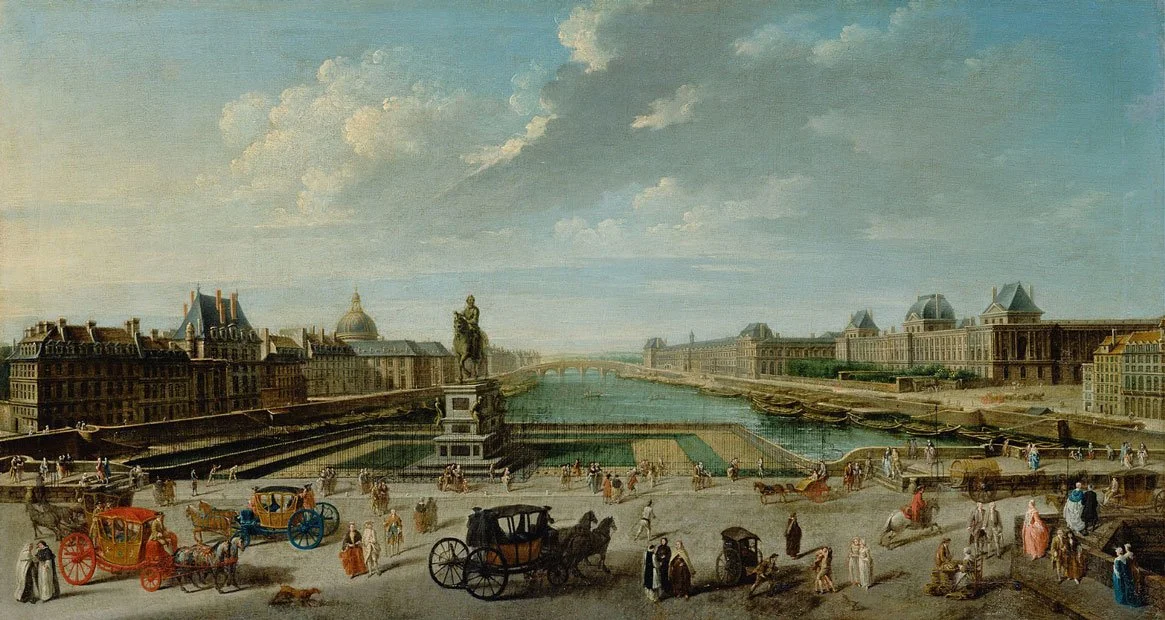
Paris from the Pont Neuf, by Nicholas-Jean-Baptiste Raguenet, 1763
Paris and London in a new style of writing
LSM is often described as a journalist, with a style that’s emotive, reflective and optimistic. It’s flavoured with a rich vein of humour.
The book is divided into 64 short chapters, each addressing a specific subject. Titles include:
Of the carriages in London
Taste for paintings in London
The houses of Paris and the houses of London
On the execution of improvement projects in Paris and London
Changes in the relationship between Paris and London caused solely by kings
As these titles imply, LSM has wide-ranging opinions about matters including government, urban development, culture and commerce.
In a chapter titled ‘Paris Merchant and London Merchant’ he wrote:
Walk into a shop in Paris and you are invited to take a seat, each party salutes the other, you talk of a thousand different things while you bargain, even about the shopkeeper’s family or public events, haggling, much haggling over the price.
In London you walk into a shop without any greeting, and without taking off your hat. You drily state what it is that you want, whereupon the person doesn’t give you some lengthy reply or salutation, they just go and get the article and show it to you.
When it comes to shopping, as with most other aspects of city life, LSM positions London as similar to Paris, but better. Some of his observations are optimistic, such as his comment that most in London are ‘deeply impressed by education and respect for the laws.’
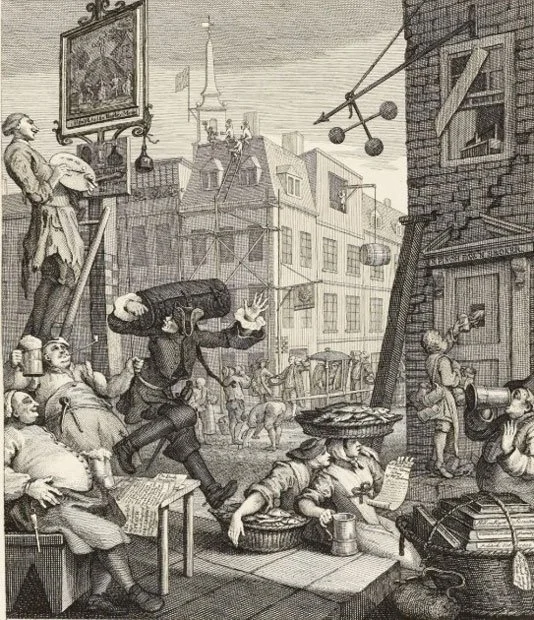
A less flattering view of London. Hogarth’s Beer Street, 1751
Who this book is for
Neighbours and Rivals provides entertaining glimpses into the twin worlds of London and Paris in 1780, supported by a wealth of contemporary images by the likes of Rowlandson and Gillray. They include a mix of cityscapes and street scenes, as well as cartoons or caricatures.
There’s a helpful list of illustrations at the back, along with a list of references and a glossary.
This book is for anyone with an interest in late Georgian London or Paris. Available for the first time in English, it offers many of us a new perspective on familiar themes and places.
The London that’s portrayed is more utopian than it was in reality, but as LSM himself states in the final section, his aim is to provoke Paris into improving itself. His book closes with this appeal:
Oh, poor humans, French or English! Compete among yourselves, well and good, but without destroying and detesting each other, without despising each other so relentlessly…
Neighbours and Rivals by Louis Sebastien Mercier is edited by Jonathan Conlin and Laurent Turcot and published by Pallas Athene. You can view sample pages on their website.
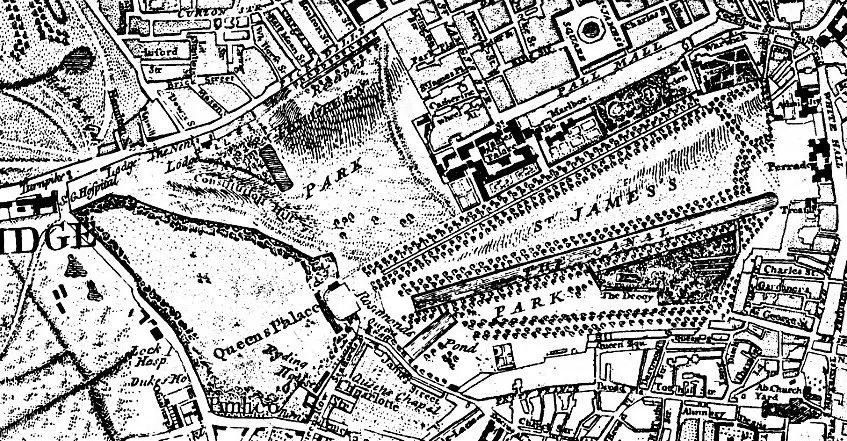
A section of Rocque's Map of London 1741-5 showing the Queen’s Palace and St James’s Park
Andrew Knowles researches and writes about the late Georgian and Regency period. He’s also a freelance writer and editor for business. He lives with his wife Rachel, co-author of this blog, in the Dorset seaside town of Weymouth.
If you have enjoyed this blog and want to encourage us and help us to keep making our research freely available, please buy us a virtual cup of coffee by clicking the button below.
Notes or sources
This is one source
This is another
Regency History
by Andrew & Rachel Knowles

We research and write about the late Georgian and Regency period.
Rachel also writes faith-based Regency romance with rich historical detail.