Were there tigers in the Regency?

Cabriolet from Driving for Pleasure by Francis T Underhill (1896)
What is a tiger?
I’m not talking about the animal. There was definitely that sort of tiger in the Regency. You could even see one in London if you visited the Royal Menagerie at Exeter ’Change or at the Tower of London.

Tigers at the Royal Menagerie at Tower of London by W Webb after H Berthaud (1830)
Tigers as grooms
The sort of tiger this post is about is the groom. More specifically, the jockey-sized groom who stood on a perch behind a gentleman driving his own carriage.
Having grown up reading Georgette Heyer, who often referred to a tiger in this way, I never questioned it. Until my editor daughter (who did not grow up reading Heyer) asked me what I meant by a tiger.
This sent me scurrying off to my sources to back up my use of the word. Various Regency sites include the word tiger in their glossaries, but I was keen to find a contemporary source.
There was no entry in etymology online. Not altogether a surprise, as I thought it might be a slang term used in sporting circles.
I tried Francis Grose’s 1811 Dictionary of Buckish Slang, University Wit, and Pickpocket Eloquence. No entry. Then I tried John Bee’s 1823 Slang, a dictionary of the turf, the ring, the chase, the pit, of bon-ton and the varieties of life followed by several books by Pierce Egan. Still nothing.
The only slang dictionary where I found an entry is John Camden Hotten’s 1864 Slang Dictionary. Here, there are two entries for tiger:
Tiger, a parasite; also a term for a ferocious woman.
Tiger, a boy employed to wait on gentlemen; one who waits on ladies is a page. 1
Hmm. Interesting. Nothing relating to a tiger being a small groom.
Searching for references to tigers in sources other than dictionaries is problematic as it draws up lots of references to wild animals. However, I tracked down a few.
In A Military Fashionable from The Guards—a Novel (1828), there are several references to tigers, and there is an aside explaining what the author means by the term:
It should be explained, that the word “tiger,” in fashionable slang, means a useful hanger-on—half companion, half agent—half tyrant, half servant—attached to the fortune, if not to the person, of wealthy young men about town. 2
Yet another definition of tiger!
Groom-tiger-boys
The earliest reference I found to a tiger as a groom was in Paris Lions and London Tigers by Harriette Wilson, which was first published in 1825:
He was sitting at the window of his hotel, in a musing, and very melancholy attitude, when his groom-tiger-boy, Tom, presented him a letter.
But—and it’s a big but—this is not the only reference to tigers that Harriette Wilson made. She wrote:
Mr Callam, who has just arrived, in Paris, to perform a part in my menagerie, lost his father, at the age of five and twenty, and, by his death, he became commander in chief, or rather sole commander of the soap-trade.
After duly mourning, and wearing a crape hat-band, till it was rusty, my Tiger began to think, seriously, of matrimony. 3
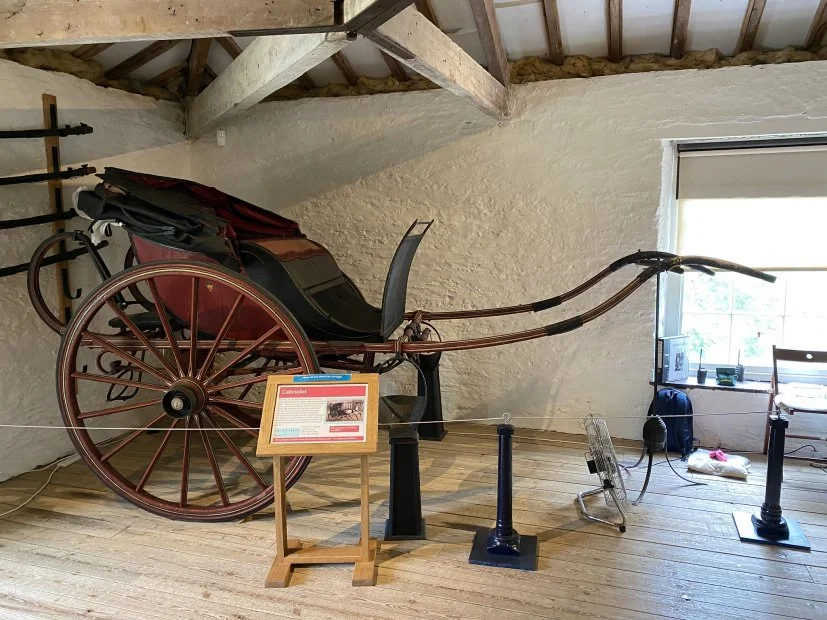
Cabriolet at the National Trust Carriage Museum at Arlington Court (2023)
Cab boys
I found another reference to tigers in a novel by Edward Bulwer Lytton called Pelham, Or, The Adventures of a Gentleman, first published in 1828.
My cabriolet was at the door, and I was preparing to enter, when I saw a groom managing, with difficulty, a remarkably fine and spirited horse…I sent my cab boy (vulgo Tiger) to inquire of the groom, whether it was to be sold… 4
A cabriolet was a two-wheeled carriage, and like a curricle, it was driven by its owner. It had a platform behind the body where a groom could stand and was distinctive because of its seashell-shaped body. Unlike a curricle, it had a hood and an apron to protect the driver and his passenger from the elements, and this added weight made balance more critical.
According to the Arlington Court carriage brochure, the cabriolet was introduced from France in about 1810, but it wasn’t until the 1830s that it overtook the curricle in popularity. The groom of a cabriolet was known as a tiger. He was often the size of a flat-race jockey and was carried on no other carriage type. 5
London tigers
Modern Carriages by Sir Walter Gilbey (1905) also connects tigers with cabriolets. He quotes GN Hooper’s Suspension of Road Carriages (1899):
The cabriolet requires still more attention to the balance (than the dog cart) for it must be built strongly to be safe. It carries a heavy body, and the weight of the groom, who stands behind, tends to alter the shape of the shafts…As the groom almost always stands behind, he really helps to remove some of the weight from the horse’s back, and the balance should be arranged as if he were always in his place.
These carriages were greatly improved about fifty years ago by the well-known Count d’Orsay and the late Mr Charles B Courtney, who greatly refined the outlines and proportions, making them lighter, more compact and far more stylish. They became par excellence the equipage of the jeune noblesse, and no more stylish two-wheel carriages for one horse were driven for many years while they were fashionable. A large well-bred horse was a necessity and this the cabriolet generally had.
The groom, or “tiger,” as he was then called, was a special London product: he was produced in no other city, British or foreign; all the genuine tigers hailed from London. His age varied from fifteen to twenty-five. Few there were that were not perfect masters of their horses, were they ever so big. In shape and make he was a man in miniature, his proportions perfect, his figure erect and somewhat defiant; his coat fitted as if it had been moulded on him; his white buckskin breeches were spotless; his top boots perfection; his hat, with its narrow binding of gold or silver lace, and brims looped up with gold or silver cord, brilliant with brushing, was worn jauntily. As he stood at his horse’s head, ready to receive his noble master, you might expect him to say, “My master is a duke, and I am responsible for his safety.” 6
In summary, a tiger was:
From London
Young (aged 15–25)
A small man
Very skilled with horses
and he wore:
A tight-fitting coat
Spotless white buckskin breeches
Perfect top boots
A well-brushed hat bound with gold or silver lace, with brims looped up with gold or silver cord, worn at a jaunty angle
This gives the impression of a superior groom for a superior carriage. Did all tigers dress like this? It is impossible to know. This was one author’s impression, and as he was writing about tigers in 1899, he was referring to the way he remembered them about 50 years earlier, around 1850. Long after the Regency had finished.
Did tigers wear yellow and black striped waistcoats?
In his description of a tiger’s appearance, Hooper makes no mention of him wearing a black and yellow striped waistcoat—the only part of the tiger’s garb described in other sources I’ve found.
The Arlington Court carriage brochure states that the cabriolet's diminutive groom was called a tiger because of his yellow and black striped waistcoat—a detail not mentioned by Hooper.
I have seen this fact repeated elsewhere, but I have found no contemporary reference to the black and yellow striped waistcoat.
Were there tigers in the Regency?
Maybe. If tigers were associated with cabriolets, and cabriolets were in England, then it’s possible, even though I am yet to find a Regency reference to one. And I remain sceptical about whether a tiger wore a black and yellow waistcoat.

Will you find a tiger in The Disappointed Daughter?
No. I chose not to call Montague Pope’s groom a tiger in The Disappointed Daughter. My book is set in 1814, and cabriolets were not popular until the 1830s. In addition, a cabriolet was an expensive carriage to run because of the size and quality of the horse needed to pull it. Monty cannot afford such a luxury, and drives a curricle instead.
Rachel Knowles writes faith-based Regency romance and historical non-fiction. She has been sharing her research on this blog since 2011. Rachel lives in the beautiful Georgian seaside town of Weymouth, Dorset, on the south coast of England, with her husband, Andrew, who co-writes this blog.
If you have enjoyed this blog and want to encourage us and help us to keep making our research freely available, please buy us a virtual cup of coffee by clicking the button below.
Notes
Hotten, John Camden, The Slang Dictionary (1864).
A Military Fashionable from The Guards—a Novel in Fragments of Literature (1828).
Wilson, Harriette, Paris Lions and London Tigers (1825).
Lytton, Edward Bulwer, Baron Lytton, Pelham, Or, The Adventures of a Gentleman (1828).
Nicholson, Christopher and Parker-Williams, Demelza, The National Trust Carriage Museum at Arlington Court brochure (2009, revised 2011).
Hooper, GN, Suspension of Road Carriages (1899) quoted in Gilbey, Sir Walter, Modern Carriages (1905).
Sources used include:
A Military Fashionable from The Guards—a Novel in Fragments of Literature (1828)
Bee, John, Slang, a dictionary of the turf, the ring, the chase, the pit, of bon-ton and the varieties of life (1823)
Grose, Francis Dictionary of Buckish Slang, University Wit, and Pickpocket Eloquence (1811)
Hooper, GN, Suspension of Road Carriages (1899) quoted in Gilbey, Sir Walter, Modern Carriages (1905)
Hotten, John Camden, The Slang Dictionary (1864)
Lytton, Edward Bulwer, Baron Lytton, Pelham, Or, The Adventures of a Gentleman (1828)
Nicholson, Christopher and Parker-Williams, Demelza, The National Trust Carriage Museum at Arlington Court brochure (2009, revised 2011)
Wilson, Harriette, Paris Lions and London Tigers (1825)
Carriages of Britain on the Carriage Foundation website
All photos © Regency History
Regency History
by Andrew & Rachel Knowles

We research and write about the late Georgian and Regency period.
Rachel also writes faith-based Regency romance with rich historical detail.