Book Review: The Shakespeare Ladies Club

The forgotten women who rescued the bawdy bard
The Shakespeare Ladies Club by Christine & Jonathan Hainsworth, from Amberley Publishing.
The bold claim of this book is that Shakespeare’s position as the brightest of Britain’s stars is largely due to a short-lived but enthusiastic promotion of his work by four women. It also makes a case that these women ‘launched a public campaign – albeit anonymously – on behalf of women’s right to full equality in society.’
It opens, unsurprisingly, with a potted history of English theatre and Shakespeare’s life. It discusses the question that many ask—why did such a successful playwright retire soon after 1610?
This is linked, in part, to changing tastes and to the rise of Puritanism which, a few decades after his death in 1616, effectively shut down the theatre altogether. When Shakespeare's plays were revived in the Restoration period, they were often sanitised by the removal of his earthy humour. Singing and dancing became crowd-pleasing additions that obscured his insightful observations into the human condition.
While the short life of the Shakespeare Ladies Club was well before the period we usually write about, I chose to review it because it helped shape the theatre culture of the reign of George III.
The members of the Shakespeare Ladies Club
More than a century after the playwright died, a group of aristocratic women formed the Shakespeare Ladies Club. During the 1730s they encouraged theatres to put on his plays and were widely acknowledged, among their contemporaries, for reviving his reputation.
A chapter is given over to each of the women considered to be part of the club. They are:
Susanna Ashley-Cooper (1710–1758)
Mary Montagu (1689–1762)
Elizabeth Boyd (1727–1745)
Mary Cowper (1719–1800)
Susanna is considered the founder of the club. She organised readings of Shakespeare’s plays in a grotto in the grounds of St Giles House in Dorset, the country home she shared with her husband, the 4th Earl of Shaftesbury.
Each chapter is something of a biography of the women, giving insights into the often complicated personalities and curious behaviours of the early Georgian aristocracy.
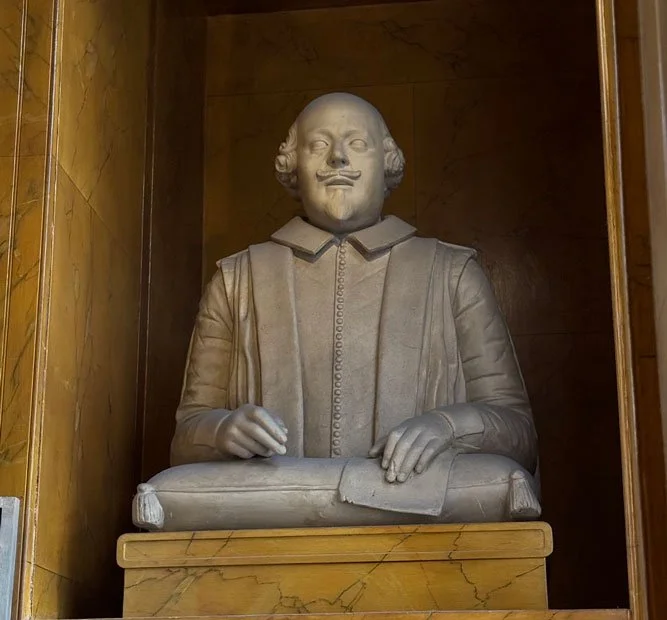
Bust in the Shakespeare Recess in the Sir John Soane’s Museum, London.
The short but active life of the Shakespeare Ladies Club
In recording the activities of the club, the authors describe in some detail how Shakespeare’s plays were mutilated during the Restoration period. While the plays were popular, the book quotes a letter from 1736, recording someone’s frustration that the Macbeth they’d just seen on stage would scarcely be recognised by its author.
The club formed in early 1736. This was 20 years before David Garrick created his Temple to Shakespeare beside the River Thames at Hampton. The authors state that while Garrick’s is often considered the first personal tribute to the playwright, the grotto at St Giles was referred to as ‘Shake Spears house’ by a visitor in 1734.
After its formation, the club encouraged theatre owners to put on Shakespeare plays in a form closer to the original text. They would ‘bespeak’ a production, and the posters advertising the plays often indicated this with these words at the top: ‘At the Particular Desire of Several Ladies of Quality.’
No book about 18th century English theatre can ignore Garrick. In this story he’s portrayed as a self-centred attention seeker who, while acknowledging the club’s role in restoring Shakespeare to the stage, engineered events to keep himself as the star attraction.
Another achievement of the club was the raising of funds to place a monument to Shakespeare in Westminster Abbey. It was placed in Poet’s Corner in January 1740.
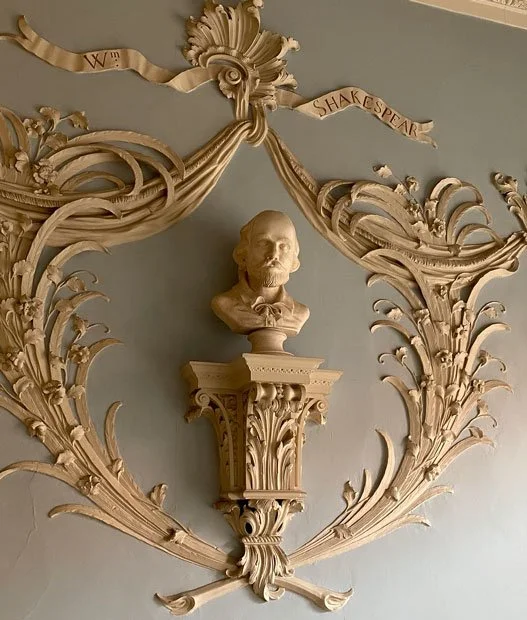
Bust of William Shakespeare in Fairfax House, York.
Much ado about not so much
In common with a number of books I’ve read recently, The Shakespeare Ladies Club makes a lot out of not very much content. While there’s lots of interesting background material, and a good number of references to the ladies from other sources, there’s very little about the club itself.
Having described the club's achievements during its short life, the authors go on to discuss other women with an interest in Shakespeare. It includes the bluestockings of the later 18th century, actress Sarah Siddons and writer Mary Wollstonecraft. It’s brought up to date with references to Dame Judi Dench and Meryl Streep.
The book also discusses what it calls ‘the authorship non-mystery’ around who actually wrote Shakespeare’s plays, and 21st century attempts to cancel his work as being politically incorrect.
Despite the relatively thin source material, the authors have created a highly readable book that reveals what a significant role was played by the women of the Shakespeare Ladies Club. It’s clear they conducted extensive research, and they ‘managed to uncover correspondence and connections that were previously unknown’, publishing it for the first time.
In particular, their research has led to them proposing that tracts published in 1739–1740, claiming equality for women, were authored by the women of the club. The documents bear the name of ‘Sophia, a Person of Quality’ but the actual author is unknown.
This book includes illustrations, lots of notes, a bibliography and an index. It would be a useful addition to the library of anyone interested in 18th-century English theatre and culture, particularly with reference to William Shakespeare.
The Shakespeare Ladies Club is by Christine and Jonathan Hainsworth and published by Amberley Books.
Andrew Knowles researches and writes about the late Georgian and Regency period. He’s also a freelance writer and editor for business. He lives with his wife Rachel, co-author of this blog, in the Dorset seaside town of Weymouth.
If you have enjoyed this blog and want to encourage us and help us to keep making our research freely available, please buy us a virtual cup of coffee by clicking the button below.
Regency History
by Andrew & Rachel Knowles

We research and write about the late Georgian and Regency period.
Rachel also writes faith-based Regency romance with rich historical detail.