The Story of Mussenden Temple

Mussenden Temple is on the edge.
Why would anyone spend a small fortune constructing a gorgeous building precariously close to the edge of a seaside cliff?
Mussenden Temple, in Northern Ireland, is one such building. Being irresistibly photogenic, it’s one of the most well-known images of Georgian architecture in Ireland. Unsurprisingly, it’s also a popular wedding venue.
We were fortunate enough to visit Mussenden Temple in June 2025, prompting us to look into its history.
The classical origins of Mussenden Temple
As with so many 18th century aristocrats, the man inspired to create Mussenden had been on the Grand Tour to Italy.
He was Frederick Hervey (1730–1803), 4th Earl of Bristol and the Bishop of Londonderry, often referred to as the Earl Bishop. His primary family estate was at Ickworth, in Suffolk. His other estates included Downhill, in Northern Ireland. He had a grand house built here in the 1770s and, a few years later, Mussenden Temple.
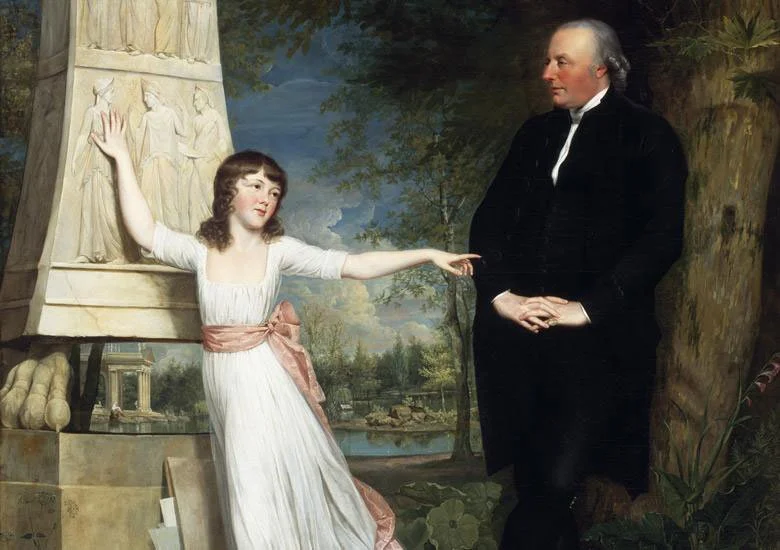
Frederick Hervey in Rome, around 1790. Pictured with his granddaughter, Lady Caroline Crichton. By Hugh Douglas Hamilton.
Some refer to Mussenden Temple as a folly—one of those garden buildings that Georgian landowners erected to show off their good taste. Grand garden schemes like those at Stourhead in Wiltshire and Stowe in Buckinghamshire boast a variety of garden temples, all modelled on buildings that survive from classical antiquity.
Mussenden Temple is no different. It’s modelled on the design of the Temple of Vesta in Italy. There’s one in Tivoli and another in Rome. It’s an unusual design for its time, being circular.
The temple was a favourite of Georgian architect Sir John Soane, who made sketches and owned a model of it, made from cork. Frederick Hervey (pronounced ‘Harvey’) met Soane when they were both travelling in Italy.
It seems that theTivoli temple was the inspiration for Hervey. His original intention was to have the historic temple in Italy dismantled, and rebuilt on his estate at Downhill in Ireland. This plan was thwarted by the Pope.
Unable to take the original Temple of Vesta from Italy, Hervey used it as the inspiration for his version at Downhill.
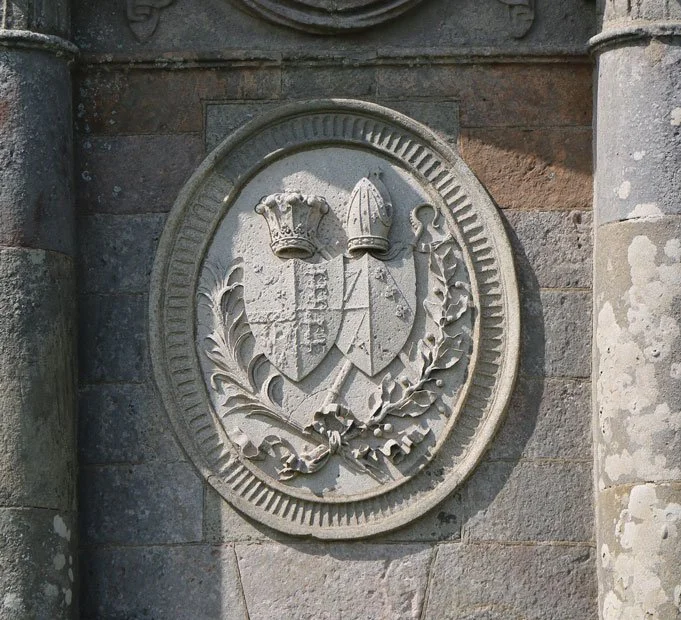
The arms of Frederick Hervey, the Earl Bishop - a rare combination of titles.
The building of Mussenden Temple
The temple was erected in the early to mid 1780s. The architect was Michael Shanahan. However, in The Londonderry Journal of 13 October 1847, the obituary of David McBlaine names him as architect of Mussenden Temple, along with Downhill House.
In 1783 Shanahan estimated the cost of building the temple as £1,507 18s.
Based on his enthusiasm for the Temple of Vesta, it’s possible that Sir John Soane contributed to the design in some way. He provided designs for some of the interiors of Downhill House and the nearby mausoleum.
The European Magazine, in 1818, published a brief description of the temple, written by Thomas Stringer MD. He wrote: “The interior is fitted as a library, and filled with books.”
There was a room underneath where Hervey allowed Catholics to celebrate mass. While he was a Bishop in the Protestant Church of Ireland, he was also in favour of Catholic emancipation.
Today, Mussenden Temple is precariously close to the edge of the cliff, overlooking the sea. It’s said that when it was first built, there was enough space to drive a coach and horses around it. That’s clearly not the situation today, erosion having moved the cliff edge towards the building.
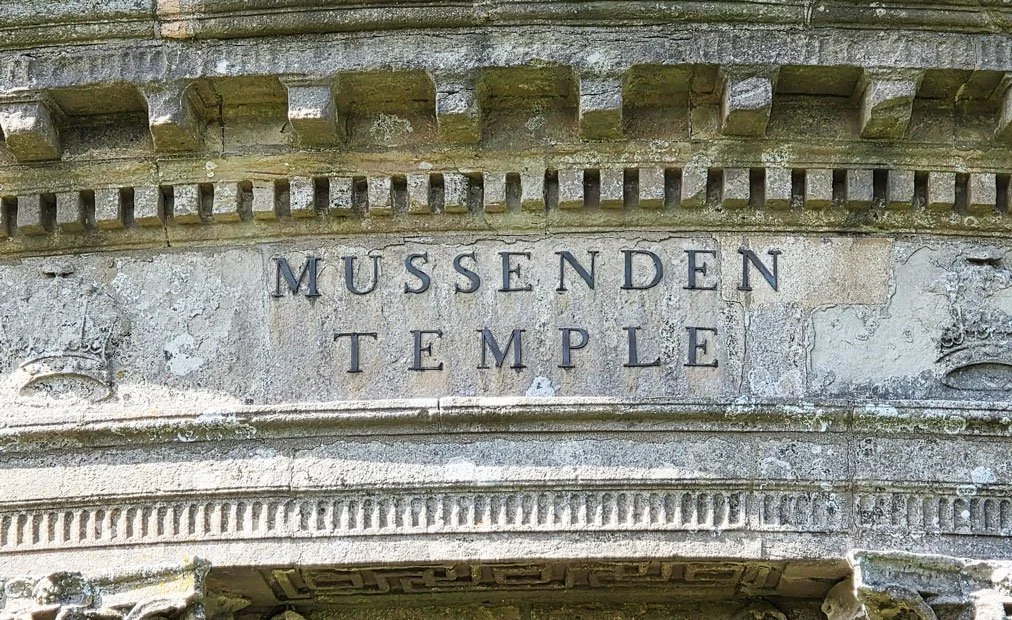
The building has always been named after Hervey’s niece, Frideswise Mussenden.
The naming of Mussenden Temple
Unusually for a Georgian garden temple, its name is inscribed above the entrance.
In his Account of Ireland, published in 1812, Edward Wakefield records that the temple was “raised to perpetuate the remembrance of a lady to whom the earl was much attached.”
That lady was his niece, Frideswide Mussenden. A noted beauty, she was the eldest of three children. She married in 1781, aged about 18.
Hervey took a paternal interest in the three children because their mother, his cousin, died when they were young. He referred to Frideswide as his ‘chère cousine’ and chose to dedicate the temple to her.
There was a brief whiff of scandal in late 1783, when a newspaper published an anonymous letter which indirectly accused Hervey of an inappropriate relationship with his cousin. The accusation, which probably had political motivations, was vigorously refuted by his supporters.
We don’t know how this episode affected Frideswide, or whether she ever visited the completed temple. It was finished in 1785, the year she died.
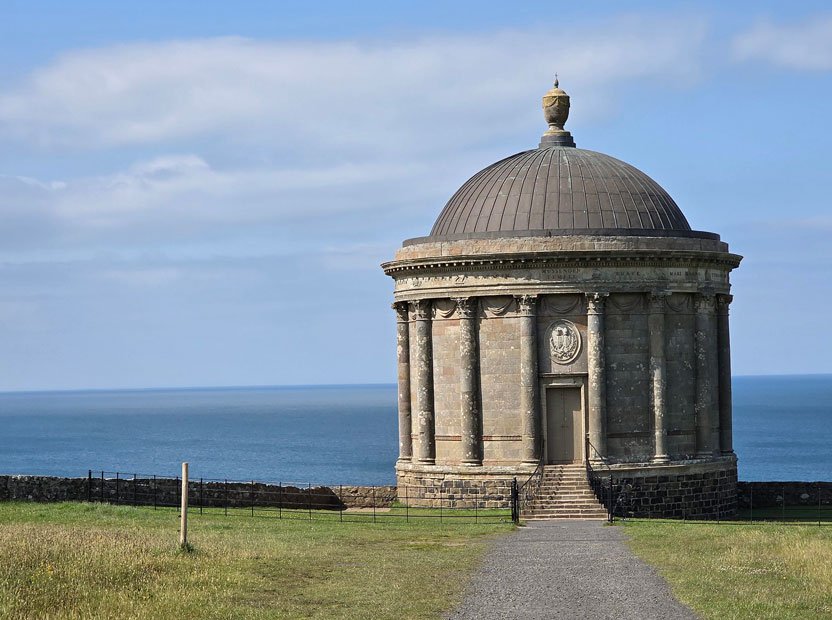
The temple was originally used as a library.
I’d never encountered the name Frideswide until now. Frideswide, also known as Frithuswith, was an English princess and abbess who lived in the years 650–727. A glance at genealogical records shows it has been used, but not often, over the last few hundred years.
In addition to the name of the temple being inscribed over the door, it also has a phrase from De rerum natura, a poem by Roman philosopher Lucretius: “Suave, mari magno turbantibus aequora ventis e terra magnum alterius spectare laborem.”
This translates to: “Tis pleasant, when the Seas are rough, to stand and view another’s danger, safe at Land.” (From the 1683 translation by Thomas Creech, the standard version in the 18th century.)
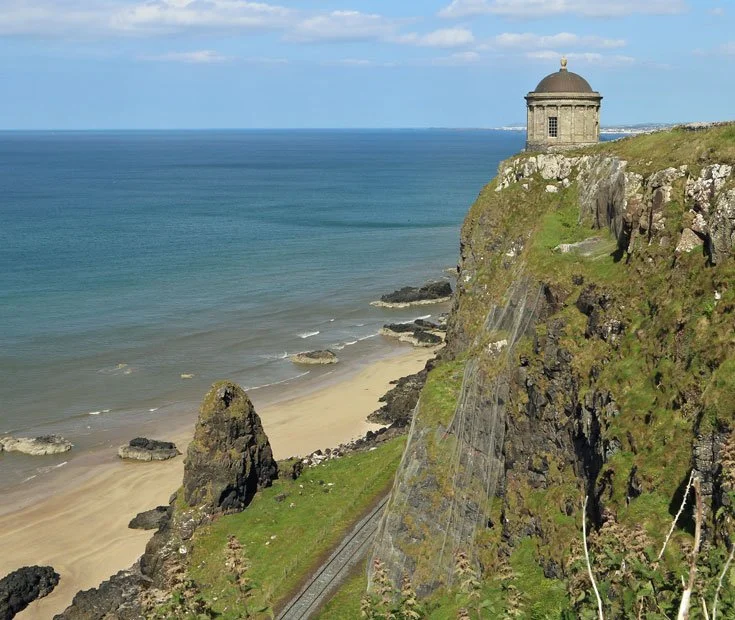
The cliff edge has crept closer over the years. Work has now been done to stabilise the rockface.
Andrew Knowles researches and writes about the late Georgian and Regency period. He’s also a freelance writer and editor for business. He lives with his wife Rachel, co-author of this blog, in the Dorset seaside town of Weymouth.
If you have enjoyed this blog and want to encourage us and help us to keep making our research freely available, please buy us a virtual cup of coffee by clicking the button below.
Sources include:
Website of the Sir John Soanes Museum London
The Earl Bishop by William S Childe-Pemberton (1924)
An Account of Ireland Statistical and Political by Edward Wakefield (1812)
The European Magazine 1818
Regency History
by Andrew & Rachel Knowles

We research and write about the late Georgian and Regency period.
Rachel also writes faith-based Regency romance with rich historical detail.