
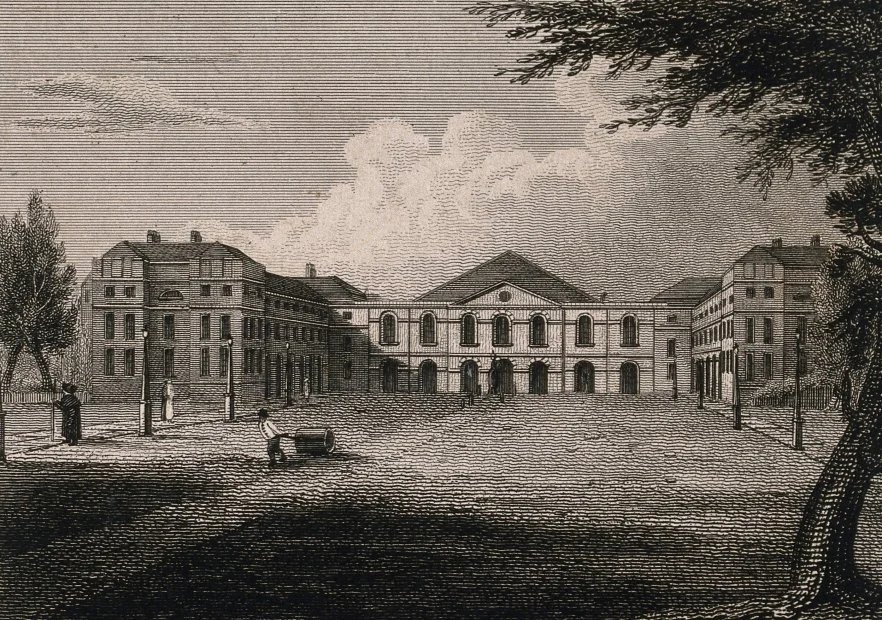
The Foundling Hospital London, drawn & engraved by W Wallis (1816) Collection
What was it?
The Foundling Hospital was a charitable organisation in London “for the maintenance and education of exposed and deserted young children.”1
The founding of the Foundling Hospital
The Foundling Hospital was set up by Thomas Coram (1668–1751), the master of a trading vessel to the American colonies. He was horrified by the plight of illegitimate infants who were often abandoned to die, or accompanied their poor mothers to the workhouse, where their chances of survival were slim.
At first, Coram found it hard to get support, as people feared such a charity would encourage profligacy. But he didn’t give up, and after 17 years campaigning, getting a number of influential upper-class women on board with the cause, Coram was successful.
On 17 October 1739, the Foundling Hospital finally received its Royal Charter from George II.
The Hospital appointed 172 governors—men chosen for their wealth and influence—and a General Committee of 50 was chosen from these.
The founding governors included artist William Hogarth, and eminent physicians, Richard Mead and Hans Sloane, and the first president was John Russell, 4th Duke of Bedford.
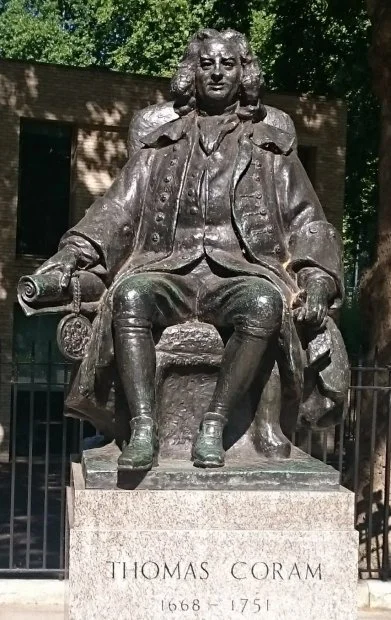
Statue of Thomas Coram, founder of the Foundling Hospital, outside the Foundling Museum, London (2018)
Who did the Foundling Hospital help?
The Hospital’s aim was to prevent
the frequent murders committed on poor miserable infants by their parents to hide their shame, and the inhuman custom of exposing new-born children to perish in the streets.2
The Microcosm of London wrote that the Foundling Hospital was of particular help to those unfortunate females who
by broken faith, by unprincipled seduction, or by some unfortunate circumstance, are placed in a situation, where indigence and excess of bodily pain are aggravated by the prospect of hopeless contumely and irretrievable disgrace; and who have sometimes been driven to a crime, which no mother could ever have imagined, who was not first reduced to the utmost extreme of agony and despair.3
The Hospital aimed to help both mother and child, by providing a home for a baby who was at risk of being abandoned, and by
rescuing its wretched mother from a course of infamy and prostitution, and restoring her to character and the means of honest industry.4
Where was the Foundling Hospital?
The Foundling Hospital was situated on the north side of Ormond Street, on land purchased from Lord Salisbury. At the time, this area was outside of the city and was therefore a much healthier atmosphere for the children to grow up in.
The Foundling Museum today stands within this area, next to Brunswick Square.
A temporary home for the Hospital was found in a house in Hatton Garden, whilst the charity found a site and built its permanent home. It was here the first 30 children were admitted on 25 March 1741.
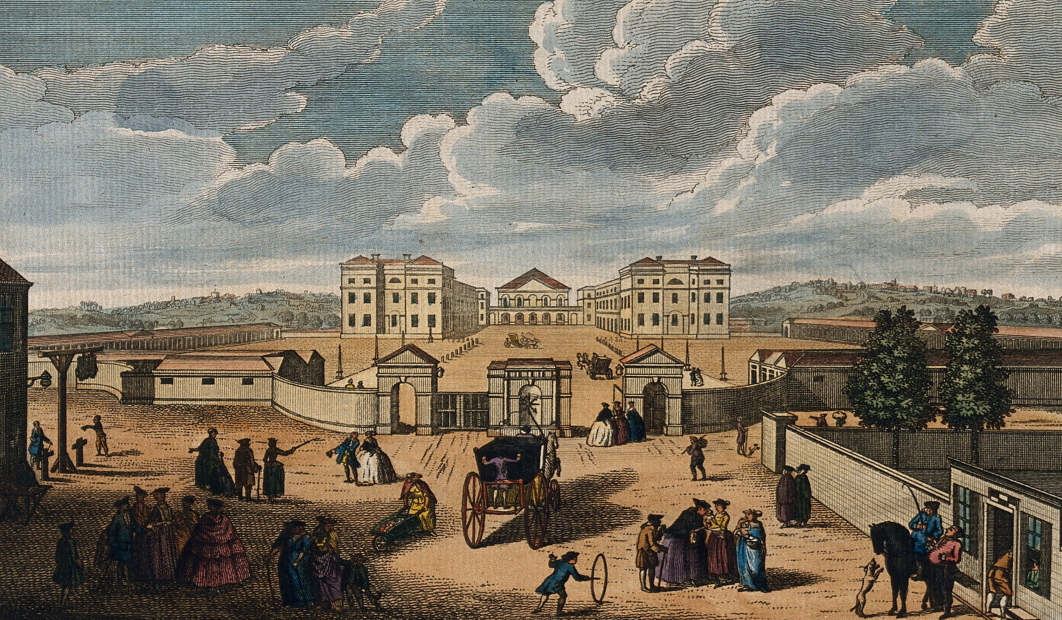
The Foundling Hospital, Holborn, London: a bird’s-eye view of the courtyard, with many people in the road - a coloured engraving after LP Boitard (1753)
What was the Hospital like?
Feltham’s A Picture for London (1809) wrote:
The Foundling Hospital is a handsome and convenient structure, with a good garden and commodious play-ground for the children. The chapel is in the centre. The east wing is appropriated to the girls, and the west to the boys. At the south extremity of the former is the treasurer's house, and the extremity of the opposite wing is appropriated to inferior officers.5
The Microcosm of London (1808-10) noted:
A kitchen has been fitted up at the Foundling Hospital, upon the plan, and under the direction, of Count Rumford.6

The Foundling Hospital - the main buildings seen from within the grounds - engraving by E Byrne after JP Neale (1816) in Wellcome Collection
Who was admitted to the Foundling Hospital?
The Foundling Hospital only accepted babies under a year, and the majority of these were under 2 months old.
Before admission, the infant had to pass a medical examination to ensure that contagious diseases were not brought into the Hospital.
After 1801, only illegitimate children were admitted, except for orphans of sailors and soldiers.
The Microcosm of London (1808–10) stated that:
The number of children admitted since the commencement of this institution is upwards of 18,800, to the present time. 7

Book recording child's details and swatch of fabric at The Foundling Hospital Museum (2018)
What was the admissions process?
The admissions procedure varied over time. In the early days, a woman could leave her baby without explanation, but after 1763, she had to explain why she couldn’t look after her child.
One bizarre case mentioned in the Foundling Museum guidebook is of a lodging keeper whose guest had left their baby behind in their room.8
By 1795, the moral character of the mother was taken into consideration.
A mother who had a baby she could not look after had to apply to the secretary of the Foundling Hospital on a Wednesday morning, before 10am, for the child to be admitted.
She had to prove:
The baby was her own.
Who the father was and that he had deserted her.
That her character was good before her pregnancy.
That she could not provide for the child herself “without being reduced to extreme indigence, and without exposure of her guilt.”9
“That by providing for her infant, and concealing her shame, there is a prospect of her returning to a virtuous course of life, and preserving her former station in society.”10
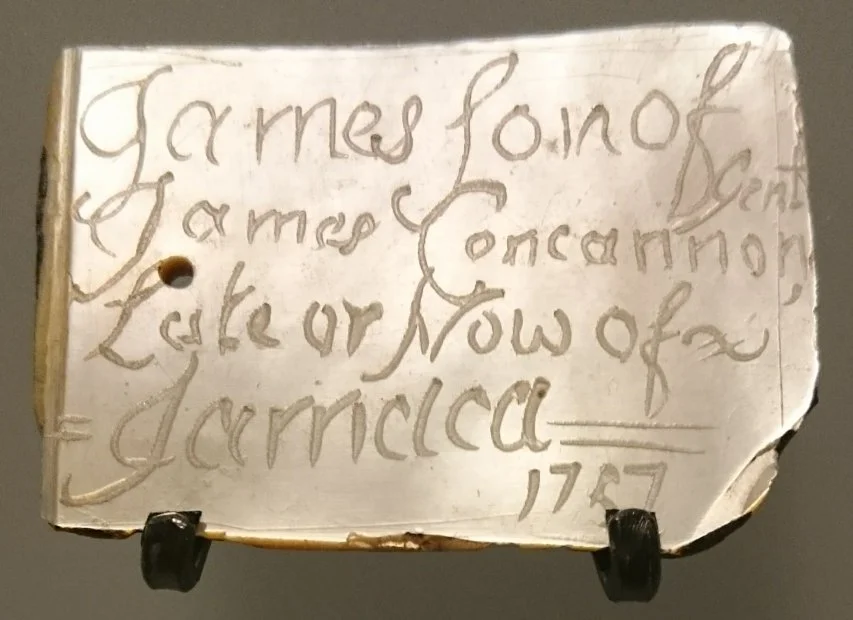
A token left with a baby at the Foundling Hospital at the Foundling Museum (2018)
Were there enough places for every applicant?
No! The need was enormous, and the Hospital had limited capacity. By 1742, over 100 people often applied for a mere 20 places.
For most of its existence, the charity had to allocate places by some means.
During the early days, a ball system was used. Women randomly picked a ball from a bag—a white ball meant the child was admitted; a red ball meant the child was not.
Later, a more discerning process was introduced, where the general committee examined the petitions for admission, and allocated available places based on the good character and circumstances of the mother.
The exception was a disastrous period of General Reception in the 1750s, where a condition of receiving a £10,000 grant from the government meant the Hospital had to accept every child who applied. As a result, so many babies were admitted that mortality rates soared.
What happened to a baby admitted to the Foundling Hospital?
Infants were admitted to the Hospital on Saturday at noon.
A billet was filled out with the details of the child, including whether anything was left with them. Both billet and child were given an admission number, and this number was their only link to their past. They were dressed in fresh clothes, given a new name, and then baptised in the Foundling Chapel, during the Sunday evening service the day after admission.
In the early days, a swatch of fabric from their clothes was given to the mother, and another swatch kept with the billet. The mother might also leave a token to help identify her child, should she ever be in a position to reclaim them.
Although a receipt system was introduced in 1772, many mothers still left tokens with their children.
On the Monday morning following, the child was sent into the country to a wet nurse, until they were about 4 or 5 years old.
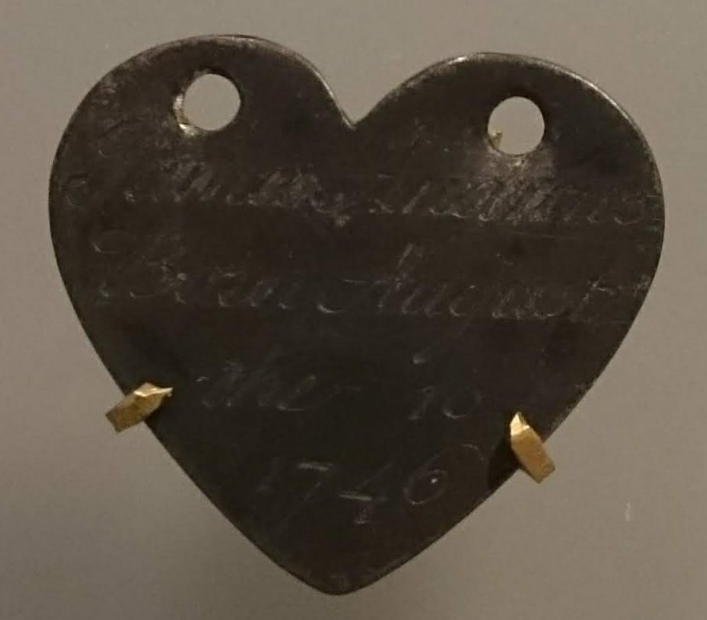
A token left with a baby at the Foundling Hospital at the Foundling Museum (2018)
What happened to the foundlings?
The foundling children returned to the Hospital to be equipped to play a useful part in society.
Education
Both boys and girls learned reading, writing and accounts. They were taught the church catechism and learned to sing the Foundling Hymns and Anthems.
Girls were taught how to knit and sew, and used this skill to work on the Hospital linen, and to make their own clothes. They were also involved in household tasks, to prepare them to be good servants.
Boys worked in the garden, kept the courtyard and chapel clean, and also helped with household work.
Apprenticeships
Boys were apprenticed at age 12 or 13 in a suitable trade. They were often placed with shopkeepers or as household servants; others were apprenticed to farmers or went to sea.
Girls were apprenticed at about 14 years old, usually as servants.
To protect the foundlings, the charity restricted who they could be apprenticed to, and frequently visited the children during their apprenticeships.
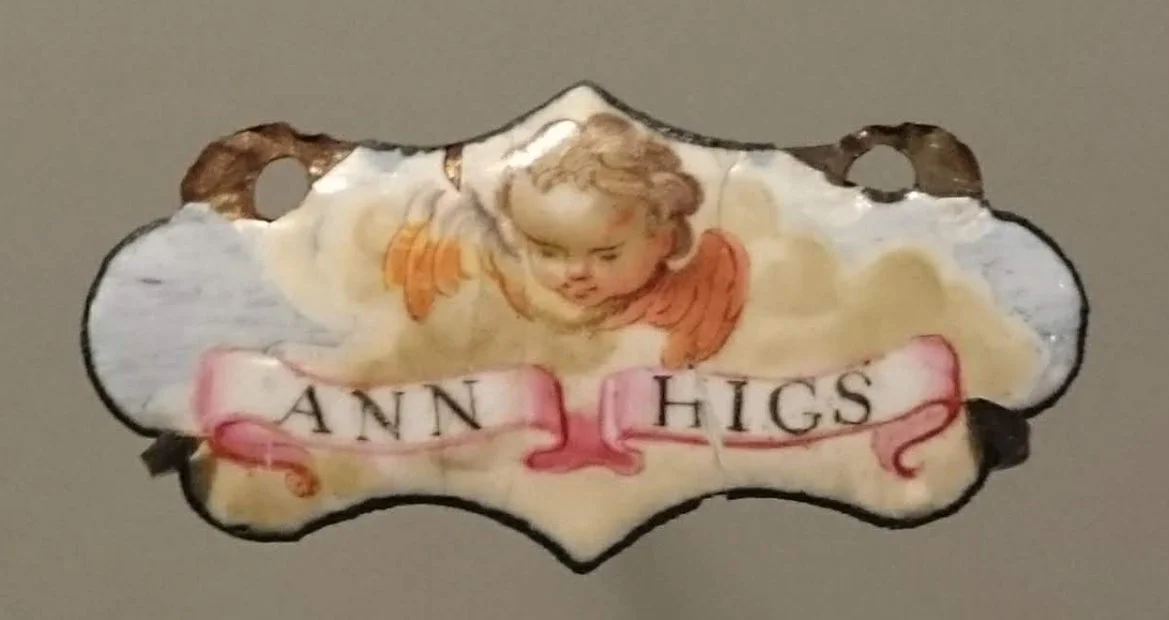
A token left with a baby at the Foundling Hospital at the Foundling Museum (2018)
Were foundlings ever reconciled with their parents?
Until 1764, a relative was required to pay for the cost of their care to date in order to reclaim a child. After this requirement was dropped, three or four children were reclaimed every year.
How was the Hospital financed?
The Foundling Hospital was largely financed by donations.
It received a large grant from the government in the 1750s, leading to the period of General Reception mentioned above. When mortality rates rose during this period, the reputation of the Hospital waned, and donations dropped.
As a result, the charity was forced to build on part of the estate, to raise money through leases and rents. This led to the construction of Brunswick Square and Mecklenburgh Square.
In addition, the Hospital took in plain work—simple sewing that the foundling girls completed.
The Foundling Hospital Chapel
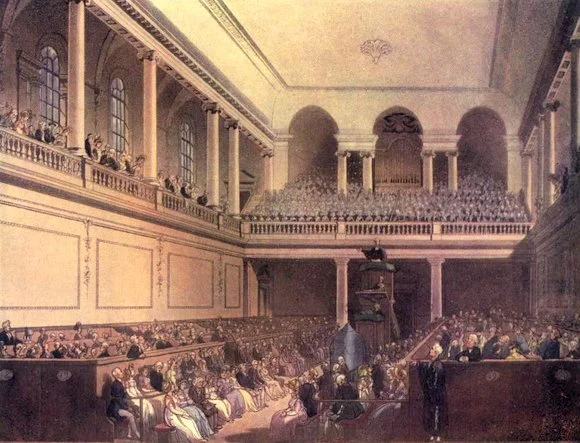
The Foundling Hospital Chapel in The Microcosm of London vol 2 (1808-10)
The Foundling Hospital Chapel generated funds, both through pew rents and through collections at its services.
The Picture of London (1809) said:
Divine service is performed in the chapel twice on every Sunday, at eleven in the forenoon, and at seven in the evening. The pews are in general let at a high rent; and besides this, there is always a collection at the doors, which from the excellence of the music, and the popularity of the preachers, is considerable, and amounts, with the rest of the pews, as we have been informed, to nearly 2,500l. per annum.11
Charles Dickens was one of the Hospital’s Victorian supporters who sponsored a chapel pew, as well as helping to raise the charity’s visibility by writing about it favourably in his work.
Sometimes, fees were received from parishes, the War Office, or someone connected with the child, in return for the Hospital admitting the infant.
Hogarth and other artistic benefactors
William Hogarth (1697–1764) was a founding governor of the Foundling Hospital, and he designed the Coat of Arms, and probably the children’s uniforms as well. He donated works of art to the Hospital and encouraged other artists to do the same.
Paintings were donated by many artists, including Francis Hayman, Joseph Highmore, Thomas Hudson, Allan Ramsay, and George Moser, who were all made governors of the charity.
As a result, the Foundling Hospital became something of an art gallery.

The March of the Guards to Finchley by William Hogarth (1750) at the Foundling Hospital Museum (2018)
Handel at the Foundling Hospital
George Frideric Handel (1685–1759) donated an organ for the Chapel and wrote the Foundling Hospital anthem.
For several years, Handel conducted a performance of his oratorio, the Messiah, and gave the proceeds to the Foundling Hospital.

Terracotta bust of George Frideric Handel by Louis Francois Roubiliac at The Foundling Museum (2018)
Visiting the charity
According to The Picture of London (1809), visitors were welcome.
This noble charity may be visited any Tuesday, Thursday, or Friday, for a small gratuity, on application to the porter at the gates.12
What happened to the Foundling Hospital?
In 1926, the Hospital moved to Redhill, Surrey, and then to Berkhamsted, Hertfordshire. In 1954, the last pupils left, and the charity became The Thomas Coram Foundation for Children.
Some of the original site is now a playground for children—Coram’s Fields. 40, Brunswick Square became the Foundling Hospital’s London headquarters in 1939, and in 2004 it opened as the Foundling Museum.
Rachel Knowles writes faith-based Regency romance and historical non-fiction. She has been sharing her research on this blog since 2011. Rachel lives in the beautiful Georgian seaside town of Weymouth, Dorset, on the south coast of England, with her husband, Andrew, who co-writes this blog.
If you have enjoyed this blog and want to encourage us and help us to keep making our research freely available, please buy us a virtual cup of coffee by clicking the button below.
Notes
A Copy of the Royal Charter for Establishing an Hospital for the maintenance and education of exposed and deserted young children (1739).
Ibid.
Ackermann, Rudolph, and Pyne, William Henry, The Microcosm of London or London in miniature Volume 2 (Rudolph Ackermann 1808-1810, reprinted 1904).
Ibid.
Feltham, John, The Picture of London for 1809 (1809).
Ackermann op cit.
Ibid.
Howell, Caro, Foundling Museum - an introduction (2014).
Ackermann op cit.
Ibid.
Feltham op cit.
Ibid.
Sources used include:
A Copy of the Royal Charter for Establishing an Hospital for the maintenance and education of exposed and deserted young children (1739).
Ackermann, Rudolph, and Pyne, William Henry, The Microcosm of London or London in miniature Volume 2 (Rudolph Ackermann 1808-1810, reprinted 1904).
Feltham, John, The Picture of London for 1809 (1809).
Howell, Caro, Foundling Museum - an introduction (2014)
Regency History
by Andrew & Rachel Knowles

We research and write about the late Georgian and Regency period.
Rachel also writes faith-based Regency romance with rich historical detail.



The Foundling Hospital in Regency London