What is a bandbox?
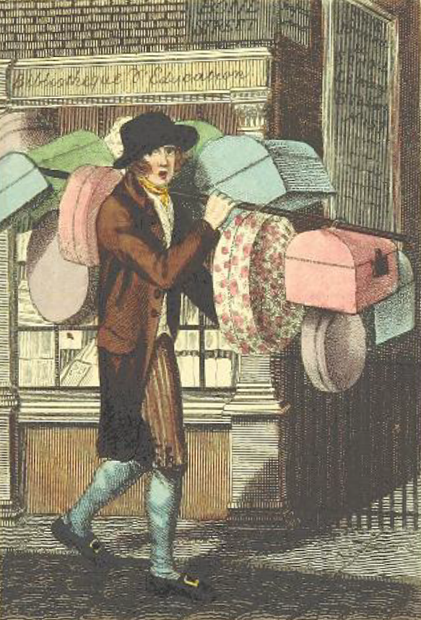
Bandbox seller from Modern London by R Phillips (1804)
With a sigh of relief, she hurried down the garden path and into the woods beyond, fastening the buttons of her pelisse with one hand as she went. The other hand was clinging to a pair of bandboxes. 1
In A Reason for Romance (The Merry Romances 2), an eloping Georgiana Merry clings to a pair of bandboxes.
But what were bandboxes? What were they made of? How big were they? What were they used for? What might you find inside a bandbox?
Read on! You might be surprised to find out…
What was a bandbox?
Bandbox: A slight box used for bands and other things of small weight. 2
The original bandboxes dated back to the 1630s when they were designed to carry the starched bands worn as collars. By the Regency, their use had extended to carrying other light items, typically women’s apparel, but they were still called bandboxes.
What was a bandbox made of and how big was it?
Bandboxes were made of pasteboard or thin wood, but varied in size, sturdiness and security. Pasteboard was a kind of thick paper or board, similar to carboard, made of sheets of paper pasted together.
In Modern London (1804), Phillips wrote:
Band-boxes, generally made of pasteboard, and neatly covered with coloured papers, are of all shapes and sizes, and sold at every intermediate price between sixpence and three shillings. Some made of slight deal, covered like the others, but in addition to their greater strength having a lock and key, sell according to their size, from three shillings and sixpence to six shillings each. The crier of band-boxes or his family manufacture them; and these cheap articles of convenience are only to be bought of the persons who cry them through the streets. 3
Bandboxes were typically bought from a street vendor (a ‘crier’ in the quote above), and they didn’t always keep their wares about their person as the picture at the top suggests.
A newspaper in 1818 reported that a bandbox maker in Clerkenwell Green:
…had been fined 40s for placing articles on the foot pavement. 4
Bandboxes sometimes came with purchases, typically hats. In Pride and Prejudice, Jane Austen wrote:
As soon as all had ate, and the elder ones paid, the carriage was ordered; and after some contrivance, the whole party, with all their boxes, work-bags, and parcels, and the unwelcome addition of Kitty’s and Lydia’s purchases, were seated in it.
“How nicely we are all crammed in,” cried Lydia. “I am glad I bought my bonnet, if it is only for the fun of having another bandbox! 5

“How nicely we are crammed in.” An illustration by Hugh Thomson for Jane Austen’s Pride and Prejudice (1894 edition).
What was a bandbox used for?
Bandboxes were not just used for carrying around bonnets without crushing them. They were used to transport any small, lightweight objects, typically ladies’ apparel.
In Georgette Heyer's Devil's Cub, the Duchess of Avon is adjured by her brother-in-law Lord Rupert to travel light:
The Duchess took him at his word, and when his coach arrived in Curzon Street next morning she had only one bandbox to be put into it. 6
Jane Austen refers to bandboxes in her books and letters. To judge from the way she refers to them, a bandbox could be used as a hatbox, an overnight bag, or simply an overflow for what would not fit in your trunk!
In a letter to her sister Cassandra, written in May 1813, Jane Austen wrote:
I have not quite determined how I shall manage about my clothes; perhaps there may be only my trunk to send by the coach, or there may be a bandbox with it. 7
In Mansfield Park, Fanny Price has a bandbox in addition to her trunk which was left in the hall. It seems that this was her equivalent of her brother William’s portmanteau:
…in walked Mr Price himself, his own loud voice preceding him, as with something of the oath kind he kicked away his son's portmanteau and his daughter's bandbox in the passage… 8
Hand luggage
A bandbox was a convenient piece of hand luggage when travelling. Though maybe not so convenient for fellow travellers.
American Benjamin Silliman recorded his experience when travelling in England in 1805:
At 7 o'clock A. M. I stepped into the coach for Birmingham. It was a small vehicle, capable of carrying four passengers inside with convenience, and six with difficulty. Although I had a priority of claim, I found five ladies already seated in the coach, and some of them were such beauties as Addison says are estimated at Haarlem by weight. Four of them carried huge band-boxes in their laps, and the fifth an infant.
In so small a carriage, and under such circumstances, you cannot but suppose that an additional one must have occasioned some inconvenience. I was obliged to sit sidewise, with one arm out of the coach, and I found my companions so little disposed for conversation, and the situation so uncomfortable, that, before we had travelled a mile, I relinquished my seat in favour of the ladies, and mounted the roof of the coach. 9
Lost and found bandboxes
If someone lost or found a bandbox, or had one stolen, they sometimes put an advertisement in the newspaper for its recovery. These adverts give us insights into what people carried in their bandboxes.
In the Salisbury and Winchester Journal in December 1819, Mr Peirce offered the sum of five pounds for the recovery of goods, including a bandbox, lost or stolen from his bar:
Lost, on or about the 20th of September, a BAND-BOX, with a PARCEL, from Mr Peirce’s bar, at the Royal George Inn, Southampton, directed for W H Devanis, Esq at the above mentioned inn till called for; the undermentioned goods is a list of its contents, viz: lilac silk dress, lilac figured, satin bray with lace sleeves trimmed with rich lace; a pair of white silk hose; a pair of topaz ear-rings, set in gold, with a large topaz ornament for the hair; likewise a white satin hat, with plumes; two books; and a gentleman’s blue coat. 10
It is not clear which items were in the bandbox, and which were in the parcel.
An advert in Drakard’s Stamford News in June 1813 reveals that it was not just female apparel that could be kept in a bandbox:
Taken up
On the road between Wansford and Stamford, on the 20th of May last, a BAND-BOX, containing part of an OFFICER’S MILITARY UNIFORM. — Whoever has lost the same, may have it again, on paying the expenses of advertising, &c by applying to Mr Saldarini, Wind-mill, Peterborough;— And Notice is hereby given, that if the articles are not claimed within a month after advertising, they will be sold to pay expenses. 11
Found inside a bandbox…
The contents of a bandbox were not always what you would expect.
In 1813, the Bath Chronicle and Weekly Gazette reported that a bandbox had been left in a house in Walcot Parish, Bath—the same parish where Jane Austen once lived:
Whereas a female infant, newly-born, was left on Saturday evening, about eight o’clock, in the passage of a house, No 39, St James’s Square, in an old paper bonnet-box, wrapped up in two pieces of old flannel, (one piece has apparently been a woman’s under petticoat), a small piece of calico, and a piece of old linen: the band-box has a hole in the top, no doubt made on purpose to give air to the child: the box was tied round with a small pink checked pocket handkerchief, torn in two and knotted together; there has been a short name in the lid of the band-box, but not legible, having been partly and no doubt purposely erased. — REWARD of TEN GUINEAS will be paid by the Parish Officers to any person who will give such information as the purposes of justice and the nature of the case may require…
The Child is alive in Walcot Poor-House, and likely to do well. 12
Rachel Knowles writes faith-based Regency romance and historical non-fiction. She has been sharing her research on this blog since 2011. Rachel lives in the beautiful Georgian seaside town of Weymouth, Dorset, on the south coast of England, with her husband, Andrew, who co-writes this blog.
If you have enjoyed this blog and want to encourage us and help us to keep making our research freely available, please buy us a virtual cup of coffee by clicking the button below.
Notes
Knowles, Rachel, A Reason for Romance (The Merry Romances 2) (2021)
Johnson, Samuel, A Dictionary of the English Language (1814)
Phillips, Richard, Modern London; being the history and present state of the British Metropolis (1804)
General Evening Post (1818)
Austen, Jane, Pride and Prejudice (1813)
Heyer, Georgette, Devil’s Cub (1932)
Austen, Jane, Jane Austen's Letters, Collected and Edited by Deirdre Le Faye (1995)
Austen, Jane, Mansfield Park (1814)
Silliman, Benjamin, A Journal of Travels in England, Holland and Scotland and of two passages over the Atlantic in the years 1805 and 1806 (1812)
Salisbury and Winchester Journal (1819)
Drakard’s Stamford News (1813)
Bath Chronicle and Weekly Gazette (1813)
Sources used include:
Austen, Jane, Jane Austen's Letters, Collected and Edited by Deirdre Le Faye (1995)
Austen, Jane, Mansfield Park (1814)
Austen, Jane, Pride and Prejudice (1813)
Johnson, Samuel, A Dictionary of the English Language (1814)
Phillips, Richard, Modern London; being the history and present state of the British Metropolis (1804)
Silliman, Benjamin, A Journal of Travels in England, Holland and Scotland and of two passages over the Atlantic in the years 1805 and 1806 (1812)
British Newspaper Archive
Regency History
by Andrew & Rachel Knowles

We research and write about the late Georgian and Regency period.
Rachel also writes faith-based Regency romance with rich historical detail.