Counting the Country: Censuses in Regency Britain

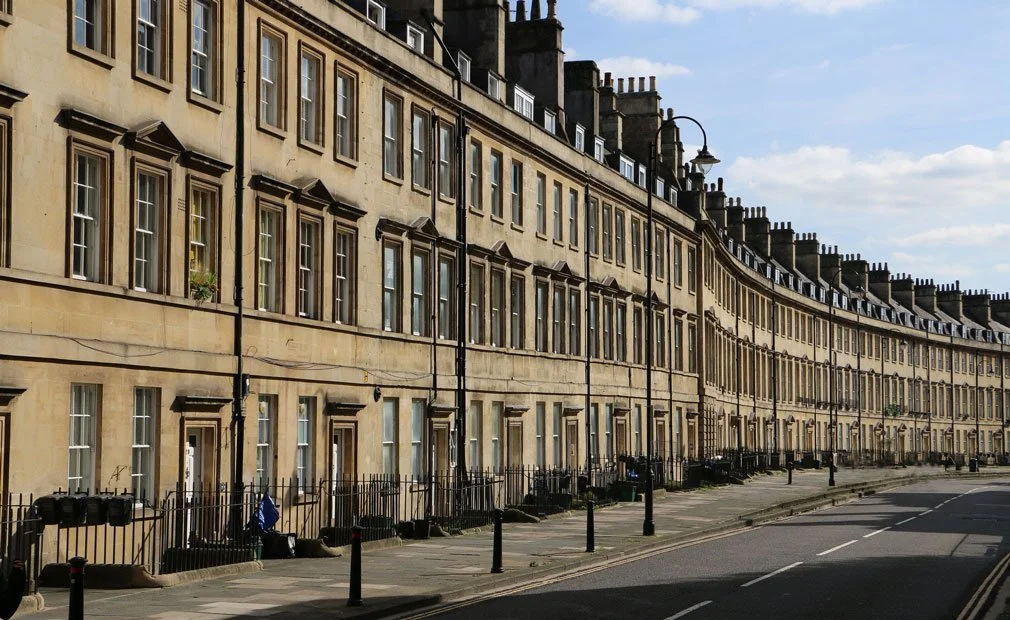
A typical English village
There were 12,596,803 people living in Great Britain on 27 May 1811, three months after the Regency began.
That’s according to the census conducted that year.
Family historians with British ancestors love the census returns that list almost every individual by name. They also know that the earliest census they can use was taken in 1841, with one every ten years after that.
What’s not so well known is that this once-in-a-decade event, the counting of everyone in the country, began in 1801.
The first four censuses did not record the details of every individual. They were more concerned with overall numbers, getting a sense of how the population was distributed, and how numbers were changing.
The census takers in 1811
Taking the census was the job of parish clerks, clergy and other trustworthy people in England and Wales. It seems that Scottish church ministers felt taking the census was not one of their duties, so the task became the responsbility of schoolmasters.
Ireland was excluded from the census.
Census-takers were instructed to go from house to house on 27 May 1811 and count:
The number of houses, inhabited and uninhabited.
The number of families.
The number of people, including children.
They were also to make a note of whether families were employed in agriculture, trade, manufacturing or handicrafts.
People who gave false information, or who refused to cooperate, ‘are liable to penalties of £5 and 40s.’
It’s curious that the amount of 40s (shillings) is specified. That’s £2, because there were 20 shillings to the pound.
Rare details from the early censuses
Although the early censuses, including 1811, were not intended to capture details of individuals - some lists of names were made. These give us a precious glimpse into the pre-Victorian world.
In 1801 the curate of the village of Oborne, Dorset, copied a list from the census into a Parish Book. It records a population of one gentleman, eight farmers, two fellmongers, a miller, a weaver, two journeymen and sixteen labourers - plus wives and children.
A rare survivor from the 1811 census is the list of people living in Dallas, Morayshire, in Scotland. There are nearly 900 individuals named including James Dean, aged 23, the schoolmaster who collected the details.
There are over 2,000 names on a census return from Devon in 1821. It’s available on the Find My Past website. Unfortunately, few of the pre-1841 detailed lists are accessible online.
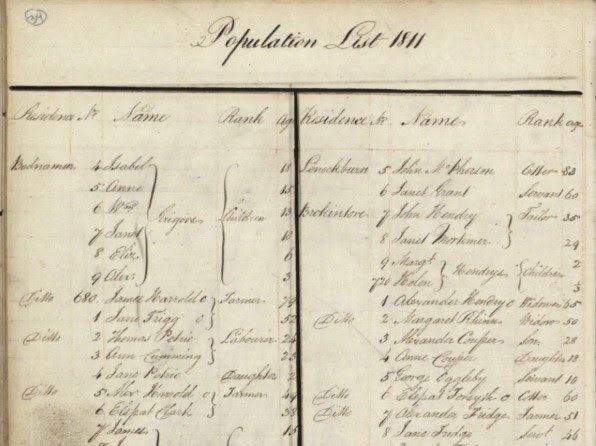
Part of the 1811 census record for Dallas, Morayshire
What does the 1811 census tell us about rural Regency England?
I looked into the early censuses because I want to better understand rural Regency England. What I’ve already learned is that the average English village (in Dorset, where I live) had around 50 houses. Of course, many were larger or smaller, but that’s a number I’ll work with.
I’ll get around to comparing places like Oborne, where we have details from 1801, to how they looked in 1841.
I’ve also been reminded of the variety in designations of places in England. Terms like hundred, wapentake, hamlet, liberty and parish all appear. While they’re used in official documents, were they terms that most people understood and felt some connection to?
Another question I want to answer is when could a community support a specific trade or business? We shouldn’t assume that every village had a dedicated butcher, baker or any kind of shop.
Regency Britain compared to today
The 1811 census reports a population of 12.6 million people in Great Britain. Today (2025) that number is estimated to be 61.4 million. (England, Wales, Scotland).
In simple terms, there are nearly five times as many people around today as there were in 1811. Picture a busy street today and remove four out of five people. That’s how much quieter it would have been in the Regency world.
Then take away all the modern forms of travel and communication. The absence of these meant that people knew all their neighbours, and any stranger would be a curiosity.
Andrew Knowles researches and writes about the late Georgian and Regency period. He’s also a freelance writer and editor for business. He lives with his wife Rachel, co-author of this blog, in the Dorset seaside town of Weymouth.
If you have enjoyed this blog and want to encourage us and help us to keep making our research freely available, please buy us a virtual cup of coffee by clicking the button below.
Regency History
by Andrew & Rachel Knowles

We research and write about the late Georgian and Regency period.
Rachel also writes faith-based Regency romance with rich historical detail.