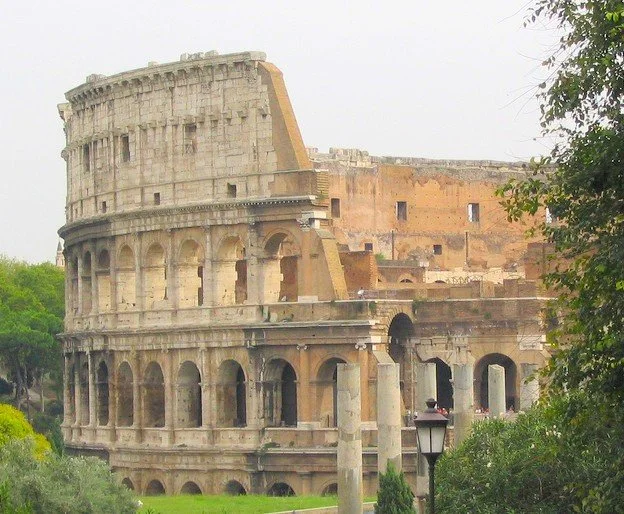
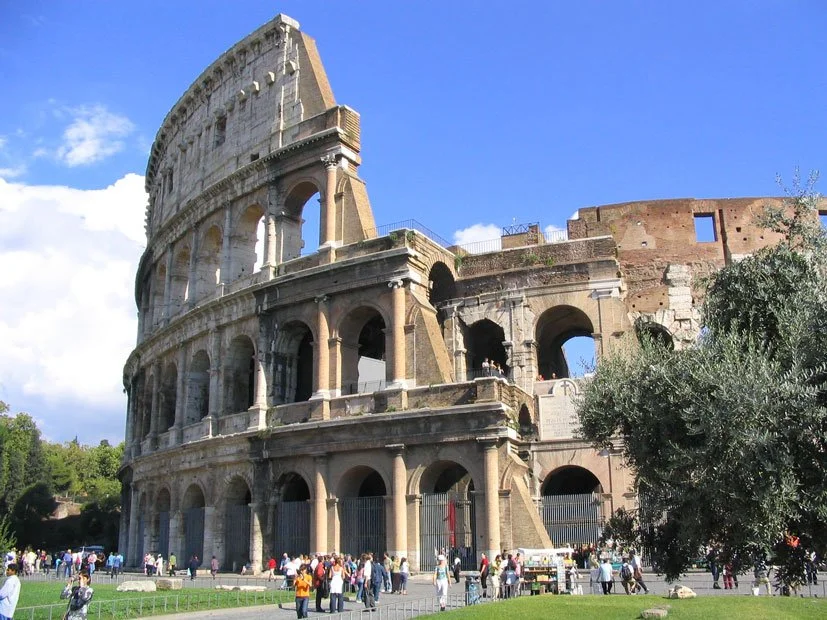
Rome was acknowledged as the ultimate destination for the Grand Tour
Everyone knows that the Grand Tour was just an excuse for rich young men to experience a playboy lifestyle at a safe distance from home.
At least, that’s one modern perspective on a defining feature of the Georgian era.
What’s perhaps surprising is that even before the Regency era, the Grand Tour had attracted a reputation for being little more than an excuse for wild parties and wanton behaviour.
A Regency young man’s announcement that he was to embark on a Grand Tour would, at least in some circles, attract knowing nods and winks, and perhaps outright laughter. Everyone knew Grand Tourists were notorious libertines.
The serious side of the Grand Tour
The picture of the Grand Tour as an extended drunken romp through Europe was, and still is, a caricature.
Not only is it a caricature, but it’s also something few young men undertook in the Regency era. Their father and grandfather were more likely to have done it. I’ll explain that in a moment.
But first, let’s consider the origins of the Grand Tour.
It was intended as a serious educational experience for the sons of aristocrats and the gentry. As they approached their late teens, their families determined they should see something of the world. After all, some of these young men would become the leaders and influencers of the future. It was essential they had a broader perspective on life than that available inside the borders of England.
These students, for that is what they were, needed guidance and instruction from older, wiser men. These guides became known as bear-leaders, because they were responsible for young cubs. The bear-leader was often a clergyman, because clerics were themselves well educated.
Probably the parents hoped the restraining hand of a scholarly man would keep their son focused on serious learning while a long way from home.
However, the students came from privileged backgrounds and felt they were socially superior to their bear-leader. Once safely across the sea, many felt entitled to break free of the boundaries laid down by their instructor. The caricature of the typical Grand Tourist was grounded in fact.
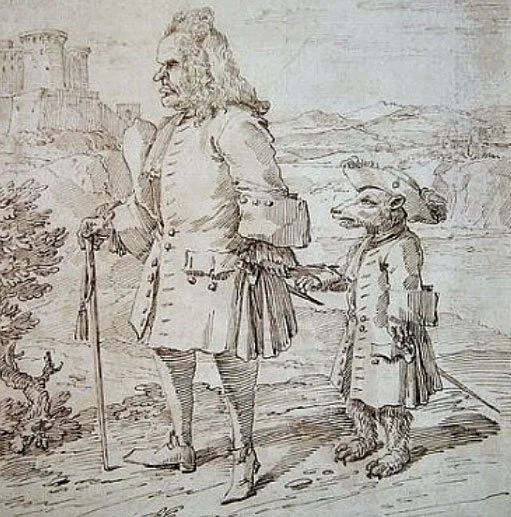
The typical Grand Tour couple, bear-leader and his pupil, drawn in the 1720s by Pier Leone Ghezzi
The Regency grand tourist
The Grand Tour, as described above, was very much a feature of the early to mid 18th century. All the evidence I’ve looked at suggests that the practice of sending young men into Europe, in the company of a bear-leader, was in decline by the last decades of the 1700s.
It stopped almost entirely in 1789, when the French Revolution convulsed Europe.
That’s not to say people stopped travelling outside of Britain. A whole crowd flocked to Paris soon after the fall of the Bastille, to see what was happening for themselves. Others continued to explore further, and visit the popular Grand Tour sites in Italy.
The Grand Tourist of the late 1700s and early 1800s was, in general, more mature, and usually more interested in seeing the sights than enjoying the freedom of from parental control.
Would these later travellers have described themselves as taking the Grand Tour? They were, undoubtedly, aware of whatmany people thought of those who did.
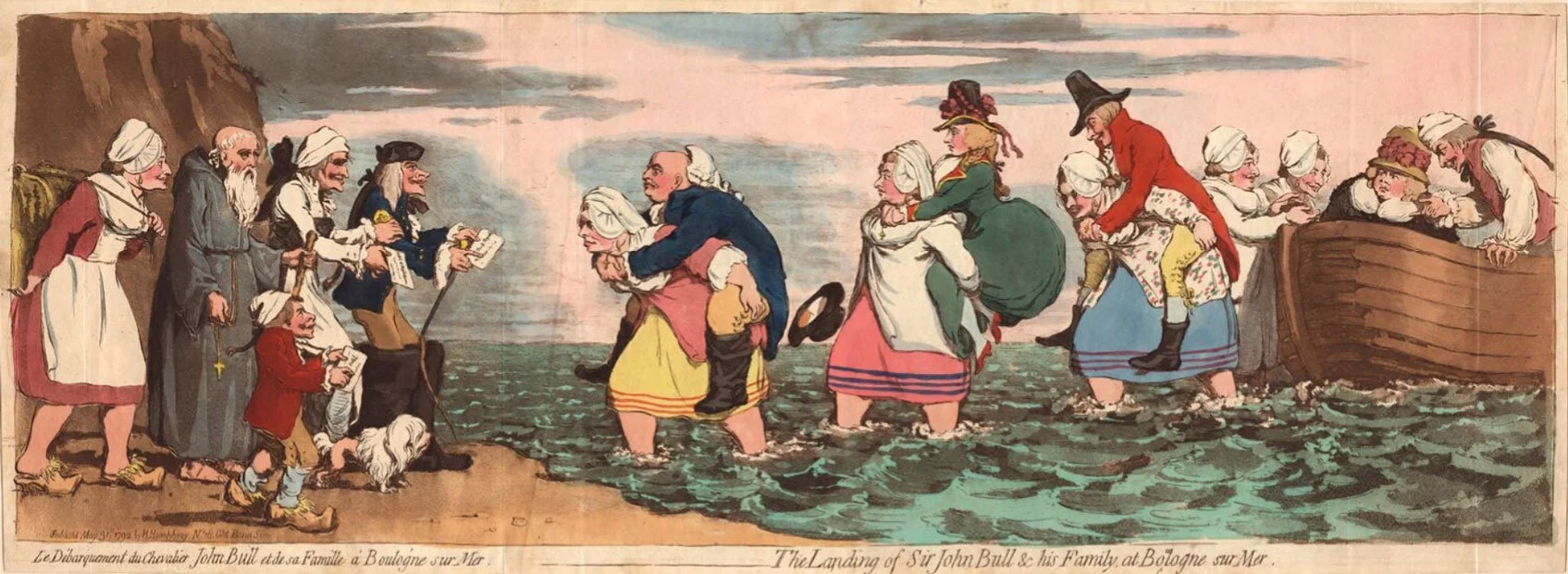
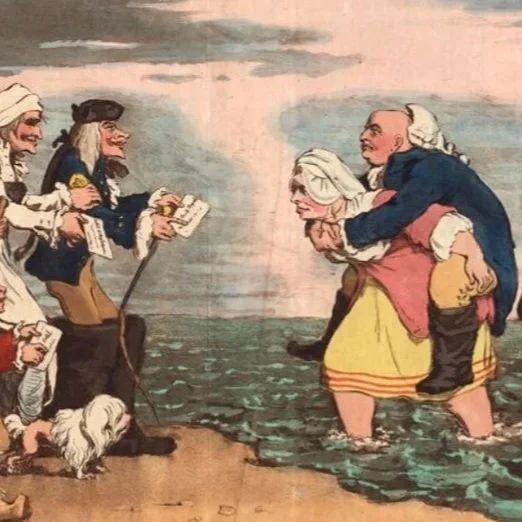
Sir John Bull and his family arriving in France. Caricature of British tourists arriving in France in the 1790s, by Gillray.
What was being said about the Grand Tour
Let’s take a look at what some people were saying about the Grand Tour.
The term ‘Grand Tour’ first appeared in a book printed in 1670. The author, Richard Lassels, noted that he’d undertaken several trips into Europe, ‘as Tutor to several of the English Nobility and Gentry’. He was a bear-leader, even if he didn’t use that title.
Eighty years later, in a novel published in 1752, Irish writer William Chaigneau, uses a conversation to explain that title to his readers. The exchange reveals the author’s opinion of those on the Grand Tour. In the words of his character, a bear-leader is:
A man who understands Latin and Greek, and is well paid by a rich Father to take his Child and expose him through every great Town in Europe.
A few lines later the effect of the Grand Tour on the young man is described. The bear-leader:
Races him round Europe, and in two or three Years he returns to his dear Parents loaded with the Baubles and Vices of each Country.
Just a few years later, in 1758, a satirical pamphlet amplified the negative impression of those taking the Grand Tour. In it, the writer mocked both the inexperienced and unprepared young men, and the inadequate tutor they were paired with. Bear-leaders, he claimed, are chosen mainly because they have already been abroad and because they are cheap.
This pair of ‘Oddities’ were the butt of jokes as they travelled around Europe, and brought home souvenirs that were ‘monstrous Compounds of collected Absurdities’.
By the mid-1700s the Grand Tour and its participants had become something of a joke.
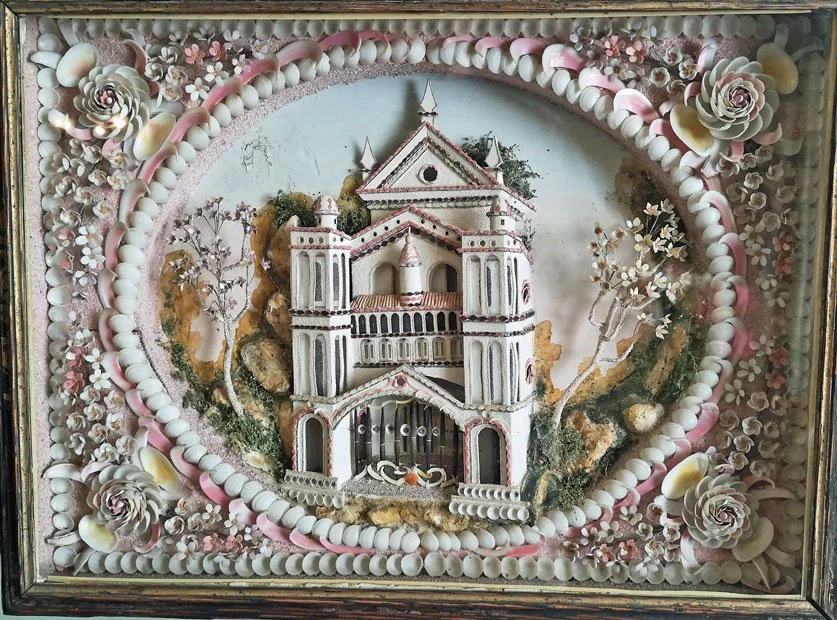
A shellwork picture bought on the Grand Tour by the Parminter cousins, two women who took the Grand Tour in the 1780s. Now displayed at A la Ronde in Devon.
Mocking the Grand Tour ‘souvenirs’
This tone continued into the early 1800s. In the August 1801 edition of The Universal Magazine of Knowledge and Pleasure, an article poked fun at both travelling tutors and the young men they accompanied.
Examine the main-spring of all their pursuits, and you will see the word Pleasure engraved upon it in indelible characters.
It also mocked what the well-travelled young man brought home with him:
A few mutilated busts, purchased at enormous price… an Italian opera girl; a broken constitution… and the most brilliant assortment of the last Parisian fashions.
He had also acquired ‘the art of pleasing’ and ‘the subtleties of seduction’.
For some, this last ‘souvenir’ wasn’t a joke, but a serious moral problem. In 1825, the writer of a pamphlet describes a Mr Church:
A man of fortune, he had made the grand-tour, and brought home all the foreign vices that degrade most of our continental travellers.
More to the Tour than the Pursuit of Pleasure
Not everyone considered European travel to be a waste of time, money and morals. A host of guidebooks from the Regency years extol the benefits of exploring Europe, even when Britain was at war with France.
Many people made the effort to travel because they were keen to see more of the world. They were enthusiastic about encountering other cultures, and seeing landscapes unknown in Britain. A desire to learn drove them to leave home, even in an age when long-distance travel meant inevitable discomfort.
Such travellers earned the respect of foreigners, enriched their own cultural life, and created a positive legacy for those around them.
However, in popular culture, both today and in the Regency era, it is not these travellers who are remembered. For over 250 years the abiding impression of the Grand Tour has been of libertines attempting to debauch their way around Europe, and being laughed at by the rest of us.
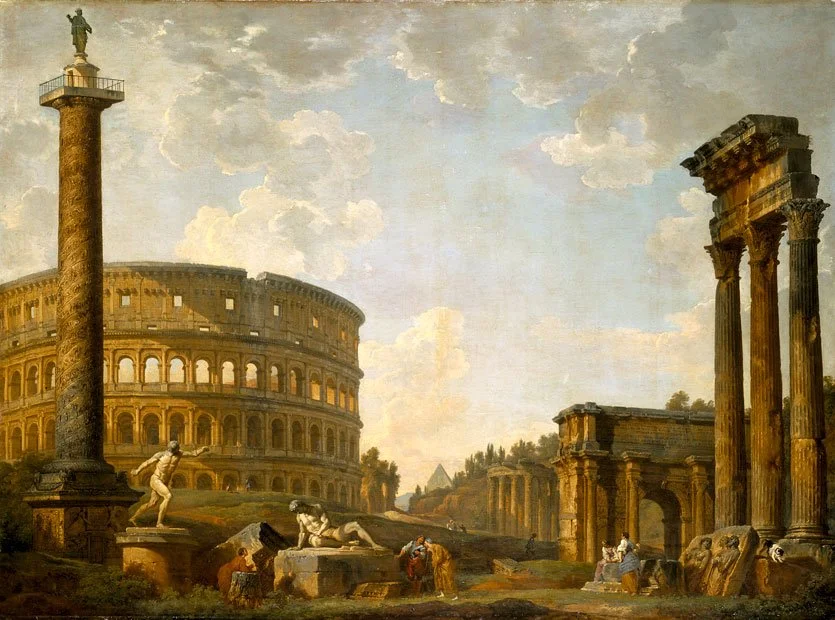
Capriccios, paintings that group historic sites into one image, were another popular souvenir of the Grand Tour. This is by Giovanni Paolo Panini and shows sites in Rome.
Andrew Knowles researches and writes about the late Georgian and Regency period. He’s also a freelance writer and editor for business. He lives with his wife Rachel, co-author of this blog, in the Dorset seaside town of Weymouth.
If you have enjoyed this blog and want to encourage us and help us to keep making our research freely available, please buy us a virtual cup of coffee by clicking the button below.
Sources used include:
The Grand Tour by Christopher Hibbert (1987)
The Voyage of Italy by Richard Lassels (1670)
The History of Jack Connor by William Chaigneau (1752)
The Bear-Leaders or Modern Travelling Stated in a Proper Light (1758)
Universal Magazine of Knowledge and Pleasure (1801)
Regency History
by Andrew & Rachel Knowles
We research and write about the late Georgian and Regency period.
Rachel also writes faith-based Regency romance with rich historical detail.