
Survey of Pall Mall, London
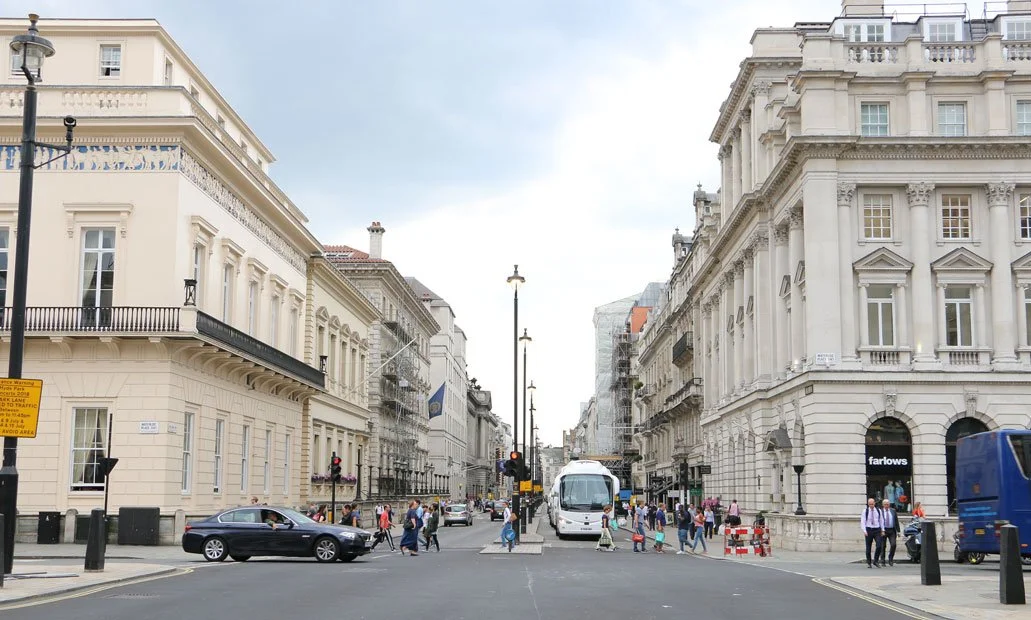
Pall Mall looking west from Waterloo Place, site of Carlton House. (2018)
Purpose of this page
This page was created to support the post about the story of Pall Mall, up to and including the Regency era. It sets out the history of many of the buildings that existed before or up to 1820.
This survey progresses west to east, along Pall Mall. Information is primarily from two sources:
Survey of London Volumes 29 and 30 (1960), part of the British History Online website
The south side of Pall Mall is owned by the Crown, with the exception of no. 79.
The north side has been in private ownership for centuries.
The only buildings on modern Pall Mall that have any similarity to how they appeared in the Regency are St James’s Palace and Schomberg House.
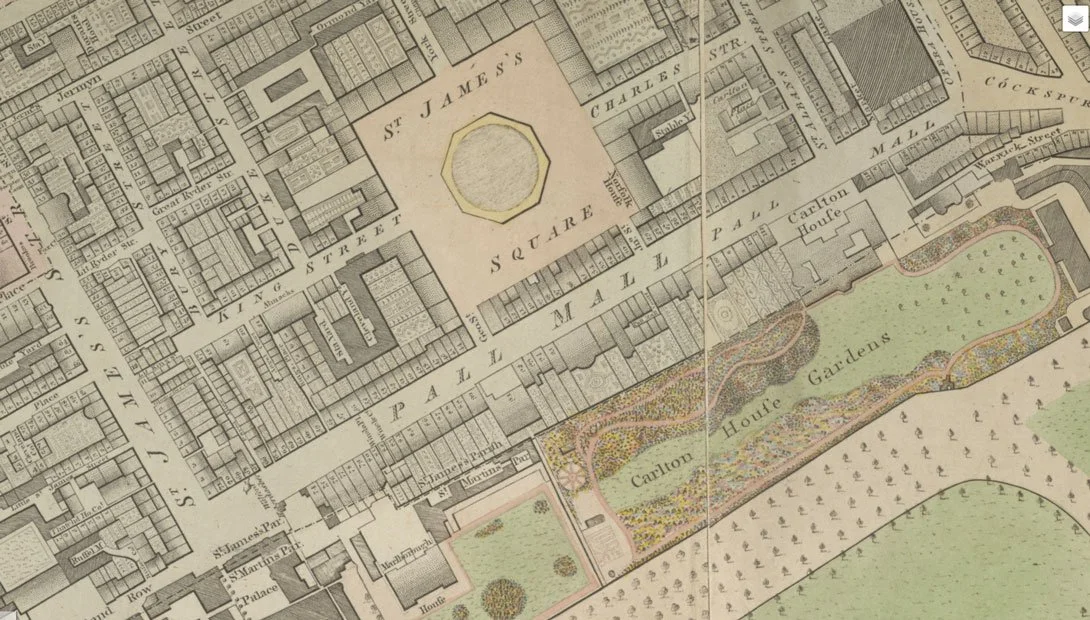
Pall Mall on Horwood’s map from the 1790s
Pall Mall: South Side
St James’s Palace
St James’s Palace was built in the 1530s by Henry VIII on the site of a leper hospital dedicated to Saint James the Less. It was a secondary palace until 1698, when Whitehall Palace burned down.
George I and George II used it as their principal residence in London, but George III preferred Buckingham House. Official events, including public audiences, continued to be held there until 1837.
The king’s private apartments were destroyed in a fire of 1809 and not rebuilt. That’s why the Queen’s Chapel is now separated from the palace by Marlborough Road.
Entrance to Marlborough House
In or shortly after 1729 the four houses at the western end of Pall Mall (south side) were demolished to make an entrance into Marlborough House.
Numbers 66-68
The clockmaking family of Vulliamy lived at no. 68 from 1765 to 1854, with the ground floor used as a shop.
The entrance gate to Marlborough House (immediately to the west of these buildings) used to be level with the front of these houses. This meant no. 67, which was on the back of the block, overlooked the grounds of the house.
A Victorian rebuild insisted there were no windows on the south and west sides of no. 67.
Now occupied by numbers 67 and 68.
Number 69
This became Hammersley’s Bank from the 1790s and was absorbed into Coutts in 1840.
It was rebuilt in the 1920s and combined with no. 70.
Now occupied by HSBC bank.
Number 70
Built by Thomas Ripley, Comptroller of the King’s Works from 1740, it was a bookseller’s from 1794 to 1810, and then a private house.
Merged into no. 69 in the 1920s rebuild.
Number 71
Sir Edward Walpole, second son of Sir Robert Walpole, lived here in 1778. It’s said he had the house to frustrate Sarah, Duchess of Marlborough, who wanted a grand entrance from her house (which is behind), onto Pall Mall.
The site of no. 71 is now the western end of the current no.71, the Oxford and Cambridge Club, built in 1836-37. The club occupies numbers sites of nos. 71-76.
Numbers 77 and 78
Built as a townhouse in the 1860s.
Number 79
This is the only building that does not belong to the Crown. It was granted to Nell Gwynne in 1676 by Charles II. She lived here until her death in 1687. It had various owners after that and has been rebuilt several times.
In 1766 Maria Dowager Countess Waldegrave secretly married the Duke of Gloucester here on 6 September 1766.
Numbers 80-82 - Schomberg House
Built in 1698 for the Duke of Schomberg, it was divided into three separate buildings in 1769.
No. 82 (eastern end) was occupied by a succession of mercers, furriers and importers. It was rebuilt in 1851 in an entirely different style.
The only part of the original Schomberg House that survives is the facade of numbers 80 and 81. The majority of the building was rebuilt in the 1950s, which is also when the facade of no. 82 was restored to the original style.
No. 81 became the ‘Temple of Health and Hymen’ run by Dr James Graham, in 1781. This included the ‘grand celestial state bed’, which helped overcome infertility problems. It’s suggested that Emma Hamilton worked here. Graham left in 1784.
Richard and Maria Cosway moved to the house in 1784 and lived there until 1791.
From 1792 to 1795 it was occupied by Thomas Goddard on behalf of the Polygraphic Society. It was then taken by picture dealer Michael Bryan (1796-1804) then Peter Coxe, auctioneer and poet (1805-6). In 1806 Thomas Payne opened a bookshop here, which continued until the 1850s.
No. 80 was home to Thomas Gainsborough from 1774 until his death in 1788. Another painter, Robert Bowyer, succeeded him until 1803.
Numbers 83-84
In 1768 the houses were leased to James Christie, auctioneer. He built an auction room in the garden. The houses were taken over by the Board of Ordnance from 1809, although the business was permitted to have offices there until 1823.
These houses are now part of the large site occupied by the Royal Automobile Club. The club covers plots 83-91.
Numbers 85-87
An early occupant of this site was the Cocoa Tree chocolate house, first documented in 1698, when it’s referred to as being ‘in Pell Mell’. It relocated several times during its history but was on this site until 1757.
The Cocoa Tree developed into a member’s club that existed until 1932. After 1757 it relocated to Pall Mall, and finally moved to St James’s Street.
In 1760 The Duke of York leased three houses on the site and demolished them to build York House. The Duke was Edward, Duke of York and Albany (1739-1767) a younger brother of George III.
On his death the house was passed to his brother, the Duke of Cumberland (1745-1790), and became known as Cumberland House. It stood mostly empty for some years after the Duke of Cumberland’s death in 1790. The Union Club occupied part of it 1801 to 1806.
In 1806 these were leased by the Board of Ordnance.
The plots are now part of the large site occupied by the Royal Automobile Club.
Numbers 88-90
These were used by a hatter, and later as offices of the Globe Insurance Company. No. 88 was occupied, in 1775 to 1780, by portrait painter Nathanial Hone, one of the first Royal Academicians.
They became part of the War Office in 1859.
The plots are now part of the large site occupied by the Royal Automobile Club.
Number 91
This was Buckingham House, named after George Grenville, first Marquis of Buckingham, who inherited it in 1779. He had a new house built on the site, completed in 1795.
The family sold it in 1847 and soon after it became part of the War Office.
The plot is now part of the large site occupied by the Royal Automobile Club.
Numbers 92-93
These buildings became the Royal Hotel in about 1777. The owner, James Weston, went bankrupt in 1809 and gave up no. 93, although the hotel continued in no. 92 until around 1816. In 1818 no. 92 was occupied by Messrs. Mott, makers of pianofortes.
No. 93 was occupied, in 1810-11, by Frederick Winsor, pioneer of gas lighting. In 1819 it was a bookshop and auctioneers.
Both buildings were demolished in the 1840s to make way for the extended Carlton Club, and the plots are now part of 100 Pall Mall.
Numbers 93-95
Occupied by Frederick Winsor, pioneer of gas lighting. In 1807 he erected 13 lamp posts, extending from his property towards St James’s Street. The lamps were only used on special occasions and probably stopped being lit in 1810. Regular gas lights were installed on Pall Mall in 1820.
One of the houses became the Waterloo Museum in 1815.
The plots became part of the Carlton Club, and are now part of 100 Pall Mall.
Number 100
The modern building named ‘100 Pall Mall’ includes the site of the Star and Garter inn (one of two with that name on Pall Mall).
It’s known to have been there from at least 1743. In 1765 it was probably the site of a duel between Lord Byron (great uncle of the poet) and his neighbour, Mr Chaworth. The latter was killed.
The inn was a popular meeting place. The laws of cricket were revised by a committee that met here in 1774. The Society of Dilettanti met here often from 1765 to 1800 - when it seems to have closed. It became an office of the Light and Heat Company, and then a place where shoe blacking was made.
The site now occupied by 100 Pall Mall became the purpose-built Carlton Club in the 1830s. It was rebuilt and extended westward (to incorporate nos. 92-93) in the 1850s, then destroyed in Second World bombing.
The second, smaller Star and Garter inn on Pall Mall was at no. 44, on the north side.
National Gallery
This stood partly at the western end of the current Reform Club building, and partly on the road now called Carlton Gardens. The property was not purpose-built and not considered suitable for displaying so many paintings.
The National Gallery also took on no. 105 before it moved to Trafalgar Square in 1838.
Number 104
From 1831 to 1836 this was used to store and exhibit the King’s pictures. The Reform Club took over in 1836 and later demolished it.
Number 105
This house was occupied by Mrs Fitzherbert between 1789 and 1796, and later by the Globe Insurance Company and Sir Walter Stirling. In 1826 George IV began using it as an annexe to Carlton House.
The National Gallery of Pictures moved from no.100 to 105 in 1834, where it remained until the new National Gallery building was opened in 1838. It was later demolished for the building of the Reform Club.
Number 106
Built in 1828-32 following the demolition of Carlton House, this was constructed for the Travellers’ Club (founded 1819). The club continues to use the building.
Number 107
Built in 1826-30 for the Athenaeum Club, which still occupies the building. Its site includes what was the first house immediately west of Carlton House, which implies that the current Travellers’ Club also stands on sites of previous buildings.
Carlton House
The eastern end of Pall Mall, on the south side, became the site of Carlton House in 1709. This was on the site of a previous house, for which I can’t currently find any information. However, in 1732 this new building, Carlton House, was sold to Frederick, Prince of Wales.
In 1783 the house was granted to Frederick’s grandson, George, Prince of Wales, and he substantially rebuilt it. Carlton House was George’s London residence and became a hub of fashionable society.
When George became king in 1820, he was already losing interest in Carlton House. It was stripped of its features in 1826 and then demolished.
Today, Waterloo Place marks the site of Carlton House. Much of the gardens behind the house became Waterloo Terrace.
Number 116 - Royal Academy of Arts
The Royal Academy held its first meeting in Pall Mall on 14 December 1768. It was here they began their annual exhibition. In 1780 it moved to the new Somerset House.
The building was on the site now occupied by the Institute of Directors.
Pall Mall: North Side
Numbers 9-18
A variety of houses were built on this stretch of Pall Mall. Some were demolished in 1818 for the development of Waterloo Place.
Number 20
Built around 1772, although the top two floors were added after 1850.
Number 29
A new house was built here in 1792-3, and in 1794 it was occupied by Royal Exchange Assurance. They remained until 1907, although the house was rebuilt in the 1880s.
Numbers 30-35
Sir Hugh Palliser took a house here in 1777. He was one of the Lords of the Admiralty. In 1778 his house was gutted by a mob, because of his insubordination in an action against the French in the English Channel.
Demolished in 1866 to make way for the Junior Carlton Club.
Number 46
The Cocoa Tree chocolate house moved here in 1757 and remained until about 1793.
The site is now part of 45 Pall Mall.
Number 49-51
Almack’s
Nos. 49-51 (now mostly part of no. 50).
William Almack opened a ‘common Alehouse or Victualling-house’ in Pall Mall at no.49, in 1759. He previously ran a coffee house in Curzon Street.
In 1762 John Scott leased nos. 50 and 51, and sub-leased no. 50 to Almack. According to the Survey of London (1960) these houses (49-51 Pall Mall) were ‘the pivot of fashionable club life in London’. Several clubs began meeting there.
Almack’s first club was formed in 1760. It lasted until 1764, and was possibly the origins of both Brooks’s and Boodle’s.
Brooks’s
In 1764 Brooks’s began in no.49.
Brooks’s moved to St James’s Street in 1778, and has remained in the same location ever since.
Boodle’s
Edward Boodle was in partnership with William Almack, and it’s likely his club was run in no. 50 from about 1764. The partnership seems to have ended in 1768, when Boodle took more responsibility for the lease of no. 50.
Boodle died in his Pall Mall house on 8 February 1772. The club appointed Ben Harding as his successor, but it kept Boodle’s name. In 1782 the club moved to St James’s Street, and has remained in the same house since then.
The Macaroni Club
This short-lived club existed between 1764 until the early 1770s. It met in one of Almack’s properties on Pall Mall, most probably no. 49.
The Ladies’ Club
As with the Macaroni Club, it’s not known which Almack’s building was used for the Ladies’ Club. Formed in 1769, it welcomed both men and women into membership. It ceased in 1777.
Goostree’s
In 1773 there are reference to a ‘New Club at Goostree’s in Pall Mall. It’s suggested that this met in no. 51, but was short-lived, ending by 1778. It was, perhaps, revived in the 1780s for a short while, but ended in 1787. That’s when Goostree sold the house to a bookseller.
From 1783 no. 50 was occupied by Hammerslay and Co, and then demolished.
From 1796 to the early 1820s no.49 was occupied by the firm Ransom and Morland.
Numbers 49-51 are now occupied by no. 50 and 52, immediately east of Angel Court.
Number 52
This was the site of Robert Dodsley’s bookshop where, perhaps, he suggested the idea of writing a dictionary to Samuel Johnson. The shop moved out of here in 1787 and it was rebuilt as the Shakespeare Gallery to display paintings.
The gallery closed in 1804 and the building was taken on by the British Institution, a body dedicated to promoting fine arts.
The Institution sold the building in 1868 and it was demolished soon after.
Number 59
This was the Smyrna coffee house, probably from 1702 to 1772.
Number 64
Occupied by the Cocoa Tree Club from around 1793 to 1799, when it moved to St James’s Street.
This is probably at or near the corner site with St James’s Street.
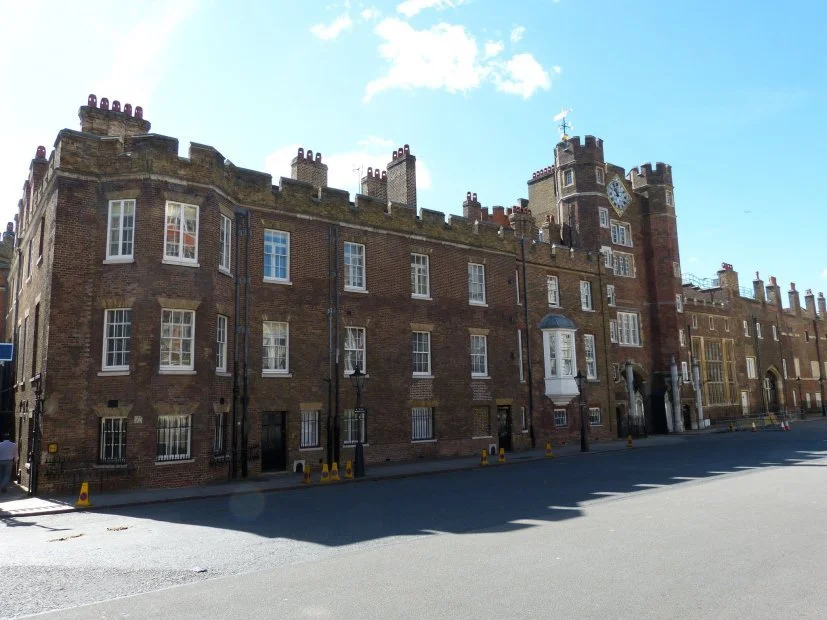
St James’s Palace (2012)
Andrew Knowles researches and writes about the late Georgian and Regency period. He’s also a freelance writer and editor for business. He lives with his wife Rachel, co-author of this blog, in the Dorset seaside town of Weymouth.
If you have enjoyed this blog and want to encourage us and help us to keep making our research freely available, please buy us a virtual cup of coffee by clicking the button below.
Sources used include:
Historic England, Listed Buildings and Places
Survey of London, Volumes 29 & 30 (Via British History Online)
Regency History
by Andrew & Rachel Knowles
We research and write about the late Georgian and Regency period.
Rachel also writes faith-based Regency romance with rich historical detail.



Jane Austen at Carlton House