Maria Cosway: Artist, Musician, Educator

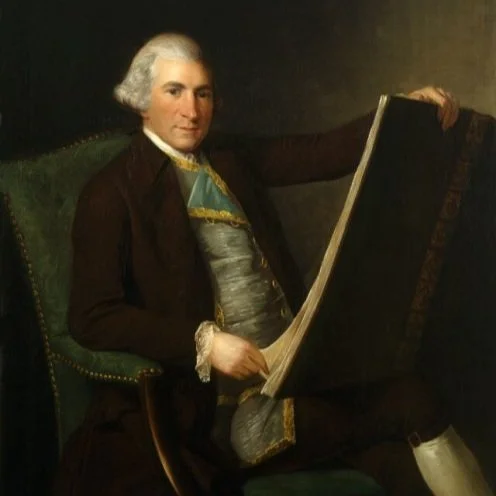
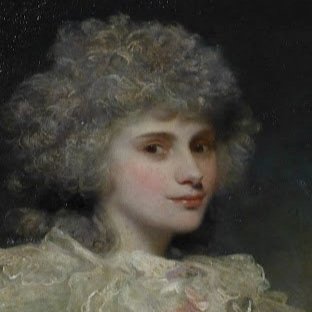
Maria Cosway by her husband, Richard Cosway, in the early 1780s
Maria’s early life in Italy
Maria Cosway was born Maria Hadfield in 1760 in Florence. Her father, Charles Hadfield, had set up several inns around the city to cater to the English undertaking the Grand Tour. His customers included the Duke of Gloucester, artist George Romney and writer James Boswell.
A painting by Thomas Patch, dated 1760, captures the scene of a dozen or so gentlemen enjoying a convivial evening at Carlo’s, Hadfield’s first inn. The artist provided a key to everyone present, including “Mr Hadfield, the landlord, holding a china punch bowl above his head.” We know from Maria’s letters that she met a good number of those who passed through the inns.
Hadfield made certain that the education of his five children went well beyond their interactions with some of the most well-connected people in English Georgian society. In later years, she felt it an insult to her parents that people assumed her good manners were due to aristocratic birth.
Despite her parents being Protestant, they chose for Maria to be baptised as a Catholic. She was educated in a convent, where she soon demonstrated artistic talents. By the age of 10 she played the harpsichord at public concerts. From age 12 her art teacher was Johann Zoffany, court painter in London and Vienna. She later got to spend a considerable amount of time in Rome, meeting with many other artists and studying the works of old masters.
Maria’s father died when she was 16. In 1779 her mother took the family back to England, where Maria soon had an introduction to one of the great painters of the day, Sir Joshua Reynolds.
Marriage and the Royal Academy
Richard Cosway was 38 when he married 20-year-old Maria at St George’s, Hanover Square. He was the official painter to the Prince of Wales, well known for his skill with miniature portraits.
He also had a reputation as a dandy and a philanderer and the marriage was probably more about convenience than love. Maria’s family needed financial support and, in the light of the recent Gordon Riots, perhaps a degree of protection because of their status as Catholics.
Shortly after the wedding, three of Maria’s paintings were selected for the prestigious Royal Academy annual exhibition. Her works were then included every year until 1789, with six displayed in 1785. Maria was a rising star in the art world, but she had one disadvantage - she was a woman.
Two of the founding members of the Royal Academy were women, Angelica Kauffman and Mary Moser. The next female member was not given entry until 1936. Women were also barred from attending the Academy’s life drawing classes, making it difficult for Maria to perfect her depictions of the human form.

The exhibition at the Royal Academy, Somerset House from The Microcosm of London (1808-10)
At the centre of London society
Richard Cosway’s most important patron was the Prince of Wales, the future George IV. He lived at Carlton House in Pall Mall, London, so Cosway moved into the same street. In 1784 he and Maria took their household to the elegant, Dutch-style Schomberg House. Today it bears a plaque announcing it as the residence of Thomas Gainsborough. He was a neighbour, the house being split into different sections.
The ambitious Richard Cosway made his new home a hub of society entertainment. Frequent musical parties drew in the most talented performers, and many of London’s elite were invited to hear them. The audience included Horace Walpole, the Duke and Duchess of Devonshire, Charles James Fox and Richard Brinsley Sheridan.
As an attractive and successful young woman Maria attracted admirers and, inevitably, gossip. There was talk of affairs. Her husband’s extramarital relationships were poorly kept secrets, but there’s no evidence Maria’s activities were more than gossip. Even her now well-known romantic relationship with American Thomas Jefferson, in Paris in 1786, was platonic. The Cosways were visiting the city together.
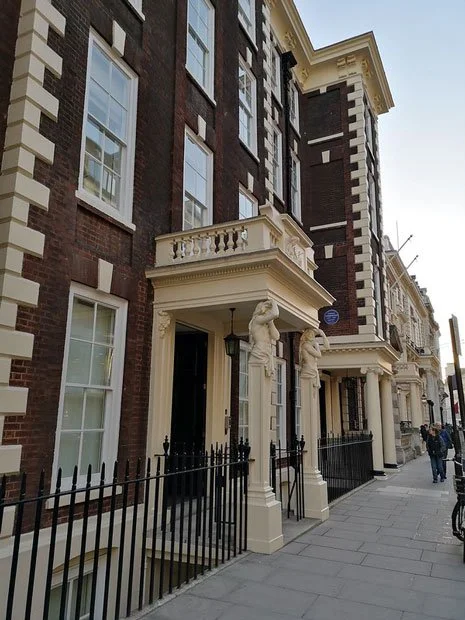
Schomberg House, Pall Mall, London - the Cosways hosted society events here, in their home
Travel and tragedy
Richard and Maria had just one child, Louisa Paolina Angelica, born in May 1790. It was a difficult pregnancy and Maria’s doctor advised she go to Italy to recuperate - so she did. She travelled with others, but left her husband and baby in England. She was away for four years.
Maria’s return to England saw her again exhibiting in the Royal Academy exhibition. A sole work was displayed in 1796, the same year that little Louisa died. Both parents were heartbroken.
Despite what was now a difficult marriage, the Cosways continued to live together and work on their painting. In 1800 Maria received a royal commission to paint Caroline, Princess of Wales and her daughter, Princess Charlotte. That same year she had seven pictures displayed in the Royal Academy exhibition.
The following year Maria returned to Paris. She set about the enormous task of making etchings of every painting in the Louvre, for an ambitious publication to include ‘An Historical Account of Each Picture’.
Travel to Paris was possible because of the new peace between Britain and France. Many English travellers to France met Maria during their trip. Unfortunately, her project foundered, and Maria began looking around for alternative sources of income. While she was still communicating with her husband by letter, it seems she had to support herself financially.
She left Paris in May 1803, just as war resumed between Britain and France. However, her destination was not London but Lyon, the second largest city in France. She had been invited to set up a school for girls.
Maria the educationalist
For the next 35 years - the rest of her life - Maria Cosway focused on education, not art.
The school at Lyon was not a success.While the French church had initiated the project, its support was limited. While it hosted a visit by Napoleon in 1805, and Pope Pious VII a few days later, the school was forced into a merger with a convent and Maria’s involvement ended soon after.
This did not blunt her enthusiasm for educating girls. In 1812, supported by Count Melzi, Duke of Lodi, she opened a new school in a former convent in Lodi, Lombardy, northern Italy. This was much more successful than the Lyons endeavour.
Despite pouring her energies into the school, Maria made the long journey back to London twice. In 1815 she reached England a few days before the Battle of Waterloo. She visited at least one school to observe how it worked. She also visited her husband, but there was no reconciliation, and the visit lasted just three months.
However, she came back in 1817, when her husband’s health was failing. She remained in England for five years, returning to her school in Lodi in 1822. Her final months in London were spent winding up Richard Cosway’s affairs after his death in July 1821.
In her final years, Maria travelled in Italy and Austria, and spent time in a house she’d bought beside Lake Como. She was also awarded the title of Baroness of the Austrian Empire, in 1834, for her work in education. By now the running of her school had been transferred to others.
Maria Cosway died on 5 January 1838 and was buried in the church beside the school. Education of children continued at the site until 1978. It’s now home to the Fondazione Maria Cosway, and its mission is ‘to educate and form young people who belong to the Lombardy environment.’
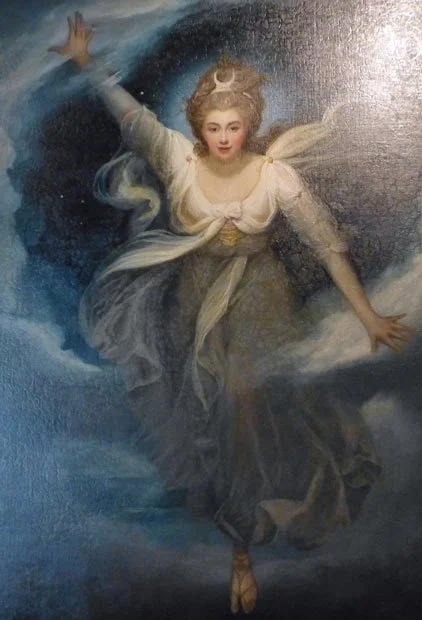
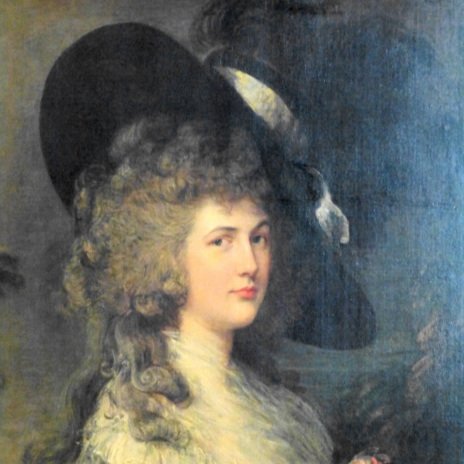
Georgiana Cavendish, Duchess of Devonshire, by Maria Cosway
Andrew Knowles researches and writes about the late Georgian and Regency period. He’s also a freelance writer and editor for business. He lives with his wife Rachel, co-author of this blog, in the Dorset seaside town of Weymouth.
If you have enjoyed this blog and want to encourage us and help us to keep making our research freely available, please buy us a virtual cup of coffee by clicking the button below.
Sources include:
Out of the Shadows: Rediscovering Maria Cosway by Diane Boucher
An Englishman in Paris: 1803 by Bertie Greatheed
Regency History
by Andrew & Rachel Knowles

We research and write about the late Georgian and Regency period.
Rachel also writes faith-based Regency romance with rich historical detail.