
Pall Mall in the Regency: The Story of a London Street
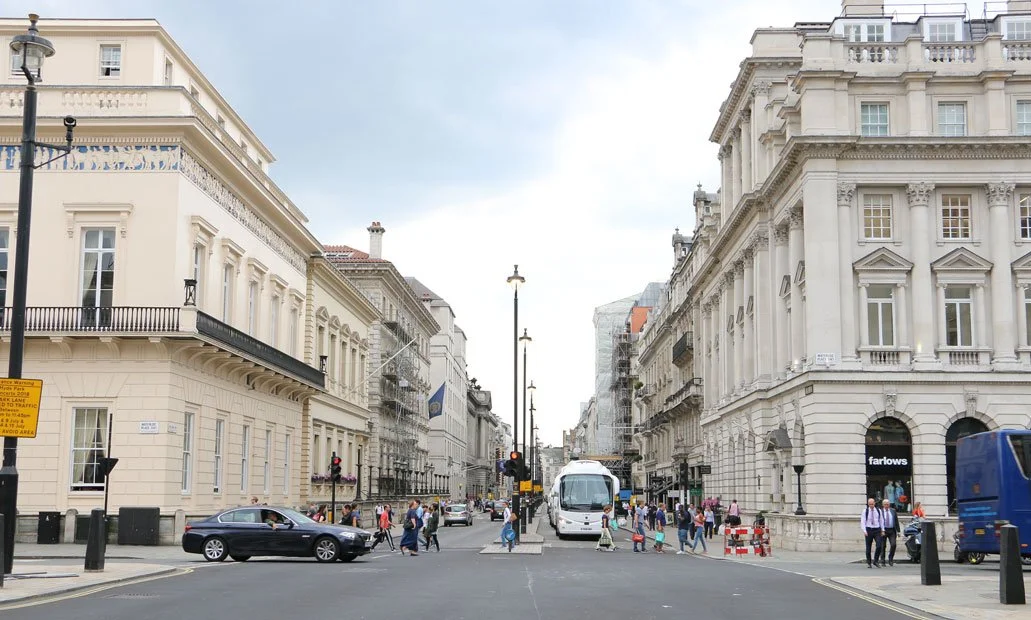
Pall Mall looking west from Waterloo Place, site of Carlton House. (2018)
Pall Mall has been at the heart of fashionable London for over 300 years.
This relatively short street, less than half a mile long, was unique in having a royal palace at either end during the reign of George III. As a result, it became a hub of society life.
We decided to investigate its history, to get something of its character in the late Georgian and Regency era.
Pall Mall has been home to two royal palaces. Also to at least two royal mistresses. It’s seen coffee houses, bookshops, clock shops and a host of gentleman’s clubs. Artists, musicians and writers have lived and worked in its many houses. It’s also witnessed riots, bombings and the first ever display of gas lamps to light public streets.
Let’s explore Pall Mall.
We’ve created a more detailed survey of Pall Mall, describing about individual buildings, businesses and institutions.
Pall Mall before the Regency
The story of Pall Mall begins with St James’s Palace. Or, going back even further, with the hospital of St James for women with leprosy. Established some time before 1200, the hospital was at a safe distance from the medieval city of London.
Being a religious house, it was one of the hundreds closed during the dissolution of the monasteries, on the orders of Henry VIII. The king decided it was a good spot to build a palace outside London. It was more a grand hunting lodge than a place of pomp and ceremony.
A map of 1658 shows St James’s Palace on the very edge of London. Surrounded by fields and parkland, it’s about half a mile west of Charing Cross, where Trafalgar Square is today. That was where London began.
Less than 25 years later, in the early 1680s, another map shows St James’s Palace was now linked to Charing Cross by Pall Mall Street. It was lined with houses on both sides, and had St James’s Square just to the north.
The area of London now known as St James’s had been laid out.
Origins of the name Pall Mall
The name Pall Mall comes from the Italian words palla (ball) and maglio (mallet). It’s from a game similar to croquet, where a ball is struck with a mallet. Popular with royalty in the early Stuart era (James I and Charles I), it was played on smooth grass on a course on the southern end of St James’s field, near the palace. The course was called a pall mall.
In 1661 the course was moved south a short distance, and the old pall mall was converted into a road that linked St James’s Palace to Charing Cross. The road adopted the name Pall Mall, becoming the Pall Mall Street on the 1680s map.
In time, the new course was also converted into a road, now known simply as The Mall.
Early buildings along Pall Mall
The 1680s map shows Pall Mall as having buildings along both sides. The most significant is, of course, the palace at the western end: St James’s.
A host of other constructions sprang up along the road, as speculators and builders seized opportunities to lease plots for houses and shops. The buildings on the north side of the street became the property of private owners, while those on the south side remained (with one exception) the property of the King.
The exception is a house granted to Nell Gwyn, mistress of Charles II, in 1676.
A moment of drama occurred on Pall Mall in 1682 when wealthy landowner Thomas Thynne was assassinated in his carriage, by pistol shot.
At the beginning of the Georgian era, in 1714, Pall Mall was probably a mix of smart houses in the latest styles and shabbier, late Tudor buildings.
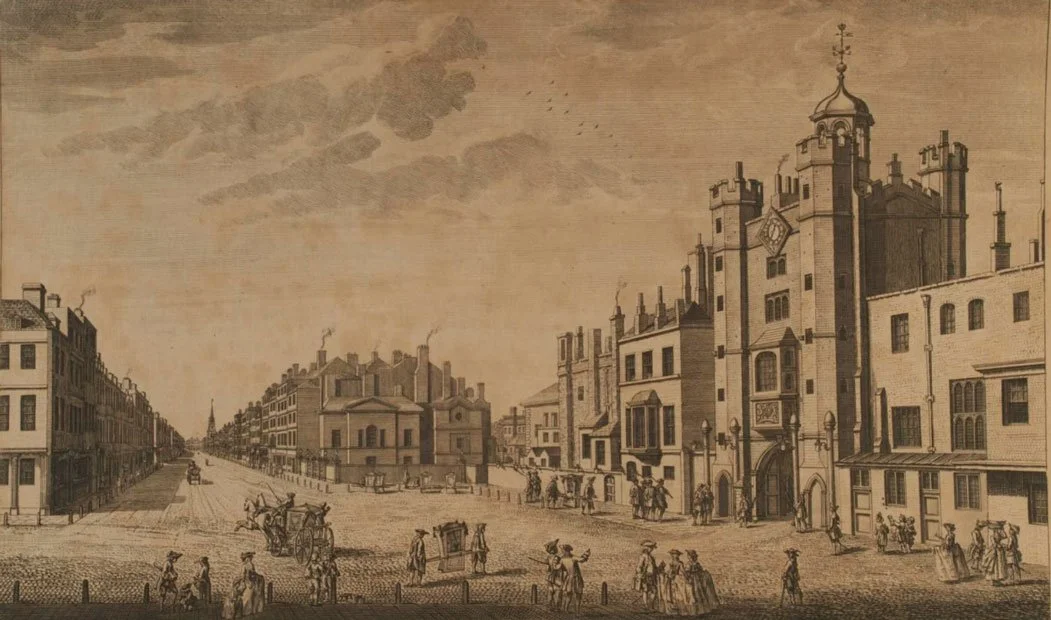
Pall Mall in 1753, from St James’s Palace (right), looking east
Characters of Late Eighteenth Century Pall Mall
In the 1600s Pall Mall went from an empty road into a busy, built-up thoroughfare. In the 1700s almost all those early buildings were torn down and replaced. The street became home to a host of characters who helped shape the Regency.
One who was extremely well known at the time was Dr Graham. Despite having no formal qualifications, he secured a reputation as a physician to society figures. One of his claims was to have created a bed that cured infertility.
In 1781 Dr Graham set up a Temple of Health in Schomberg House, Pall Mall. The centrepiece of the Temple was the Celestial Bed. It combined features such as electricity, live birds and organ music to create an environment to promote conception. It’s suggested that Emma Hart (later Emma Hamilton) was one of the scantily-clad temple nymphs who helped create the appropriate atmosphere.
The Temple was short-lived, closing in 1784. But the next inhabitants continued to attract the cream of society. They were Richard and Maria Cosway, artists.
Richard was made Painter to the Prince of Wales, elevating his status to the top of fashionable society. The Cosways’ home became a fashionable salon. Thomas Gainsborough lived next door, in another part of Schomberg House.
Another character on Pall Mall, also close to the Prince of Wales, was Mrs Fitzherbert. In 1785 she and the Prince married in secret and, in 1789, she moved into a house on the south side of the street.
Of course, the Prince of Wales also lived on Pall Mall. He was granted Carlton House in 1783, on his coming of age. Here he could create a household that suited his taste, and a palace that reflected his extravagant personality.
Another name well known in the Regency was that of Almack. William Almack opened a tavern on the north side of Pall Mall in 1759. It was here that he had a role in establishing clubs that later became Brooks’s and Boodle’s. His more famous Regency establishment, Almack’s Assembly Rooms, was in neighbouring King Street. Almack died in 1781, but his legacy continued into the Regency.
Institutions on Eighteenth Century Pall Mall
Other famous names with homes on Pall Mall include a number of venues and institutions, some of which have survived until today.
Carlton House has already been mentioned. The palace of the Prince of Wales was at the other end of the street from St James’s Palace, the hub of royal power for several generations. George III broke with tradition, choosing to live in Buckingham House rather than in the ancient red brick building. St James’s continued to be used for royal audiences, meaning the King and Queen both visited several times a week.
Carlton House has now gone, demolished in the 1820s after George IV (as the Prince of Wales became) lost interest in it. Another institution that’s gone is the Star and Garter Inn, on the south side of the street. A popular meeting place, it hosted the Dilettanti Club from 1765 until the inn closed in 1800.
An institution that outlived its life on Pall Mall was the auction house, Christie’s. In 1768 James Christie leased two houses on the south side of the street and built an auction room in the gardens. The business he formed continued to operate from here until 1809, and had some of the space as offices until 1823.
Also on the south side of Pall Mall, starting in 1768, was the Royal Academy of Arts. It was here they held, in 1769, their first annual exhibition - an annual event that continues today. The Academy moved to Somerset House in 1780.
Pall Mall’s artistic connections continued, becoming an early home to the collection which became the National Gallery. This occupied two houses on the south side of the street, one of which had been the home of Mrs Fitzherbert.
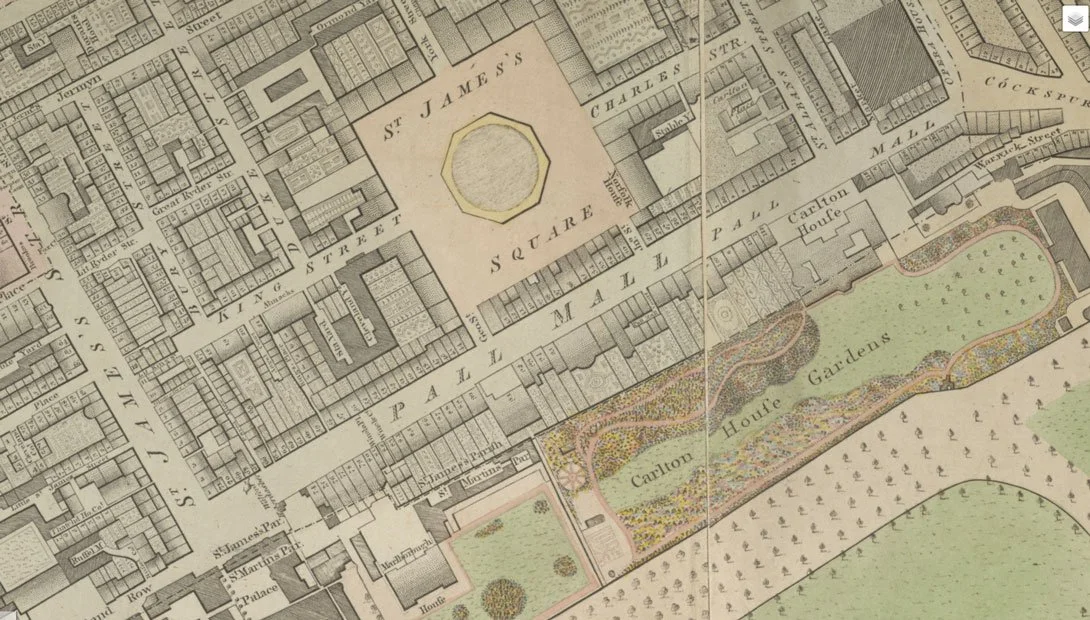
Pall Mall on Horwood’s map from the 1790s
Pall Mall in the Regency
By 1800 Pall Mall was home to a mix of national institutions, inns, hotels, shops, offices and private homes.
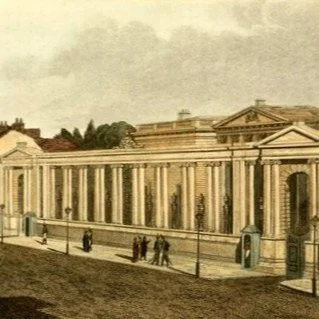
It still had a palace at each end, St James’s and Carlton House. The latter was set back from the road, screened behind a colonnade.
As Jane Austen travelled along Pall Mall in 1814, on her way to Carlton House, she would probably have passed many different offices, homes and shops, including:
The Office of Ordnance (government department responsible for military supplies)
Christie’s Great Room, part of his auction house
Chevalier and James Bladen Ruspini, manufacturers of ‘Dentrific Powder, and Tincture for the Teeth and Gums’
A London home of Lord and Lady Holland.
Harding and Co, retailers of Hubert’s Roseate Powder
Howell and Co, suppliers of cloth
John Budd, bookseller
Kelly’s Opera Saloon
Royal Exchange Assurance Office
Mr Francis, Upholsterer
Mr Gibb’s, Grocer
Jarvis & Goddard, Wax & Tallow Chandlers
Jeffery Edward, Bookseller
Charles Rich., & Co. Taylors
Hunt, James, Wine & Spirit Merchant
Cane William, Hatter and Hosier
G Camplin, Straw-hat manufacturer
Chapple Clement, Bookseller and Stationer
Various banks, such as that of Hammersleys, Greenwood, Drewe & Brooksbank
The home of John Barber and also the lace warehouse of Barber and Co
Scott, Slee and Statham, Manufacturers of the Original Day and Martin’s Japan Blacking
John Humby, Boot-maker
Jane Austen would not have seen the imposing colonnade of the King’s Theatre, also referred to as an opera house. The theatre itself faced onto Haymarket, but its southern side ran along Pall Mall. A colonnade was built here in the late Regency, as part of a widening of the street.
She may, however, have seen the experimental gas lamps in the street, set up in 1807 by Frederick Winsor. From 1806 he invited potential investors to view his ‘Experiments and Illuminations’ at his home and laboratory on Pall Mall.

Harding, Howell & Co, 89 Pall Mall (Ackerman’s Repository of Arts 1809)
What became of Regency Pall Mall
Today Pall Mall looks very different to the street Jane Austen saw in 1814. She would recognise St James’s Palace and one other property on the south side - Schomberg House. That said, only two-thirds of the frontage of Schomberg is original.
Every other building has been replaced, almost all in the Victorian era or early 20th century. A number were destroyed by bombing in the Second World War.
The most significant alterations were the addition of Waterloo Place and the removal of Carlton House.
Waterloo Place was intended as a grand space for monuments, in front of Carlton House. Despite being named after the great battle where Napoleon was finally defeated, plans had already been laid by architect John Nash.
By the time houses had been cleared and Waterloo Place built, the Prince Regent was losing interest in Carlton House. It was demolished in the 1820s and replaced by an extension of Waterloo Place, and Carlton House Terrace.
This means that some of the buildings around Waterloo Place are now among the oldest on the street, dating from the reigns of George IV and William IV.
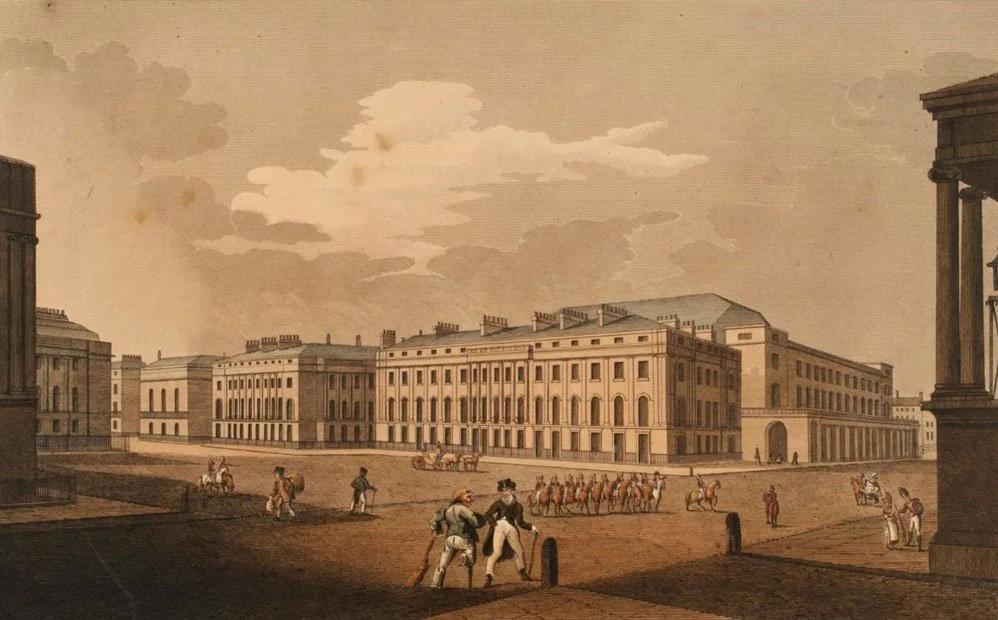
Pall Mall and Waterloo Place in 1818. The colonnade of the King’s Theatre is on the right, and the theatre roof is just visible, rising behind the other buildings.
Andrew Knowles researches and writes about the late Georgian and Regency period. He’s also a freelance writer and editor for business. He lives with his wife Rachel, co-author of this blog, in the Dorset seaside town of Weymouth.
If you have enjoyed this blog and want to encourage us and help us to keep making our research freely available, please buy us a virtual cup of coffee by clicking the button below.
Sources used include:
Historic England, Listed Buildings and Places
Survey of London, Volumes 29 & 30 (Via British History Online)
The Post Office London Directory (1814)
Newspapers including The Morning Chronicle, The Morning Post and The Star
Regency History
by Andrew & Rachel Knowles
We research and write about the late Georgian and Regency period.
Rachel also writes faith-based Regency romance with rich historical detail.



Jane Austen at Carlton House