Film review: Mary Anning and the Dinosaur Hunters
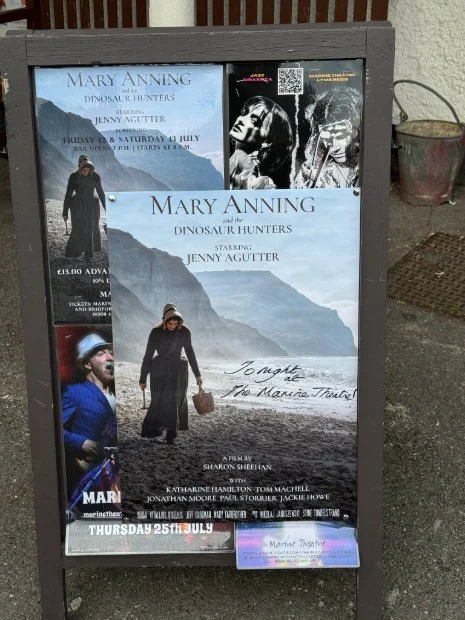
Film posters outside the Marine Theatre, Lyme Regis (12 July 2024)
We had high expectations of this film. Shot on the Dorset coast, telling the story of Regency fossilist Mary Anning, and with assurances of being historically accurate, we couldn’t resist attending as soon as we could.
The premiere was in June and was quickly booked up. We had to wait until the second showing, a few weeks later. It’s an independent film, reliant on small venues choosing to show it.
We watched in the Marine Theatre in Lyme Regis, the town where Mary Anning lived all her life. The sound quality wasn’t great and I don’t know if that was the production or the venue. It’s a theatre, not a dedicated cinema.
Epic length but not epic quality
This film would have been better had it been shorter. The running time is 250 minutes (two and a half hours). There’s at least 60 minutes of unnecessary content.
The Dorset coast is beautiful. But there were too many long, lingering shots that did nothing to move the story forward.
Not that it was clear which story we were meant to be following. Anning wasn’t just a finder of fossils. She was a woman from a poor background who wanted to be taken seriously by the scientific establishment. She had little formal education yet taught herself French to read papers on palaeontology. She was accused of creating fake dinosaurs to earn money.
This film tried to take on all these stories, and more. It also addressed her love life, a theme previously taken by an earlier film about her - Ammonite. Given that there’s no historical evidence for her having any love interests (other than fossils), both takes are equally fictional.
Factually accurate but only in part
We were keen to see this film because we’d heard it was historically accurate.
That perception quickly changed when Jane Austen was introduced, and described herself as rich and famous. When she visited Lyme in 1803 and 1804, it was many years before publishing her first book - which she did so anonymously - and Jane was never a wealthy woman.
Mary’s relationship with Henry De la Beche was also hard to watch, both from a historical perspective, and simply as a viewer.
It’s presented as a romance, which is probably fictional, although arguably possible as he lived in Lyme when he was young and they knew one another from an early age. However, the romance is shown as happening around the time her father died - when historically she was just 11. The actress playing the younger Anning was a young woman, not a girl.
This could be overlooked as storytelling. However, it became even harder to take seriously when the actors suddenly changed into their older counterparts. Henry seemed to have aged twice as much as Mary.
A laugh went up around the theatre when this now very mature gentleman claimed his marrying someone else was because his parents demanded it. This was one of the few moments of unintentional comedy.
Another of Anning’s keenest supporters, Lieutenant-Colonel Thomas Birch, is barely mentioned (or did I miss something because of the patchy sound quality?)
It’s implied (probably unintentionally) that Mary invented the BOGOF. (Buy one get one free).
That said, many of the historical incidents in Anning’s life were referred to including: surviving a lightning strike as an infant, the death of her beloved dog, Tray, her losing money through investments, her drinking to ease the pain of the cancer that killed her, and her friendship with Elizabeth Philpot.
Philpot was played by well-known actress Jenny Agutter, who’s listed as star of the film.
Hard work for anyone but die-hard fans of Anning and Dorset
Several people left the Marine Theatre during the showing of this film. As we left, at the end, I overheard someone saying ‘it was like something from the 1970s.’ Another boldly announced it was ‘the worst thing I’ve ever seen in my entire existence.’
This is a low-budget film and it shows in the quality of acting, dialogue, costumes, set and editing. It’s extremely slow paced and lacks energy.
It’s always nice to see the Dorset coast on the screen, and we noted the details about Anning’s life that were referenced during the film. But this felt like a poor return on giving up two and a half hours and the ticket price.
There’s no denying that the cast and crew have huge respect for what Anning achieved, and worked hard to deliver it. It’s unfortunate that they created a slow, sprawling mess. The low budget production quality could be more easily overlooked were the editing and storytelling much sharper.
I believe there’s still an opportunity to tell Anning’s story in a way that captures the energy and drama of her life, in a way that engages and excites an audience.
Mary Anning and the Dinosaur Hunters
Directed and written by Sharon Sheehan
Starring Jenny Agutter, Mark Fletcher, Katharine Hamilton
Released June 2024
Andrew Knowles researches and writes about the late Georgian and Regency period. He’s also a freelance writer and editor for business. He lives with his wife Rachel, co-author of this blog, in the Dorset seaside town of Weymouth.
If you have enjoyed this blog and want to encourage us and help us to keep making our research freely available, please buy us a virtual cup of coffee by clicking the button below.
Regency History
by Andrew & Rachel Knowles

We research and write about the late Georgian and Regency period.
Rachel also writes faith-based Regency romance with rich historical detail.