Eye-Wear in the Era of Jane Austen
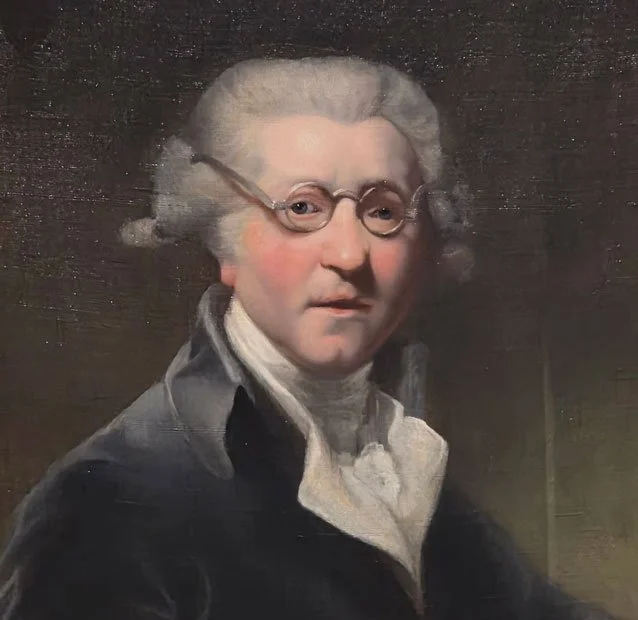
Copy of a self-portrait of Sir Joshua Reynolds. He painted the original in the 1780s. (British Optical Association Museum).
It’s not unusual to see characters wearing spectacles in on-screen versions of Regency romances. Adaptations of Jane Austen’s novels, and related stories, such as The Other Bennet Sister (BBC, 2026) use glasses to indicate both the age and intellectual status of key characters.
As far as we can tell, in the Regency era it was relatively unusual to see people wearing glasses in public.
It wasn’t that people didn’t need help with their vision. Then, as now, eyesight usually deteriorated with age. Nor were spectacles a rarity - they were on sale across Britain.
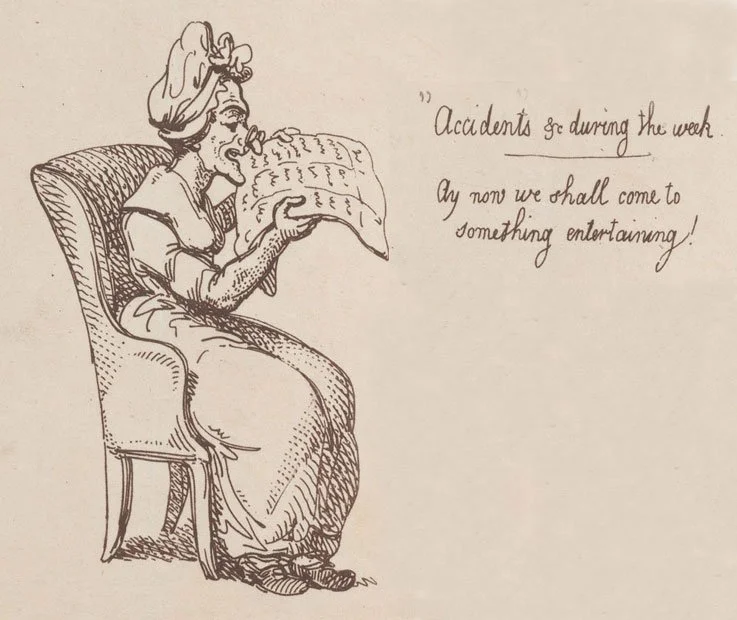
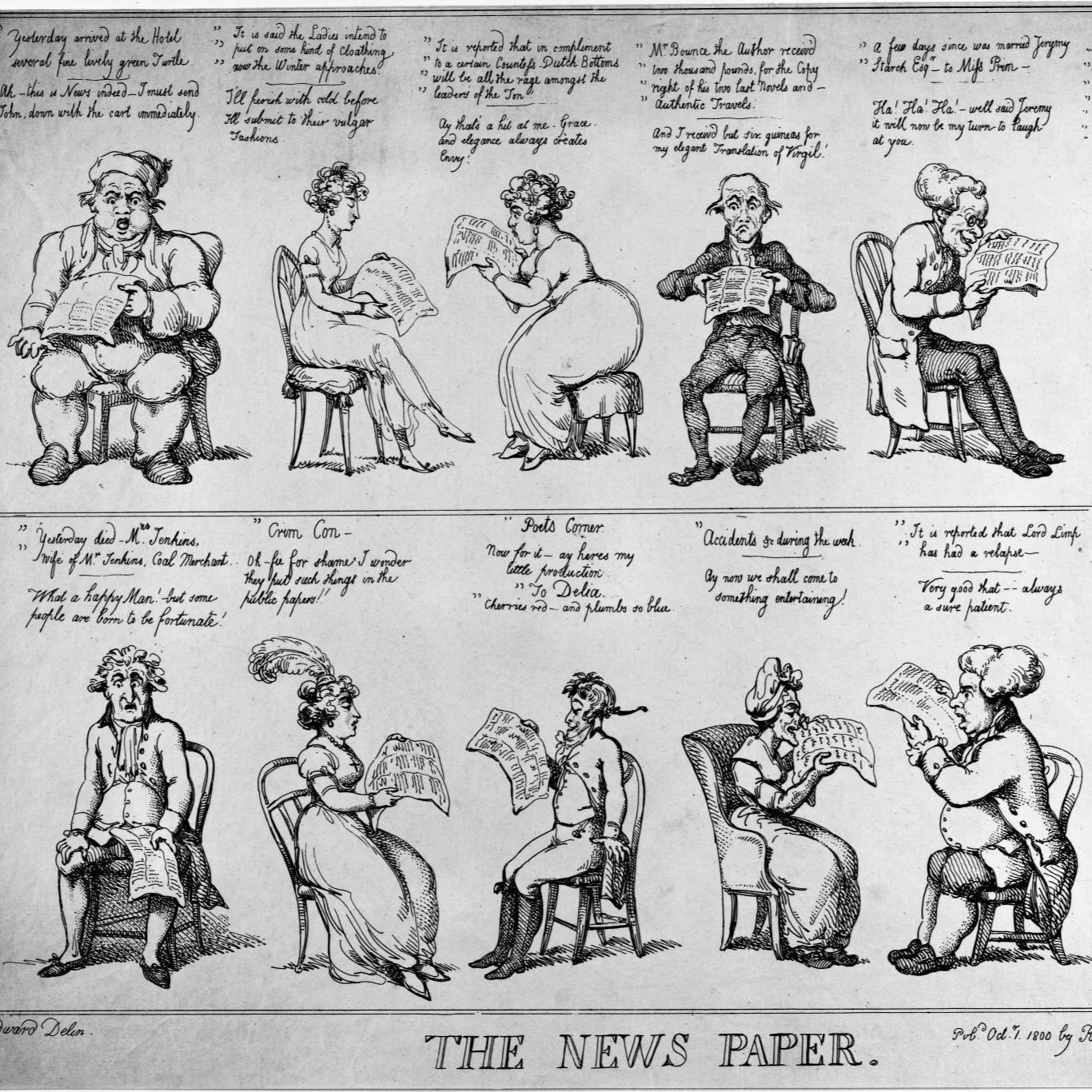
Spectacles sometimes appear in Regency artwork. As now, satirical prints used glasses to indicate age or intelligence, often poking fun at personalities of the day. A very small number of people allowed glasses to appear in formal portraits.
In the Regency, lots of people owned spectacles or glasses (in the UK, we use both terms interchangeably). But their use was generally restricted to private settings.
This post was prompted by a visit to the British Optical Association Museum in London.
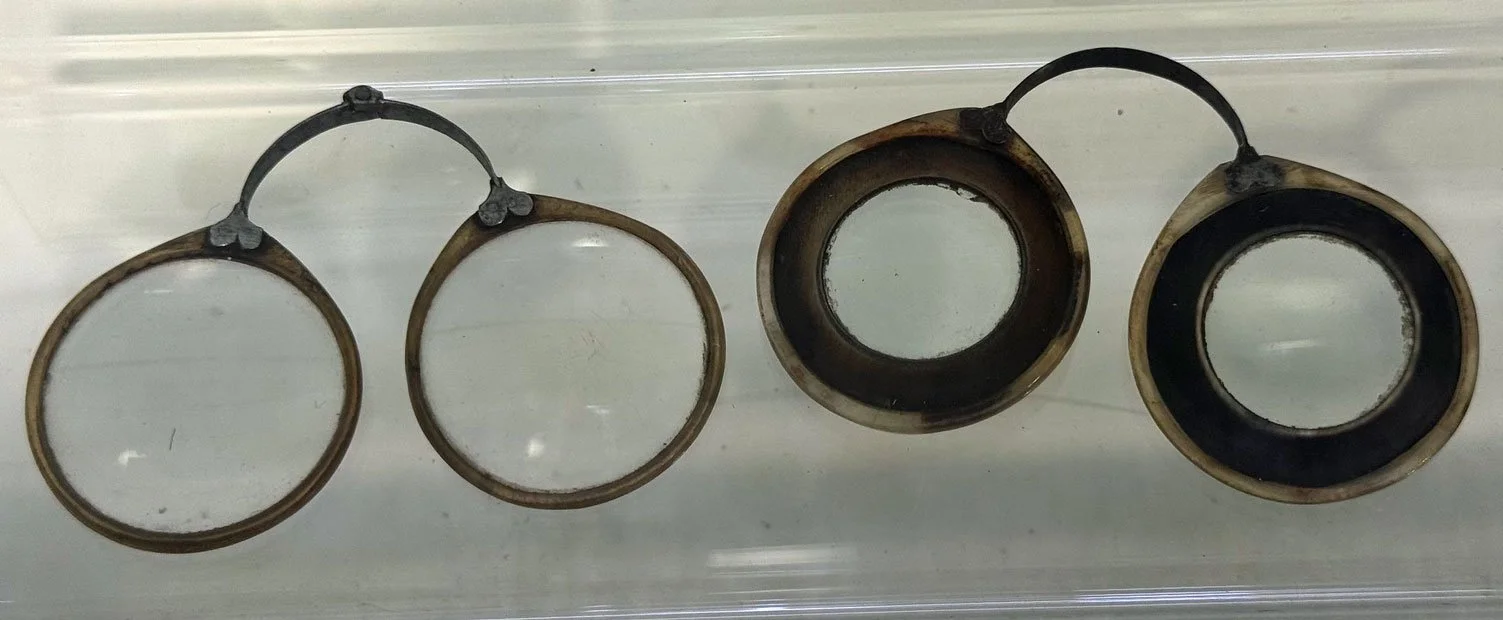
Mid-18th century spectacles. Those on the left are folding nose spectacles, popular because they could be folded to make them more compact (British Optical Association Museum).
A brief history of eye-wear before the Regency
People have known about the magnifying properties of lenses for at least 2,000 years. Holding a piece of glass over a document could help make text easier to read.
Spectacles or glasses (we use both words in the UK) probably originated in north Italy in the 1200s. Early forms involved two lenses with a connector that had to be wedged on the nose. Useful for deskwork by those who could read, but tricky to keep in place.
The nose arch appeared in the 1500s. The 1700s saw the introduction of arms but no hooks for ears, because of wigs. Rings were added to the ends, allowing a ribbon to be threaded through to tie the glasses in place.
Spectacles were rarely worn in public. They were difficult to use when moving about, and society did not always approve. George III never wore glasses, preferring to use a pocket telescope.
Why were glasses also known as spectacles? In an essay published in 1760, B Martin refers to ‘visual glasses, vulgarly known as spectacles’. The suggestion is that ‘spectacles’ is the common term for Regency eye-wear.
Benjamin Franklin’s good idea
I started wearing glasses around 15 years ago, when it became hard to read books. I now have three sets of glasses: one for reading, one for computer work, one for general wear. The latter are varifocals - correcting vision at different distances.
I regularly switch between pairs, depending on what I’m doing.
Benjamin Franklin was frustrated by having to change pairs. A keen problem-solver, he had the lenses for short and long distance cut in half. One half of each was fixed into a frame for both eyes, giving him bifocals.
By this means I wear my spectacles constantly, I have only to move my eyes up or down, as I want to see distinctly far or near, the proper glasses being always ready.

Rachel models a pair of Regency spectacles. These have extending arms (slider visible on the right arm). (British Optical Association Museum 2026).
What Regency spectacles looked like
Lenses in early glasses were always circular, because that’s the only shape they could make. The first oval glasses appeared in the 1700s, although almost all were circular until the early 1800s.
The British Library has three pairs of glasses that were stored inside Jane Austen’s portable writing desk. All three have oval lenses, and straight arms with no hooks.
Did she use these pairs? We can never know for sure.
Some pairs that we saw, in the museum, had folding arms. Others had extending arms. This meant they could fit inside a relatively small case or a lady’s reticule.
Not all spectacles had clear glass. Green or blue glass was sometimes used.
The earliest tri-focals were patented in London in 1827, incorporating sections of three different lenses.
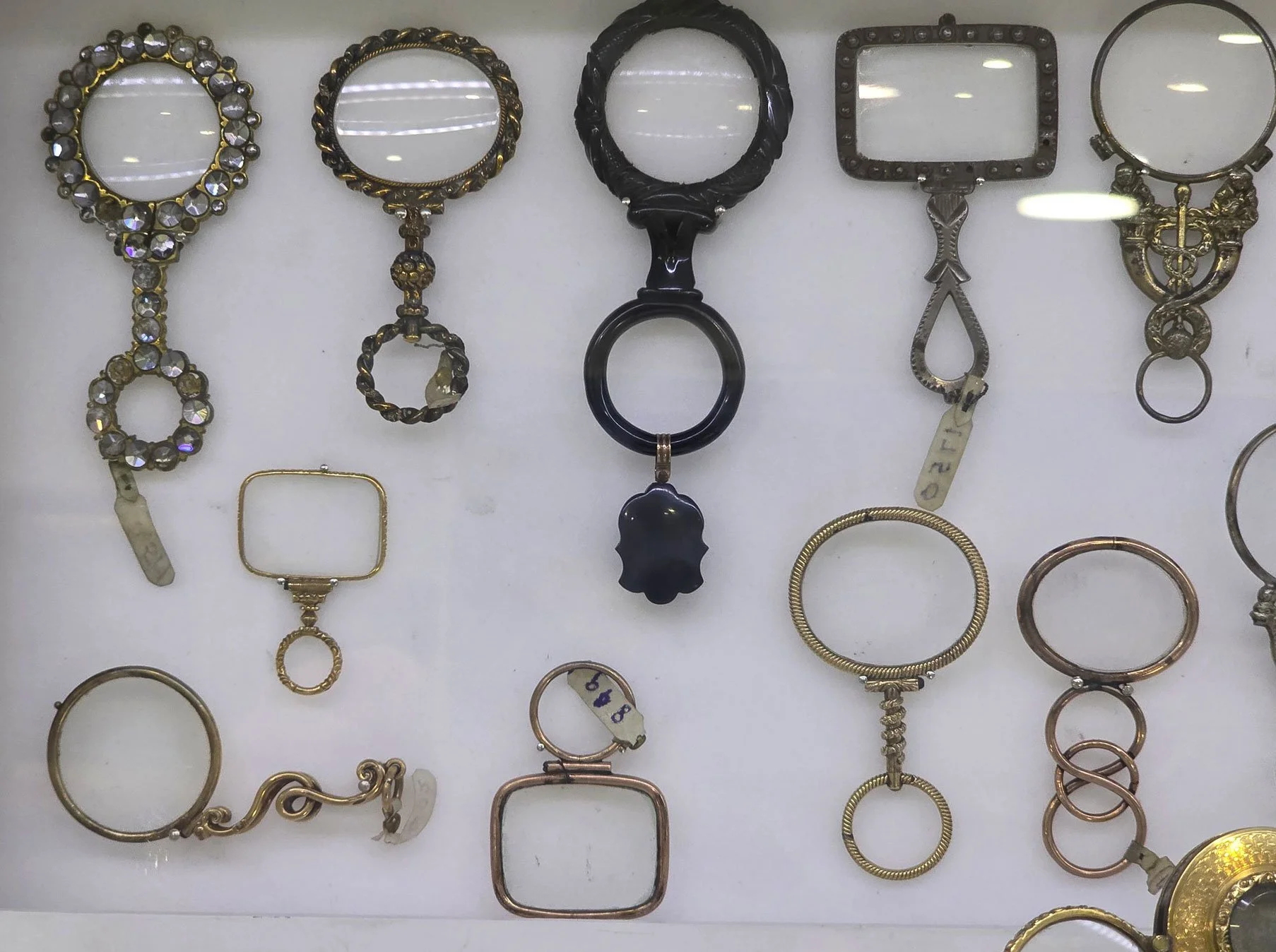
A selection of quizzing glasses displayed at the British Optical Association Museum.
Alternatives to spectacles
For those who didn’t want to wear glasses, or for when glasses weren’t convenient, the alternatives included:
Quizzing glasses - a single lens with a handle, much like a traditional magnifying glass.
Prospect glasses - a short telescope, just a few centimeters long.
Lorgnette - glasses with a side handle, such as opera glasses.
Spyglasses - discrete lenses could be built into other objects, such as walking stick handles or fans.
Monocle - a single lens that came into use in the early 1800s.
Scissor glasses - a pair of lenses mounted on a vertical handle, which made them look like a pair of scissors.
Where and how to buy spectacles in the Regency
The trade of optician was long-established by the time of the Regency. However, their work was not limited to spectacles. Many were better known as makers of telescopes. They also made microscopes and, of course, spectacles and other forms of reading glasses.
Regency newspapers have plenty of advertisements offering spectacles for sale. Many businesses called themselves opticians, but not all. Some offered spectacles alongside a wide range of other, entirely unrelated, goods.
The optical trade was entirely unregulated. In Britain, until the 1950s, anyone could call themselves an optician.
Shopping for glasses in the Regency probably involved trying on lots of different pairs to see whether the lenses offered the right level of correction. There are no eye test charts from that era. It’s likely that at least some sellers had a book to hand, which customers could use to test the lenses.
P & J Dolland, optical instrument makers in the Regency, sold ‘concave glasses for Short-sighted persons, in horn’ for 2 shillings. The same pair in pearl and silver cost 12 shillings.
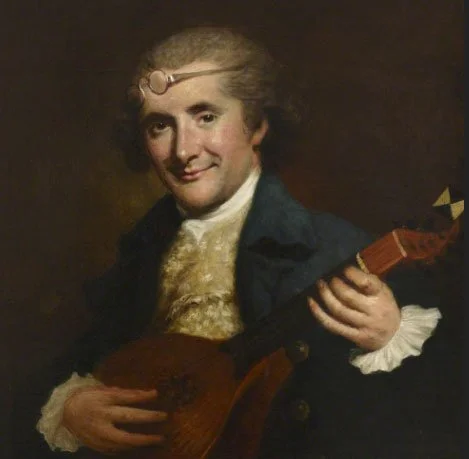
Thomas Hurst, mandolin player, not afraid to be seen in spectacles (1782).
Who wore spectacles in the Regency?
Throughout history, most people have worn glasses for practical purposes, not for looks. In the late Georgian and Regency era, it was unfashionable to be seen in a pair of spectacles.
Not everyone was bothered by fashion. Sir Joshua Reynolds shows off his specs in a self-portrait from the 1780s.
Mandolin player Thomas Hurst is pictured with spectacles on his forehead in 1782.
Robert Harris, a Georgian gentleman, allowed his portrait to be painted with glasses in hand. Presumably this was to indicate he was a devout reader of the Prayer Book in his other hand.
Hannah More, writer, was painted in 1821, in her 70s. She’s not afraid to admit to wearing glasses, which are clasped in one hand.
In the Regency, as now, glasses were symbolic as well as practical. In her books, Jane Austen only puts one person in spectacles - Miss Bates’ mother in Emma. These emphasise her age, and are used to comedic effect by Miss Bates making a big deal of their being repaired by Frank Churchill.
How would she feel about screen adaptations of Pride and Prejudice that put Mary Bennet in glasses?
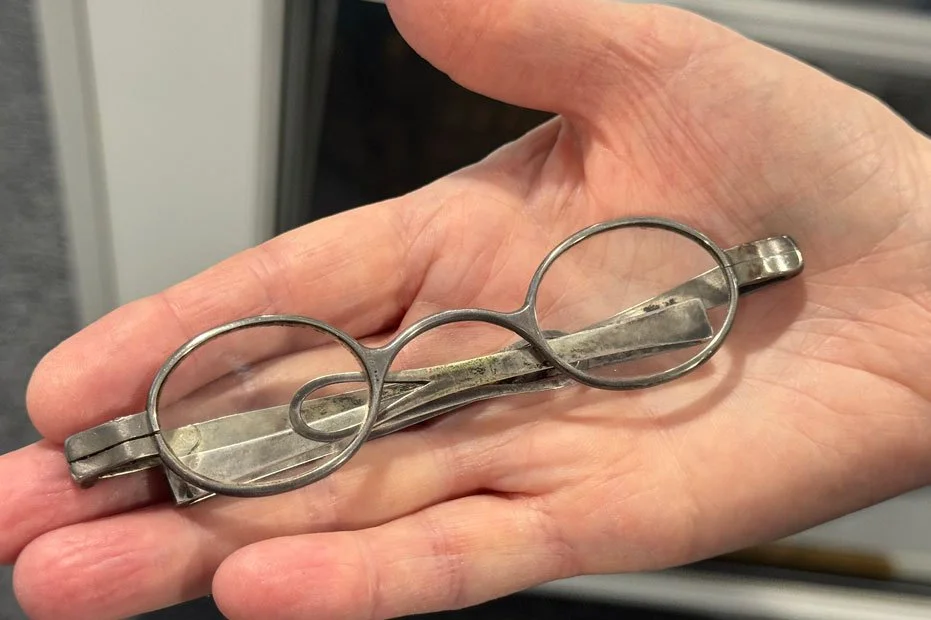
Georgian spectacles with folding arms. They would fit neatly into a small case or a lady’s reticule.
Andrew Knowles researches and writes about the late Georgian and Regency period. He’s also a freelance writer and editor for business. He lives with his wife Rachel, co-author of this blog, in the Dorset seaside town of Weymouth.
If you have enjoyed this blog and want to encourage us and help us to keep making our research freely available, please buy us a virtual cup of coffee by clicking the button below.
Sources include:
The Book of English Trades (1818)
Simpson & Co (Play, 1823)
Philosophical Transactions of the Royal Society
The Life and Works of Benjamin Franklin (1815)
Essay on Visual Glasses (B Martin 1760)
Regency History
by Andrew & Rachel Knowles

We research and write about the late Georgian and Regency period.
Rachel also writes faith-based Regency romance with rich historical detail.